The Tradeoff: Is Lower Arsenic Rice Also Lower in Nutrients?
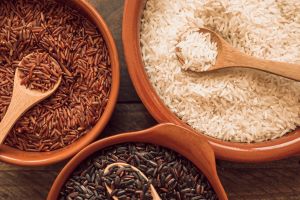
rice photo from Freepik
by Reed Mangels, PhD, RD
In a recent post for The Vegetarian Resource Group Blog, I identified steps consumers can take to minimize their exposure to arsenic from rice. A reader wondered if the Thai jasmine rice, and Indian white basmati rice which had markedly less arsenic than other kinds of rice (1) were enriched with nutrients and if that was an issue.
To begin to answer this question, it’s important to understand the difference between brown and white rice. Rice is a grain, meaning that it is the seed of a cereal grass. In its less processed form, brown rice, the rice kernel has three parts. The outer coating of the kernel is called the bran. Inside the bran, or outer shell, the other two parts of rice are found, namely the germ and the endosperm. The germ is the part of the rice that can sprout into a new plant. The endosperm is the energy supply for the seed. Bran is a good source of fiber, vitamins and minerals. The germ is also a good source of vitamins and minerals. The endosperm mainly supplies carbohydrates in the form of starch.
When brown rice is processed into white rice, the outer coating (bran) and the germ are removed. What is left is the starchy endosperm which has few vitamins or minerals. When white rice is enriched, some of the vitamins and minerals that were removed in processing are added back. In the United States, if rice is labeled “enriched,” it must have thiamin, riboflavin, niacin, folic acid, and iron added (1). Other nutrients such as fiber that are lost in processing are not added back. Unenriched white rice does not have these vitamins and iron added. I checked several brands of Thai jasmine rice and basmati rice and none were enriched. You can check the product label to see if the brand that you are buying is enriched. The table below compares the nutrient content of half a cup of different types of cooked rice (2).
| Type of rice | Thiamin (mg) | Riboflavin (mg) | Niacin (mg) | Folate (mcg) | Iron (mg) |
| Brown rice | 0.09 | 0.03 | 2.06 | 4.88 | 0.39 |
| Enriched white rice | 0.13 | 0.01 | 1.16 | 45.8 | 0.94 |
| Unenriched white rice | 0.02 | 0.01 | 0.37 | 1.86 | 0.19 |
If you eat rice occasionally, the differences in nutrients between brown rice, enriched white rice, and unenriched white rice are unlikely to make a big difference in your overall nutrient intake. If you eat rice frequently and have decided to eat more Thai jasmine and basmati rice to reduce your arsenic intake, and the products you choose are not enriched, you’ll need to be aware of other sources of the nutrients that are used to enrich rice. The Vegetarian Resource Group blog and website have information about vegan sources of riboflavin and iron. Thiamin is found in beans and whole grains including oatmeal. Good sources of niacin include nuts, beans, and whole grains. Folate is found in green leafy vegetables, fruits, beans, nuts, and whole grains.
And remember, other whole grains including barley, bulgur, and oats are good sources of fiber, vitamins, and minerals.
References
- Food and Drug Administration, Department of Health and Human Services. 21 CFR 137.350. Enriched Rice. https://www.ecfr.gov/current/title-21/chapter-I/subchapter-B/part-137/subpart-B/section-137.350.
- U.S. Department of Agriculture, Agricultural Research Service, Beltsville Human Nutrition Research Center. FoodData Central. https://fdc.nal.usda.gov/