The Vegetarian Resource Group Blog

Land Use and Biodiversity
Posted on January 08, 2024 by The VRG Blog Editor

By Jeanne Yacoubou, MS

In our recent article on the climate footprints of vegan pizza v. meat pizza, we began by noting two astounding facts about animal agriculture:

  • 77% of all soybeans grown in the world is for livestock consumption.
  • 74% of the global corn crop is animal feed.

Underlying these statistics is another one of even greater importance concerning land use that we didn’t touch on in our carbon footprints article:

  • Livestock takes up 77% of all land suitable for agriculture on the planet. This includes grazing land plus land used to grow the crops they eat.

You may think that if livestock took up more than three quarters of the world’s agricultural land, it would at least produce the most food calories and protein available for human consumption. Unfortunately, this is far from the truth.

For all that land use, raising livestock contributes merely 18% of the world’s calories and only 37% of total protein according to an analysis by Our World in Data based on the work by Poore & Nemecek. This is a very inefficient way to feed over 8 billion people.

By contrast, if everyone in the world were vegan, we could reduce the amount of agricultural land needed to feed people a nutritious diet by 75% concludes that analysis. Since it takes almost 100 times as much land to produce a gram of protein from beef versus tofu, you can see how the land savings would quickly add up when everyone converts to veganism.

However, predicting greater meat consumption with an exploding population of nearly 10 billion by 2050, the World Resources Institute calculates feeding them will require 600 million more hectares of land for grazing and feed crops.

On an already crowded planet, where is this land supposed to come from? Deforestation.

According to the World Resources Institute, rates of primary forest loss are still increasing despite the declaration of 145 countries in 2021 to halt and reverse deforestation by the end of this decade. In 2022, 4.1 million hectares were lost. That’s the equivalent of 11 soccer fields per minute and 2.7 gigatons of carbon emissions.

Along with this habitat loss, continued deforestation plunges the world’s biodiversity further into crisis. Experts refer to the current loss as the sixth mass extinction. Currently, one million species of animals and plants are at risk of extinction in the next few decades.

Forests contain the most species diversity of any ecosystem:

  • 60,000 tree species
  • 80% of amphibian species
  • 75% of bird species
  • 68% of mammal species

Ecologists warn that the rapid loss of biodiversity is a death knell for human civilization, even more so than the climate crisis. Although the problems humanity are facing threaten human existence, system change can reverse course.

Ending animal agriculture by switching to veganism will remove the need for more deforestation to supply cropland and grazing areas necessary for livestock. Instead, the restoration of natural ecosystems (rewilding) on unused agricultural land can occur – barring more urban development. And with more intact nature, biodiversity will surely rebound.

Everyone wins in that situation.

To support The Vegetarian Resource Group research, donate at www.vrg.org/donate

Or join at www.vrg.org/member/cabdacae.php

The Vegetarian Resource Group’s $30,000 Scholarship Program for Graduating High School Seniors in the USA

Posted on January 05, 2024 by The VRG Blog Editor

Thank you to more generous donors, in 2024 The Vegetarian Resource Group will be awarding $30,000 in college scholarships! Deadline is FEBRUARY 20, 2024.

We will accept applications postmarked on or before FEBRUARY 20, 2024. Early submission is encouraged.

Applicants will be judged on having shown compassion, courage, and a strong commitment to promoting a peaceful world through a vegetarian (vegan) diet/lifestyle. Payment will be made to the student’s college (U.S. based only). Winners of the scholarships give permission to release their names to the media. Applications and essays become property of The Vegetarian Resource Group. We may ask finalists for more information. Scholarship winners are contacted by e-mail or telephone. Please look at your e-mail.

If you would like to donate to additional scholarships or internships, go to www.vrg.org/donate

Applications

Please click here to download a PDF of the application. However, applicants are not required to use an application form. A neatly typed document containing the information below will also be accepted as a valid application.

Please send application and attachments to [email protected] (Scholarship application and your name in subject line) or mail to The Vegetarian Resource Group, P.O. Box 1463, Baltimore, MD 21203.

If emailing, please put your essay in a separate attachment with your first name and last initial. A PDF or Word document is preferred, but if you send a Google document, make sure permission is given so readers can access it. For more information call (410) 366-8343 or email [email protected].

Do the Dietary Guidelines for Americans, 2020-2025 Address Meat-like Analogs?

Posted on January 05, 2024 by The VRG Blog Editor

By Reed Mangels, PhD, RD

Dietary Guidelines for Americans is a document that is produced every 5 years and serves as a statement of current federal policy on the role of dietary factors in health promotion and disease prevention. It is used as the foundation for federal nutrition education materials, by schools, the food industry, and many others.

In an earlier post, I stated that the Dietary Guidelines for Americans U.S.-style Dietary Pattern limits total meat, poultry, and eggs to 4 ounces per day for those with a 2200 calorie diet. This prompted a question from a reader about whether the Dietary Guidelines’ provided any similar limit on meat-like analogs. The reader explained that they meant products like Impossible burgers or other meat-like analogs that were not mainly vegetable- or grain-based.

The Dietary Guidelines identifies “core elements that make up a healthy dietary pattern” (1). One of these core elements is the so-called protein foods which includes “lean meats, poultry, and eggs, seafood, beans, peas, and lentils, and nuts, seeds, and soy products” (1). Soy includes “tofu, tempeh, and products made from soy flour, soy protein isolate, and soy concentrate” (1).

While the Dietary Guidelines suggests replacing processed or high-fat meats with beans, peas, and lentils, no suggestions are made for replacing high-fat or processed meat-like analogs. The Healthy U.S.-style Dietary Pattern suggests that those eating a 2200 calorie diet get 5-ounce equivalents a week of nuts, seeds, and soy products. An ounce-equivalent is defined as 1 Tablespoon of nut or seed butters or ½ ounce of nuts or seeds or ¼  cup of tofu. No definition is provided for an ounce-equivalent of soy products other than tofu. The Healthy Vegetarian Dietary Pattern separates their recommendations for soy products and for nuts and seeds. This pattern suggests that those eating a 2200 calorie diet get 8-ounce equivalents a week of soy products but, again, no explanation is provided of what an ounce equivalent is for anything except tofu.

With greater use of a variety of soy products, including processed meat-like analogs, additional dietary guidance is needed on recommended amounts and serving sizes of these products.

Reference

  1. U.S. Department of Agriculture and U.S. Department of Health and Human Services. Dietary Guidelines for Americans, 2020-2025. 9th Edition. December 2020. Available at DietaryGuidelines.gov.

To read more about Dietary Guidelines in the United States see:

The Dietary Pattern in Dietary Guidelines for Americans Could Easily Be Made Vegan and Nutritionally Adequate

What Have the U.S. Dietary Guidelines Said About Vegan and Vegetarian Diets? A Look Back

2020=2025 Dietary Guidelines for Americans Released; Has Both Positive and Negative Features

2015-2020 Dietary Guidelines Released

2010 Dietary Guidelines Released

To read more about Dietary Guidelines in other countries see:

Do International Dietary Guidelines Promote Vegan/Vegetarian Diets?

Mexican 2023 Dietary Guidelines Recommend that 92% of our Plate Should be Plant Foods

Spain’s Dietary Recommendations: Less Meat, More Plant Foods

Subscribe to Vegan Journal Today!

Posted on January 04, 2024 by The VRG Blog Editor

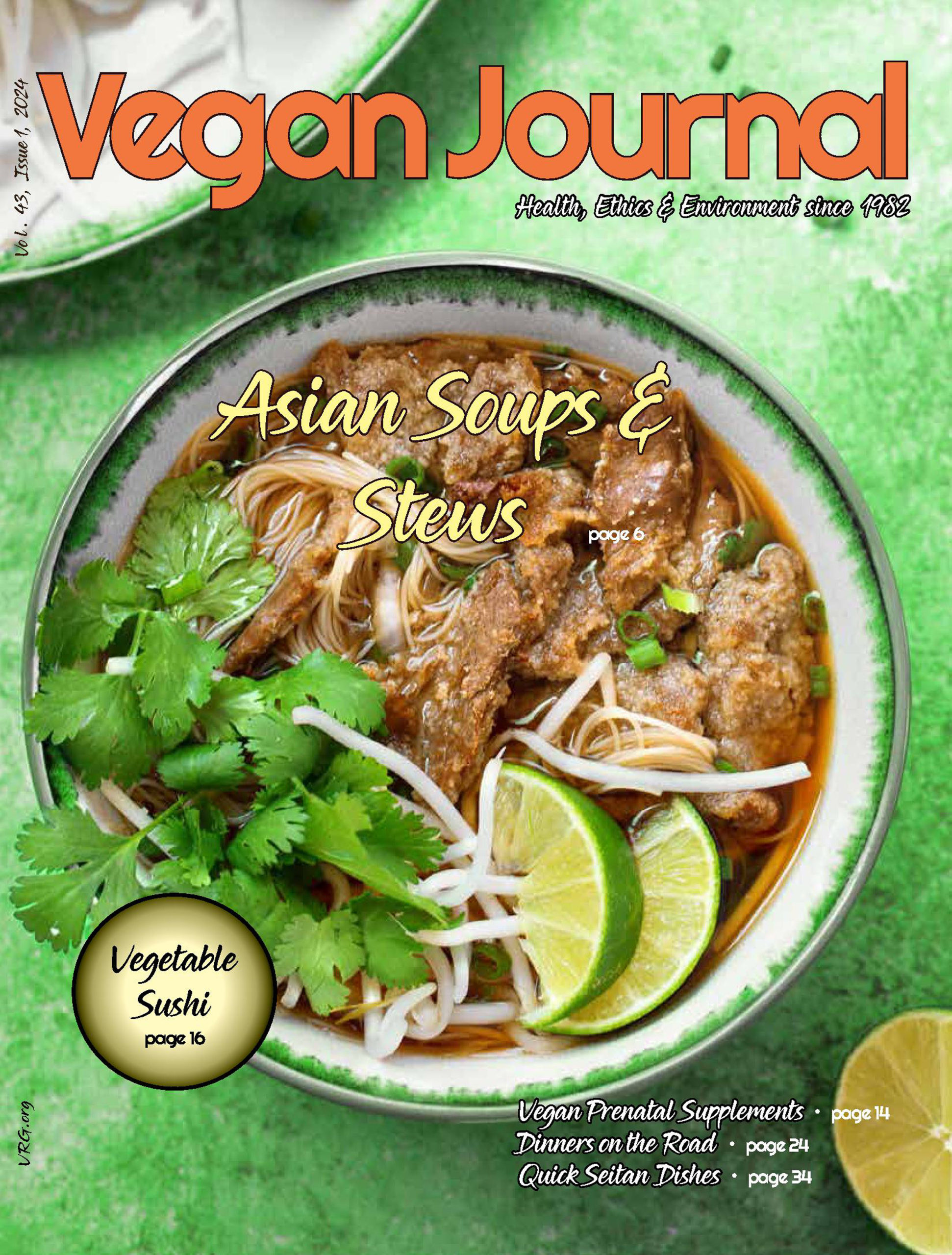
Vegan Journal is published by The Vegetarian Resource Group. Enjoy in-depth original research, product and book reviews, scientific updates on veggie nutrition, delicious vegan recipes with gorgeous photos, plus so much more. Both long-term vegans and those new to a vegan life-style will enjoy this magazine.

To subscribe in the USA only, see: https://www.vrg.org/member/2013sv.php

PIZZERIA UNO

Posted on January 04, 2024 by The VRG Blog Editor

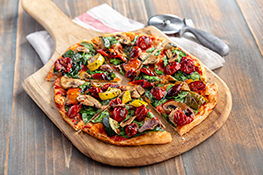
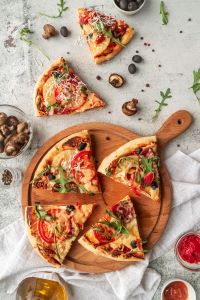
Pizzeria Uno is featuring Vegan Garden Pizza (pictured above), Vegan Cheese Pizza, and Vegan Cheeseburger Deep Dish Pizza. See https://www.unos.com/menus/glutenfree-vegan-pizza.php
See ingredients and nutrition breakdown at https://www.unos.com/nutrition.php
As of December, where they list zero calories for fat, but do list a number for total fat, you may not want to depend on the zero calories. Has anyone tried these pizzas?

For information about vegetarian and vegan restaurants in the U.S. and Canada, see https://www.vrg.org/restaurant/index.php
For information about other chains, see https://www.vrg.org/fastfoodinfo.php

The contents of this posting, our website and our other publications, including Vegan Journal, are not intended to provide personal medical advice. Medical advice should be obtained from a qualified health professional. We often depend on product and ingredient information from company statements. It is impossible to be 100% sure about a statement, info can change, people have different views, and mistakes can be made. Please use your best judgment about whether a product is suitable for you. To be sure, do further research or confirmation on your own.

To support The Vegetarian Resource Group research, donate at www.vrg.org/donate
Or join at https://www.vrg.org/member/2013sv.php

Feature Black Beans in Your Next Meal!

Posted on January 03, 2024 by The VRG Blog Editor

photo by Hannah Kaminsky

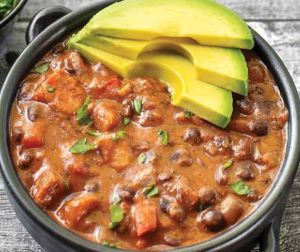
Hannah Kaminsky shares several delicious black bean-based vegan recipes in an issue of Vegan Journal. Enjoy Colombian Black Bean Soup, Mole Enchiladas, Black Bean Chipotle Chile, Loaded Spanish Sweet Potatoes, and Tex-Mex Pasta Salad.

Read the entire article here: https://www.vrg.org/journal/vj2023issue3/2023_issue3_modern_classics.php

To subscribe to Vegan Journal in the USA, see: https://www.vrg.org/member/2013sv.php

BEN AND JERRY’S SWITCHING TO OAT MILK

Posted on January 03, 2024 by The VRG Blog Editor

Ben and Jerry’s will be switching all their non-dairy flavors to oat milk. For more information, see https://www.benjerry.com/whats-new/2023/10/best-non-dairy-recipe

The contents of this posting, our website and our other publications, including Vegan Journal, are not intended to provide personal medical advice. Medical advice should be obtained from a qualified health professional. We often depend on product and ingredient information from company statements. It is impossible to be 100% sure about a statement, info can change, people have different views, and mistakes can be made. Please use your best judgment about whether a product is suitable for you. To be sure, do further research or confirmation on your own.

Join the Discussion with 565+ Families in The Vegetarian Resource Group’s Parents and Kids Facebook Group!

Posted on January 02, 2024 by The VRG Blog Editor

Recent topics brought up include:

– The Norwalk, CT school district will start having a vegan option on the menu each day. Offerings will include hummus, plant-based chicken nuggets, sweet and crunchy chickpea wraps, plant-based “beef crumbles” and burgers, and a Mediterranean salad.

– I was curious if anyone is ever concerned about their children not growing to their full height potential due to being vegan?

– The Vegetarian Resource Group will once again be awarding $30,000 in college scholarships to graduating American high school seniors promoting the veggie lifestyle. See: https://www.vrg.org/student/scholar.htm

https://www.facebook.com/groups/VRGparentsandkids is intended to be a group that offers support for families raising children on vegan diets and for vegan kids around the world. We envision it as a place to get advice about a wide-variety of topics: pregnancy, birthday parties, school lunches, Halloween, non-leather apparel, cruelty-free products, summer camps, and more. Please use it as a place to share your wisdom, seek advice, or just find a sympathetic ear. The goal is to offer support.

Consequently, any profane, defamatory, offensive, or violent language will be removed. Feel free to disagree, but do so respectfully. Hateful or discriminatory comments regarding race, ethnicity, religion, gender, disability, sexual orientation, or political beliefs will not be tolerated. We expect that posts should relate to vegan diets and lifestyles. The Vegetarian Resource Group reserves the right to monitor all content and ban any user who posts in violation of the above rules, any law or regulation, SPAM, or anything otherwise off topic.

Please share this information with any veggie families that you know! Thanks.

Water Footprints of Vegan Pizza vs. Meat Pizza

Posted on January 02, 2024 by The VRG Blog Editor

By Jeanne Yacoubou, MS

In a previous article, we calculated the carbon footprints of vegan pizza vs. meat pizza. The carbon emissions associated with the meat pizza were seven times greater than those resulting from the vegan pizza. In this post, we’ll see whether the difference between the water footprints of the same vegan and meat pizzas is as great.

Agricultural water use in a climate crisis

Approximately 70% of the world’s freshwater is used for food production every year. That is a huge withdrawal of the meager 3% total freshwater on Earth compared to saltwater (97%).

Compounding the problem of water availability is that only 0.5% out of the 3% is available for human use. (The rest is tied up in melting glaciers and polar ice caps, on their way to diluting salty oceans.) What is that quantity in gallons?

Based on estimations by the United States Geological Survey, in which the volume of all the freshwater on Earth is roughly 2,551,000 mi3 and one cubic mile of water equals more than 1.1 trillion gallons, the 0.5% of freshwater available for human use is approximately 2,551,000 x 0.005 x 1.1 ≅ 12,755 x 1.1 ≅ 14,031 trillion gallons ≅ 14 quadrillion gallons.

So, if agriculture uses 70% of the planet’s freshwater, that’s approximately 14,031 x 0.7 ≅ 9,821 trillion gallons ≅ 10 quadrillion gallons per year. That volume of water would fill roughly 9,821/660,000 ≅ 0.015 trillion ≅ 15 billion Olympic-sized swimming pools (holding 660,000 gallons each).

It makes sense in a climate crisis where global heating leads to extreme droughts or flooding in major agricultural regions to use that freshwater wisely. This is where foods’ water footprints can guide us to prudent water consumption.

What is a food’s water footprint?

The amount of freshwater (ground and surface water) needed to produce a particular food from farm to fork is called that food’s blue water footprint. In this post’s calculations, based on the work by Poore & Nemecek as interpreted by Our World in Data, only blue water, referred to as freshwater withdrawal, is counted.

The data used here do not include green water (rain/snow), or grey water defined as the freshwater needed to dilute pollutants – such as fertilizer and pesticide runoff – resulting from a food’s production to levels that meet local water quality standards. Nor do the data include where or when the water is used.

All types of water and where or when they are used are important in determining a food’s water footprint as accurately and precisely as possible. Other researchers consider all of these factors and more in their calculations of the water footprints of foods.

Water is used at every step of the process in food production including:

  • Growing and harvesting crops
  • Raising and slaughtering animals
  • Processing all agricultural foodstuffs
  • Packaging and transporting foods

Water footprints of pizza ingredients

Using Poore & Temecek’s data as presented by Our World in Data, we modified our ingredient tables used in our carbon footprint article to include water footprint data.

Vegan Pizza Ingredients

Ingredient Amount (kg) Unit factor (L/kg) Water footprint (L)
2 cups whole wheat flour 0.25 648 162
4 tbsp olive oil 0.06 1411.24 84.67
3 lbs tomatoes 1.36 291.67 396.67
½ cup onion 0.06 53.86 3.23
1 lb dairy-free cheese 0.45 1416.95 637.63
1 lb meat-free crumbles 0.45 107.63 48.43
1 cup broccoli 0.13 224.9 29.24
1 cup mushrooms 0.13 1459.08 189.68

Total: 1,551.55 L ≅ 387.89 gallons

Meat Pizza Ingredients

Ingredient Amount (kg) Unit factor (L/kg) Water footprint (L)
2 cups whole wheat flour 0.25 648 162
6 tbsp olive oil 0.08 1411.24 112.9
3 lbs tomatoes 1.36 291.67 396.67
½ cup onion 0.06 53.86 3.23
½ lb mozzarella cheese 0.23 1507.35 346.69
½ lb Parmesan cheese 0.23 2253.21 518.24
½ lb ground beef 0.23 2493.95 573.61
½ lb bacon 0.23 1649.71 379.43
1 cup mushrooms 0.13 1459.08 189.68

Total: 2682.45 L ≅ 670.61 gallons

Conclusions about pizza water footprints

The water footprint of a meat pizza is 1.73 times higher than the water footprint of a vegan pizza. This result is similar to that of our 2017 assessment of the comparative water footprints of a bean/tofu burrito vs. a meat burrito. In that investigation, we found the water footprint of a meat burrito was 2.14 times as great as that of a bean/tofu burrito.

You may wonder why there is not a greater difference between the water footprints in our pizza and burrito examples like there was for carbon footprints (7-fold).

A 2020 review article on the water footprints of diets provides an answer to this question. In that meta-analysis, researchers noted that animal foods have significantly larger green water footprints while plant foods generally have larger blue water footprints.

Since our pizza example considered blue water footprints only, our final tabulation does not realistically quantify the total water footprint of the animal foods (beef, bacon, and dairy cheese) on the meat pizza. In other words, if both blue and green water footprints had been included, the difference between the water footprints of vegan vs. meat pizza – and, by extension, those of vegan vs. meat burritos – would be greater.

A.Y. Hoekstra, a leading water researcher, argues that the significantly larger water footprints of animal and dairy foods vs. plant foods have not been taken into account by nations overly concerned with sustainable production instead of sustainable consumption. Hoekstra points out that since raising animals for meat and dairy significantly adds to humanity’s water footprint, as well as to water pollution and water scarcity, countries searching for ways to save water must acknowledge that reducing animal products in our diet is an obvious solution and act on this fact.

In a world of increasing water scarcity in a climate emergency, every drop of water – green, blue, and grey – counts.

See other environmental articles here. https://www.vrg.org/environment/

To support The Vegetarian Resource Group research, donate at www.vrg.org/donate

Or join at https://www.vrg.org/member/2013sv.php

COOMER VEGAN LEATHER BARREL CHAIR

Posted on January 01, 2024 by The VRG Blog Editor

Wayfair advertises this Coomer Vegan Leather Barrel chair. The description says it’s faux leather, but also indicates that the arm is leather. The customer service agent said the upholstery material of this item is faux leather, and the arm is also faux leather. Here is information. https://www.wayfair.com/furniture/pdp/corrigan-studio-coomer-2675-w-barrel-chair-w004332449.html

You should still check when you go to order.

Here is our list of other non-leather items including shoes, wallets, belts, etc.: https://www.vrg.org/nutshell/leather.php

  • Donate

  • Subscribe to the blog by RSS

  • VRG-NEWS

    Sign up for our newsletter to receive recipes, ingredient information, reviews of new products, announcements of new books, free samples of products, and other VRG materials.

    Your E-mail address:
    Your Name (optional):


↑ Top