Posted on
February 09, 2022 by
The VRG Blog Editor
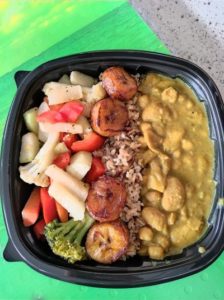
Curry Bean Stew
Mark, a Jamaican-born cook, established a vegan food truck
in 2017 and in August 2021 opened his first brick and mortar location in Boynton
Beach, Florida. Located in a small strip mall, Natuurlik features delicious vegan
Caribbean food. We sampled the Curry Bean Stew consisting of chickpeas and lima
beans, in a turmeric sauce with curry leaf and coconut milk. It is served with
wild rice (or a choice of another grain), plantains, and delicious fresh
vegetables. We also enjoyed a refreshing Whipped Coffee, which quite honestly
can be consumed as dessert! Some of the other items found on their menu include
a BBQ Jackfruit Meal, Seitan Tacos, Vegan Crab Cakes, Avocado Toast, Cassava
Fries, Fresh Juices, Smoothies, and more. This casual restaurant has both
indoor and outdoor seating.
Posted on
February 08, 2022 by
The VRG Blog Editor
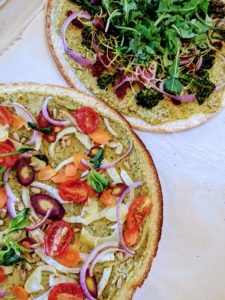
Please join Host Sheri DeMaris from RVN Television with her guest, Rissa Miller, Senior Editor at the Vegan Journal magazine as she demonstrates two amazingly delicious vegan pizzas using a white bean, garlic spread as sauce. If you are looking for not only a magazine with great recipes but also articles on the latest research on the benefits of a vegan diet you will want to pick up a copy!
Posted on
February 08, 2022 by
The VRG Blog Editor
By Reed Mangels, PhD, RD
According to the Non-GMO project,
a genetically modified organism (GMO) is “a plant, animal, microorganism or
other organism whose genetic makeup has been modified in a laboratory using
genetic engineering or transgenic technology. This creates combinations of
plant, animal, bacterial and virus genes that do not occur in nature or through
traditional crossbreeding methods.” Bioengineered plants or animals have had a
new gene inserted in them to give them a new trait, potentially one that is
considered useful such as being resistant to a disease.
Polls have consistently shown that consumers are in favor of
using product labels to identify foods that contain genetically engineered
ingredients or GMOs.
On January 1, 2022, the USDA’s rules for labeling products
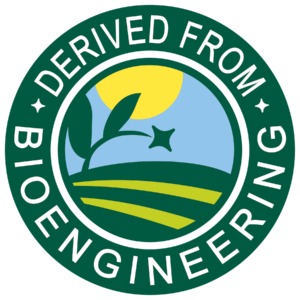
with GMOs went into effect. Foods can say, “contains a bioengineered
ingredient” or can have a round label that says “bioengineered” or “derived
from bioengineering” or can be labeled with a phone number or a QR code that
consumers can use to get more information.
Consumer organizations are concerned because many consumers
are not familiar with the term “bioengineered.” Also, consumers may not have
smart phones or be unfamiliar with the technology for QR code access.
In addition, just because a package doesn’t have a label,
there’s no guarantee that it doesn’t contain genetically modified ingredients.
Products containing GMO corn, soybeans, or sugar do not have to be labeled if
the levels of DNA in the final product is “not detectable.” So, for example, if
high fructose corn syrup, derived from GMO corn is used in soda, and the DNA
from the corn doesn’t show up because of the processing that has been done, the
soda does not have to be labeled. Products made from crops containing 5% or
less of genetically engineered ingredients also don’t have to be labeled. In
contrast, the European Union (EU) standard is much lower (0.9%) to allow for
accidental contamination. Animal products, such as milk and eggs, from animals
whose feed contained GMOs do not have to be labeled.
Marion Nestle, author of Food
Politics and other books, describes the new labeling rules as “useless.”
Fortunately for those consumers who don’t want their food to contain GMOs,
other certifications such USDA Organic and NON-GMO Project Verified are still
allowed to appear on packages.
Posted on
February 07, 2022 by
The VRG Blog Editor
What can you pack for a vegan lunch? Whether you’re going to school, work, a
picnic, or on a road trip, you need options for lunch. Check out 50 ideas to
fill your lunch bag!
Posted on
February 07, 2022 by
The VRG Blog Editor
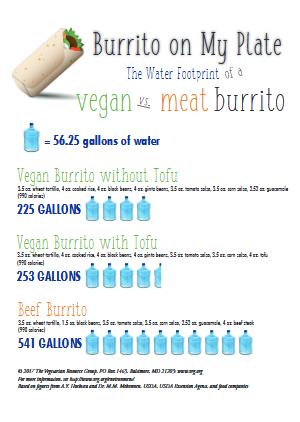
The Vegetarian Resource Group has a graphic called Burrito on My Plate,
which shows viewers the water footprint of a vegan versus a meat-based burrito.
It takes 225 gallons of water to make a vegan burrito without tofu and 253
gallons of water to make a vegan burrito with tofu. In comparison, it takes 541
gallons of water to make a beef burrito.
Posted on
February 04, 2022 by
The VRG Blog Editor
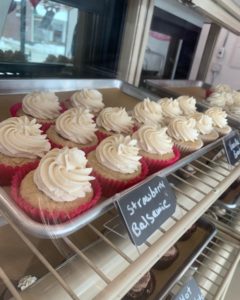
Photo from The Sweets Geek
The Vegetarian Resource Group maintains an online Guide to
Vegan/Vegetarian Restaurants in the USA
and Canada.
Here are some recent vegan restaurant additions. The entire guide can be found
here: http://www.vrg.org/restaurant/index.php
To support the updating of this online restaurant guide,
please donate at: www.vrg.org/donate
Here are some new additions to VRG’s guide (Note: Due to
the COVID-19 pandemic many are doing take-out
and/or delivery now):
Animal Liberation Kitchen serves PB Choco banana
croissant, croissant plain, shitake gyro, JustEgg patty, basil feta croissant
sandwiches, and more.
Roots
Vegan Kitchen, Delray Beach Market, 33 SE 3rd Ave., Delray Beach, FL 33483
For breakfast try their pancakes, overnight oats, coconut
chia pudding, and glory morning muffin. For lunch and dinner enjoy roasted
vegetable warm salad, buffalo cauliflower, hearts of palms tacos, veggie
tamales, jackfruit reuben, and much more.
Stache
West Hollywood, 8941 Santa Monica Blvd., West Hollywood, CA 90069
Following its mission of being a hub for the queer
community — an “all-inclusive social house for every form of self-expression”
and “safe and fun place for all to continue to grow, connect and thrive” — this
bar, nightclub, and restaurant has a packed schedule of events like drag brunch
and drink-and-draw, in décor honoring the underground spaces of queer history —
an industrial warehouse with historic lgbtq images and murals by local artists.
The food is all vegan and includes a regular menu with burgers, wings, tacos,
burritos etc. (don’t miss the banh mi fries!) and a special weekend brunch menu
with pancakes, breakfast scramble etc.
Take-Two
Café, 433 State St., Schenectady, NY 12305
Whether you need a cheerful start to your day or something
hearty to fill your belly in the afternoon, Take-Two Café offers delicious,
locally and ethically sourced meals and coffee in a relaxing environment.
Favorites include the avo smash – avocado, pesto, feta, cucumbers, and walnuts
on toasted bread – and the Buffalo crane wrap – loaded with buffalo seitan,
buffalo ranch, lettuce, tomato, shredded carrots, and cheese sauce on a crunchy
tostada and wrapped in a flour tortilla, all grilled to perfection with
homemade salsa on the side. Not too hungry but desperate for an energy boost?
Choose from an assortment of teas, coffees, lattes, and iced drinks of your
liking. Take-Two encourages all people – whether vegan or not – to enjoy a
taste of fresh, plant-based cuisine.
The
Sweets Geek, 4050 Erie St., Willoughby, OH 44094
The Sweets Geek is a cake shop where you can indulge in a
delectable dessert. Strawberry balsamic crispy cake, pumpkin rolls, buttercream
and cookies, pastries, and other bites are on the menu.
Vegan Fried Chick’un, 2961 W. Broadway, Vancouver, BC V6K 2G9, Canada
Chick’un nuggets, hot crispy
chick’un burger, yam fries, chick’un tenders, and more are available.
Simple take-out window in
downtown Vancouver specializing in all-vegan custard pudding — a smooth, creamy
treat made from kabocha squash, coconut milk and maple syrup. All ingredients
are organic and vegan, and free of white sugar nuts and soy. Flavors include
vanilla and caramel, matcha green tea, chocolate, sesame etc. They also do a
soy pudding and vegan crème brûlée, and offer a kit to make your own pudding at
home, and their products can be found in numerous restaurants and grocery
stores.
Wild Thing, 1477 NE Alberta St. #100, Portland, OR 97211
Wild Thing is a plant-based
café serving vegetable bowls, smoothies, and natural wine. Everything is local,
seasonal, and organic. The build-your-own-bowl menu offers a choice of a base
(grains and greens), vegetable toppings, sauces, and crunchy toppings. Vegan proteins can also be added to the
salad. Signature bowls are also on the menu including the Wild One bowl with
greens, lemony Brussels sprouts, green tahini miso and coconut garlic sauces,
and Wild Spice. Smoothies are also available such as the maca mocha smoothie
made with locally roasted coffee. Their menu also includes house-canned wines
made from locally grown grapes.
Posted on
February 04, 2022 by
The VRG Blog Editor
Recent topics brought up
include:
– A parent asked: Can you recommend any vegan pamphlets designed for kids – for those who would be learning about veganism? We recommended looking here: https://www.vrg.org/family/kidsindex.htm
– Do You Know a Vegan High School Student Willing to Share
What They Eat in A Day? Goodful is looking to cast a vegan high school student to
show what they eat for breakfast, lunch, and dinner.
https://www.facebook.com/groups/VRGparentsandkids is intended to be a group that offers support for families raising children on vegan diets and for vegan kids around the world. We envision it as a place to get advice about a wide-variety of topics: pregnancy, birthday parties, school lunches, Halloween, non-leather apparel, cruelty-free products, summer camps, and more. Please use it as a place to share your wisdom, seek advice, or just find a sympathetic ear. The goal is to offer support.
Consequently, any profane, defamatory, offensive, or violent language will be removed. Feel free to disagree, but do so respectfully. Hateful or discriminatory comments regarding race, ethnicity, religion, gender, disability, sexual orientation, or political beliefs will not be tolerated. We expect that posts should relate to vegan diets and lifestyles. The Vegetarian Resource Group reserves the right to monitor all content and ban any user who posts in violation of the above rules, any law or regulation, SPAM, or anything otherwise off topic.
Please share this information
with any veggie families that you know! Thanks.
Posted on
February 03, 2022 by
The VRG Blog Editor
By Reed Mangels, PhD, RD
A Vegetarian Resource Group member wrote to us with concerns
about getting enough protein because they weren’t able to tolerate more than
half a cup of beans a day. They had heard that older adults need more protein.
There is reliable research that suggests that older adults
need slightly more protein than younger adults do. A somewhat higher protein
intake, especially when combined with resistance training can build muscle in
older adults. This increased muscle can help to offset the muscle loss that is
a part of the aging process. Muscle loss can increase the risk of falls and
keep older people from doing the tasks they’d like to do.
How much more protein are we suggesting? Get out your
calculator! It seems like between 0.36 and 0.57
grams of protein per pound of body weight along with resistance training can
lead to a larger muscle mass in older people (1). In practical terms, if you weigh 120 pounds,
these recommendations would suggest that you get 43 to 68 grams of protein a
day; for someone weighing 150 pounds the recommendations suggest 54 to 86 grams
of protein. You can use this helpful
table to see how much
protein is in many vegan foods (scroll down to table 2).
Some experts
(2,3) suggest that spreading out protein over the entire day, instead of eating
one or two higher protein meals may further support muscle building. So, for
example, if you calculated that you needed 86 grams of protein per day, you
might try to eat around 30 grams of protein at each of 3 meals.
Here are some
sample meals that have around 30 grams of protein and don’t rely heavily on
beans since the person who originally asked the question didn’t want bean-heavy
meals.
A toasted bagel
with 2 Tablespoons of soy nut butter with 8 ounces of pea protein milk and a
banana
Strawberry
Smoothie made with 8 ounces of oat milk,
2 scoops of rice protein powder, a Tablespoon of nut butter, and ½ cup
of strawberries
Scrambled tofu
with toast: 6 ounces of extra firm tofu
scrambled with half a cup each of onions and peppers, and 2 Tablespoons of nutritional yeast; 2
slices of whole grain toast
2 burritos made
with ½ cup of cooked lentils, 1 cup of cooked quinoa and 1 cup of steamed chopped
broccoli
Veggie burger on
a bun with a cup of sweet potato oven
fries, peas and a cup of steamed green peas
Chili made with ½
cup of prepared TVP and ½ cup of beans served over 1 cup of cooked quinoa; and
a corn muffin
Stir-fry with 3 ounces
of sautéed seitan strips, ½ cup each cauliflower and carrots, and 3 Tablespoons
of slivered almonds served over 3/4 cup of cooked brown rice
Tempeh (¾ cup) in
barbecue sauce served over a medium baked potato with 1 cup of sautéed collards
Tofu in peanut
sauce (6 ounces of extra-firm tofu and 3 Tablespoons of peanut sauce) mixed
with a cup of steamed kale and served over ¾ cup of whole-wheat pasta
Of course, you
may need more (or less) protein than in these examples and don’t want to always
calculate the protein content of every meal. You can simply try to eat
concentrated protein sources such as soy products, seitan, beans, quinoa, nuts,
and nut butters throughout the day.
To learn more
about nutrition and other issues for older adults see Resources for Seniors
References
1. Haub MD, Wells AM, Tarnopolsky MA, Campbell WW. Effect of
protein source on resistive-training-induced changes in body composition and
muscle size in older men. Am J Clin Nutr.
2002; 76(3): 511–517.
2. Farsijani S, Morais JA, Payette H, et al.
Relation between mealtime distribution of protein intake and lean mass loss in
free-living older adults of the NuAge study. Am J Clin Nutr 2016;104:694–703.
3. Farsijani S, Payette H, Morais JA, et al. Even
mealtime distribution of protein intake is associated with greater muscle strength,
but not with 3-y physical function decline, in freeliving older adults: the
Quebec Longitudinal Study on Nutrition as a Determinant of Successful Aging
(NuAge study). Am J Clin Nutr 2017; 106:113–24.
The Vegetarian Resource Group (VRG) is a non-profit organization dedicated to educating the public on veganism and the interrelated issues of health, nutrition, ecology, ethics, and world hunger. We have been helping health professionals, food services, businesses, educators, students, vegans, and vegetarians since 1982. In addition to publishing the Vegan Journal, VRG produces and sells a number of books.
Sign up for our newsletter to receive recipes, ingredient information, reviews of new products, announcements of new books, free samples of products, and other VRG materials.