Perhaps you’ve heard about Aquafaba. The liquid you’ve been draining from
your beans all these years is actually surprisingly similar to raw egg whites
and can be used for baking in much the same way. The liquid can be baked,
whipped to make meringue, turned into marshmallows, or used to create uncanny
cheese substitutes.
Laura McGuiness shares her experience baking with aquafaba in a previous
issue of Vegetarian Journal. She
explains, “Aquafaba is still largely a mystery, even to scientists. The
proteins and starches in the bean juice appear to mimic the proteins in egg
whites, but the exact science leaves something to be desired. What we do know
from an analysis by The Norwegian Food Research Institute is that aquafaba is
mainly composed of starch and proteins. Because of the high starch content,
aquafaba is able to form stable gels, which may aid in its ability to emulate
egg whites.”
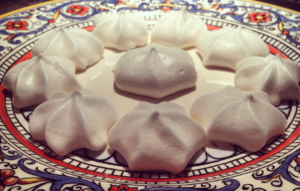
You’ll find the following recipes in this article along with photos of some
of the baked items:
Basic Meringue Cookies
Baked Alaska
Lemon Apocalypse Pie
Chocolate Mousse
Walnut Fudge
Lemon Dacquoise
– New Vegan Videos from The Vegetarian Resource Group
– Recipe shared for Banana Soft-Serve
– Vegan Children’s Books
https://www.facebook.com/groups/VRGparentsandkids is intended to be a
group that offers support for families raising children on vegan diets and for
vegan kids around the world. We envision it as a place to get advice about a
wide-variety of topics: pregnancy, birthday parties, school lunches, Halloween,
non-leather apparel, cruelty-free products, summer camps, and more. Please use
it as a place to share your wisdom, seek advice, or just find a sympathetic ear.
The goal is to offer support.
Consequently, any profane, defamatory, offensive,
or violent language will be removed. Feel free to disagree, but do so
respectfully. Hateful or discriminatory comments regarding race, ethnicity,
religion, gender, disability, sexual orientation, or political beliefs will not
be tolerated. We expect that posts should relate to vegan diets and lifestyles.
The Vegetarian Resource Group reserves the right to monitor all content and ban
any user who posts in violation of the above rules, any law or regulation,
SPAM, or anything otherwise off topic.
Please share this information
with any veggie families that you know! Thanks.
For many years, if you wanted to know how much sugar was
added to a food, you could look at the ingredient list on the product’s label
and look at the Nutrition Facts label which would tell you the total amount of
sugar in the food. This was problematic for several reasons. Some food
manufacturers would use lots of different sources of sugar in a product – for
example, high fructose corn syrup, sugar, molasses, and brown sugar all might be
listed as ingredients. Since ingredients are listed in descending order of how
much of each is in a product, if there are lots of sources of sugar, none of
them might make it to the top of the list of ingredients. You might think the
product mainly contains peanuts but if you added up all the sugar sources,
total sugar might really be the most prominent ingredient. Secondly, back when
the label only listed total sugar, a product that had unsweetened dried fruit
would look like it had lots of sugar when really, that sugar was there
naturally in the form of fruit.
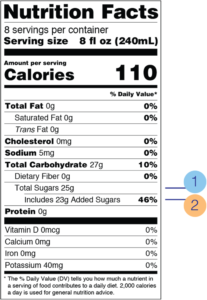
The new Nutrition Facts Label, required on all foods as of
January 2021, tells the amount of added sugars that are in products. As the Food
and Drug Administration says, “Added sugars include sugars that are
added during the processing of foods (such as sucrose or dextrose), foods
packaged as sweeteners (such as table sugar), sugars from syrups and honey, and
sugars from concentrated fruit or vegetable juices. They do not include
naturally occurring sugars that are found in [cow’s] milk, fruits, and
vegetables.”
Recommendations call for limiting added sugar to 10% or less
of total calories per day. That’s because these added sugars don’t much if
anything for us nutritionally – they mainly supply calories. If you need 1600
calories a day, 160 calories or less should be from added sugar. Since sugars
have 4 calories a gram, that means 40 grams or less of added sugar per day for
someone who needs around 1600 calories a day. There is no requirement for added sugars; the
10% of calories is an upper limit.
I was recently looking at some popular vegan ice creams and
noted that they had 30 grams or more of added sugar in a serving. Knowing which
foods have a lot of added sugar and having a perspective on what is a
reasonable amount of added sugar for you can help you choose foods and decide
how much of these foods you want to eat.
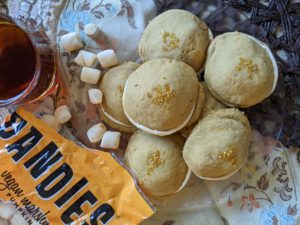
Nothing
says fall like biting into a gingery pumpkin cookie. Stuffing it with soft,
fluffy vegan marshmallows only makes the experience better. Try this recipe
with Dandies seasonal pumpkin mini marshmallows or their regular vegan
mini-marshmallows. Testers agreed these cookies were especially comforting warm
from the oven, served with hot tea or cocoa!
Dry
Ingredients
2-3/4 cups flour, plus more for rolling
1 teaspoon baking powder
1 teaspoon ground cinnamon
1 teaspoon ground ginger
Pinch ground cloves (optional)
Pinch ground allspice (optional)
Wet
Ingredients
1 cup vegan margarine, softened but not liquid (tested with
Earth Balance and Country Crock Almond Plant Butter)
1 cup packed organic brown sugar
1/2 cup canned pumpkin puree (plain, not pie filling)
1 Tablespoon molasses
1 teaspoon vanilla extract
1 Tablespoon plain, unsweetened vegan milk
1 Tablespoons ground psyllium husk seeds
One 5-ounce bag pumpkin Dandies mini-marshmallows
(plain mini Dandies work too)
2 Tablespoons decorative sugar (optional)
In a medium bowl, combine dry ingredients and set aside. In
a large bowl, mix vegan margarine, brown sugar, pumpkin, molasses, and vanilla
with an electric mixer or by hand until well blended. Add in dry ingredients in
three portions, mixing well each time. Quickly add in vegan milk
and ground psyllium husk seeds. This is the binder and psyllium sets
up very fast, so several fast strokes or a few circles in the bowl with an
electric mixer will do the job. Dough will be soft but not too sticky.
Wrap in parchment paper or plastic
wrap and chill in the fridge for at least one hour or up to overnight.
When ready to bake cookies, preheat
the oven to 350 degrees and line two cookie sheets with parchment paper or
silicone baking sheets.
On a clean flat surface, spread
some flour and rub flour on a rolling pin (a large jar or glass bottle will
work if you don’t have a rolling pin). Working with half the dough, roll it
flat until it’s about 1/8-inch thick. Add more flour as needed to prevent
sticking. Using a standard (not wide mouth) 12 oz. Ball jar, cut out circles
and place on the cookie sheets. Repeat until all dough is used and there are
about 40 “bottoms.” Top each dough circle with 2-3 Dandies, until all are used
up from the 5-ounce bag.
Repeat rolling second half of
cookie dough and cutting circles. Place a dough circle on each Dandies-topped
cookie and press edges lightly to keep the melty marshmallow inside during
baking. If desired, top cookies with a sprinkle of decorative sugar.
Bake 12-14 minutes at 350 degrees
until cookies are lightly browned on the bottom and Dandies are melted. Some
marshmallows will squish out the sides. Allow to cool on the pan 5 minutes
before serving. Store in a sealed container on the counter up to 3 days or
longer in the fridge (if they last that long!).
Zel Allen serves up a wide variety of vegan comfort food recipes in a
previous issue of Vegetarian Journal.
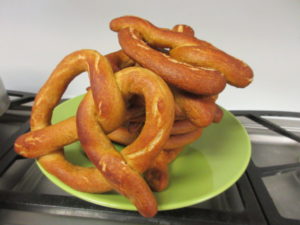
Make your own Giant German Pretzels (see photo) and dip them into either a
Smoky Cheezy Sauce or a Mustard Sauce. Also enjoy Southern Cornbread or Vegan
Buttermilk Pancakes with Buttery Apples. Move on to recipes for Cream of
Mushroom Soup, Asparagus on Toast with Almond Sauce, Smothered Tomato and
Mushroom Pasta with Herbs, Smoky Cheezy Stuffed Potatoes, Chocolate Brownie
Pudding, and Old Fashioned Apple Crisp. Your family and friends will love these
recipes!
In addition to The Vegetarian Resource Group’s quarterly
vegan magazine (Vegetarian Journal),
VRG publishes a national email newsletter called VRG-News each month. Vegan
news is so vast these days that we saw the need to publish more than can fit in
our quarterly magazine.
Sign up for our national email newsletter here: https://lists.vrg.org/mailman/listinfo/vrg-news_lists.vrg.org
Many years ago one of our members wanted to purchase a
higher model Volvo without leather seats. He was unable to obtain this, and the
sales person said, “You do not eat the seats, you know!” Volvo has
now announced they will offer vegan and sustainable alternatives. “The
impetus behind the move to vegan leather is based in company concerns about
animal welfare — the negative environmental impacts of cattle farming,
including deforestation.” However, at this point, the company will still
offer wool blends. Volvo Cars is also looking at ways to reduce the use of
residual products from livestock production commonly used within or in the
production of plastics, rubber, lubricants, and adhesives.
Don’t be afraid to speak up and promote your vegan values when making purchases. After all, it wasn’t that long ago that many of us kept requesting vegan donuts, burgers, milks, shoes, etc. at stores. If enough people ask, change will eventually happen.
The contents of this posting, our website, and our other publications, including Vegetarian Journal, are not intended to provide personal medical advice. Medical advice should be obtained from a qualified health professional. We often depend on product and ingredient information from company statements. It is impossible to be 100% sure about a statement, info can change, people have different views, and mistakes can be made. Please use your best judgment about whether a product is suitable for you. To be sure, do further research or confirmation on your own.
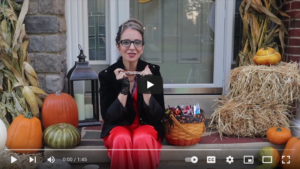
It’s the spookiest night of the year… and you
want to give out vegan candy to all the little ghouls and goblins that knock on
your door. But what to do? Are there vegan Halloween candy options? YES! We’ve
got you covered.
The Vegetarian Resource Group (VRG) is a non-profit organization dedicated to educating the public on veganism and the interrelated issues of health, nutrition, ecology, ethics, and world hunger. We have been helping health professionals, food services, businesses, educators, students, vegans, and vegetarians since 1982. In addition to publishing the Vegan Journal, VRG produces and sells a number of books.
Sign up for our newsletter to receive recipes, ingredient information, reviews of new products, announcements of new books, free samples of products, and other VRG materials.