Did you know that around 100,000 people in the United States
die prematurely each year due to air pollution resulting from human activities
(like driving)? And that about 20,000 of those deaths are linked to
agriculture? I had no idea of this issue until I read a recently published
study conducted by scientists from the United States and the United Kingdom.
This study attributed 15,900 deaths per year in the United
States to air pollution related to food production and estimates that 80% of
these deaths are related to animal-based food production. There are numerous
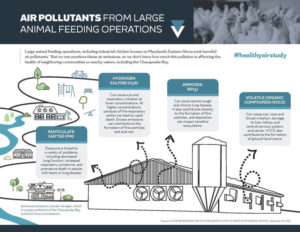
ways that food production contributes to air pollution. For example, livestock
waste (urine and feces) and fertilizer applications result in ammonia
production. Ammonia is estimated to be associated with 69% of deaths related to
air quality from food production. Particulate matter from dust from tillage,
dust kicked up by livestock hooves, field burning, and emissions from
agricultural equipment is estimated to be associated with 27% of food
production air quality-related deaths.
Red meat production has the greatest impact on health damage
related to air quality. The health effect of red meat production on air quality
is estimated to be 10 times higher than that of nut and seed production and 15
times more than that of the production of other plant foods. Production of
eggs, poultry, and dairy products all have a greater impact on deaths
attributed to food production air quality than does production of plant foods.
The researchers developed mathematical models to predict the
effect of dietary changes in the United States on deaths due to
agricultural-related air quality. Substituting poultry for red meat would
potentially result in a 40% decrease in deaths, shifting to a vegetarian diet
would potentially decrease deaths attributed to air pollution related to food
production by 76%, and a shift to a vegan diet would potentially decrease
deaths by 83%. Thus, a national shift to a vegan diet could prevent more than
13,000 deaths per year from food production-related air pollution alone. That’s
not to mention other environmental and health benefits.
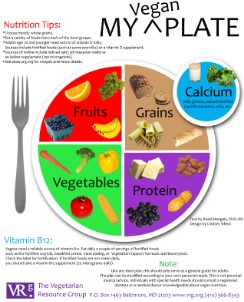
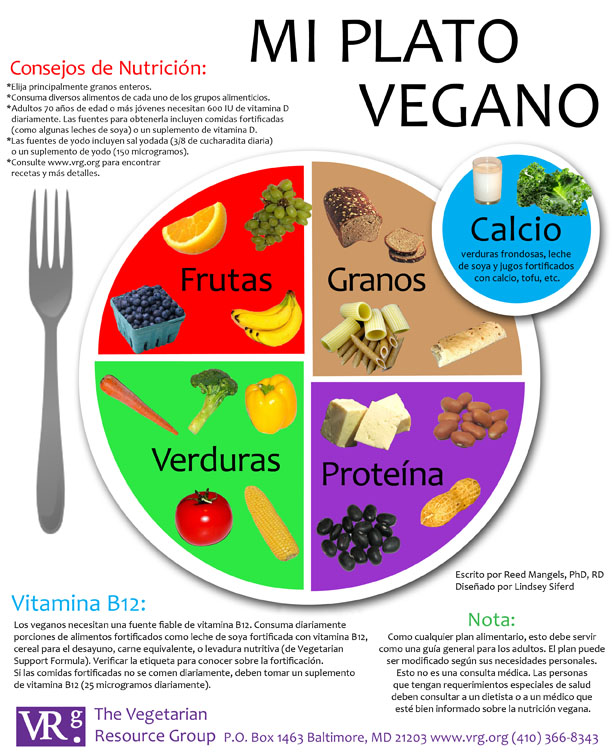
Nothing beats a simple graphic to get the vegan message out!
The Vegetarian Resource Group created My
Vegan Plate to display on outreach tables at various events. If you live in
the United States, you can request copies of this handout to distribute by
emailing us at [email protected]
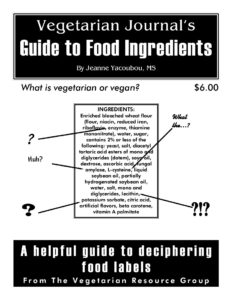
Have you ever wondered if an
ingredient listed on a food label is vegan or not? The Vegetarian Resource
Group has an online guide to food ingredients that lets you now whether a
specific food ingredient is vegan, vegetarian, non-vegetarian, typically vegan,
typically vegetarian, may be non-vegetarian, or typically non-vegetarian.
Veg-curious? Vegetarian? Vegan? This program is for you! You will learn how to be a healthy vegetarian/vegan, how to deal with social situations, and how to get started as a vegetarian/vegan. We’ll also talk about being a vegetarian athlete as well as ideas for simple meals and snacks. Bring your questions to this interactive session.
Reed Mangels, PhD, RD is a Nutrition Advisor for the non-profit, educational
Vegetarian Resource Group (www.vrg.org) and the nutrition editor and a regular
columnist for Vegetarian Journal.
Registration is required to receive a link and password. Deadline to
sign-up will be 1 hour before the program begins.
Links and passwords will be emailed at least 30 minutes before the program.
The virtual room will open 3 minutes before the program begins. We do recommend
everyone “arrive” at least 10 minutes before the program to ensure
you are able to enter the “room.” If you do not receive an email with
the program link at least 30 minutes before the program begins, please check
your spam and other folders. If still unable to find it, please use the Chat to
ask a team member for help.
For those under 18 years of age who may be joining us, we recommend that a parent/legal guardian be with you during the meeting. Learn more about Zoom at zoom.us.
*Reminder – Those not on the Guest List will not be considered registered, and will not receive a virtual “ticket”. Registration accepted on a first come first serve basis.
To request an accommodation under the Americans with Disabilities Act for library-sponsored events, please call 408-808-2000 at least three business days prior to the event.
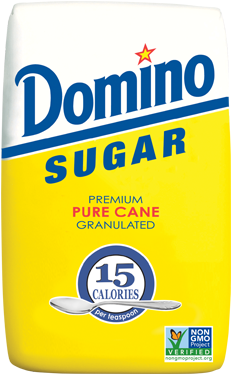
According
to their website, ASR
Group is the world’s largest refiner and marketer of cane sugar. In the United
States, ASR produces sugar under these brand names: Domino Sugar, Florida
Crystals, and C&H Sugar.
In
April and May 2021, The Vegetarian Resource Group spoke with Michael Burchell,
Senior Director, Global Corporate Quality and Daryl Sabourin, Global Director
of Sustainability, about sugar processing at ASR.
We
learned that they currently use three different methods for cane sugar
decolorization and purification:
Cow bone char
Ion exchange resin using a polystyrene bed (a non-biodegradable, fossil fuel-derived plastic)
Granular activated carbon (GAC) using coal or coconut husks
ASR
Group employs all of these methods at various refineries around the country.
Burchell
told us that all three processes yield sugar of comparable purity and quality.
Because each type of refining requires its own type of costly, specialized
equipment that has a functional life of 50+ years, changing processing methods
is not frequently done.
Baltimore’s
refinery converted completely away from bone char filtration in June 2015.
Burchell stated that concern about using animal material, especially in light
of zoonotic diseases, was one reason they made the switch.
At
the Baltimore location, Domino now uses granular activated carbon (sourced from
both coal and coconut husks) and ion exchange resin for processing.
The
Yonkers, NY refinery eliminated bone char in the ’80s. It currently uses
granulated activated carbon, as does the South Bay, FL refinery which has
always been bone char-free.
By
contrast, the ASR sugar refineries in Crockett, CA and Arabi, LA use bone char
filtration.
In
the 1990s, 90% of the cane sugar industry was using cow bone char as a filter.
Burchell points out, however, that the ASR Group was already 40% bone char-free
in the ’90s.
Burchell
estimated that today, 65% of all ASR sugar is bone char-free.
Burchell
told The VRG that consumers can tell if a particular package of Domino Sugar,
Florida Crystals or C&H Sugar is completely bone char-free if the lot
number appearing on the label begins with 1, 4, or 6.
The
carbon footprint of cane sugar
Michael
Burchell informed The Vegetarian Resource Group that methane gas was the energy
source driving the sugar processing in some refineries. And where granular
activated carbon was used, coal was one of the source materials.
Both
methane gas from fracking and coal from mining are fossil fuels. The burning of
fossil fuels is the leading cause of our climate crisis.
We
wanted to know more about how the fossil fuel (also called carbon) footprints
of the three industrial methods for cane sugar processing compare. This
information may help educate climate-conscious consumers when they are deciding
which foods and beverages to purchase.
Burchell
directed us to Daryl Sabourin, ASR Group’s Global Director of Sustainability.
Sabourin
was unable to tell us exactly how the fossil fuel footprints of the three sugar
processing methods compare. His company has not determined what they are.
Sabourin estimated that a complete assessment would cost “at least $70,000.” It
isn’t required by the government and no other companies are conducting this
type of analysis.
When
consumers want this information and believe the extra cost through raised
prices (or tax credits?) are worth it, companies may start conducting this type
of analysis. A complete environmental impact assessment, including a fossil
fuel footprint analysis, would provide essential information about the total
environmental costs of production methods. This information would allow
businesses to transition toward using only the methods which have the smallest
environmental and fossil fuel footprints and be leaders in
sound sustainability practices.
Sabourin
estimated that for the granular actived carbon (GAC) method, coal, itself a
fossil fuel, would have a higher fossil fuel footprint than coconut husks. He
also estimated that since bone char manufacture and regeneration require
extremely high temperatures for extended times, the bone char method would have
a higher carbon footprint.
The contents of this posting, our
website, and our other publications, including Vegetarian Journal, are not
intended to provide personal medical advice. Medical advice should be obtained
from a qualified health professional. We often depend on product and ingredient
information from company statements. It is impossible to be 100% sure about a
statement, info can change, people have different views, and mistakes can be
made. Please use your best judgment about whether a product is suitable for
you. To be sure, do further research or confirmation on your own.
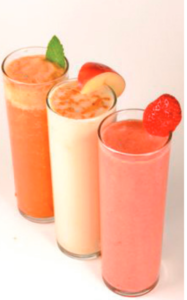
Looking for a healthy dessert? Why not try a dessert
smoothie! Ivy Grob (a former VRG intern) shared some of her recipes in a
previous issue of Vegetarian Journal including Strawberry Shortcake,
Banana Chocolate, Berry Cobbler, Peanut Butter Cup, Peach Pie, and Apple Pie
Smoothies. Read the article here: https://www.vrg.org/journal/vj2016issue3/2016_issue3_dessert_smoothies.php
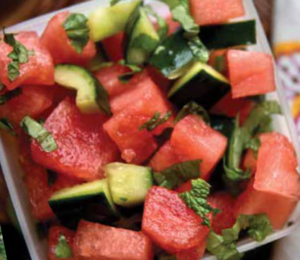
Shannon Cebron
offers a number of vegan recipes you can prepare and take with you on your next
camping and/or hiking trip. Her previous Vegetarian
Journal article “Take it Outside” offers recipes for Curried Tofu Salad
Sandwiches, Roasted Garlic Everything Bagel Dip, Watermelon Herb Salad, Trail
Mix Cookies, Whole Wheat Banana Bread Muffins, and Kale & Chickpea Scramble
Burritos. Read the entire article here: https://www.vrg.org/journal/vj2020issue2/2020_issue2_take_outside.php
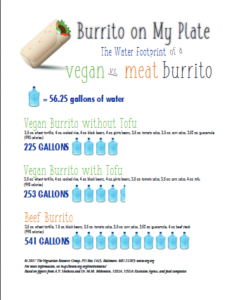
The Vegetarian Resource Group has a graphic called Burrito on My Plate,
which shows viewers the water footprint of a vegan versus a meat-based burrito.
It takes 225 gallons of water to make a vegan burrito without tofu and 253
gallons of water to make a vegan burrito with tofu. In comparison, it takes 541
gallons of water to make a beef burrito.
Nothing beats a creative
salad dressing that’s quick to prepare and toss into your salad mixture. Chef
Nancy Berkoff has a few suggestions including Indian Curried Grapefruit
Dressing, Thai Peanut-Orange Dressing, Retro Green Goddess Dressing, Italian
Sun-dried Tomato-Rosemary Vinaigrette, Chinese Sesame-Soy Dressing, Continental
Shallot and Caper Dressing, Southwestern Chili Pepper Dressing, and more.
Create and submit a video relating what you want to tell others
about vegetarianism/veganism.
Some possible topics: food, nutrition, your feelings about
veganism/vegetarianism, water usage and vegetarianism, veganism and animal
rights, or other vegan topics which appeal to you. Humor and feelings are
appreciated. All videos should be positive, not be critical of anyone, and not
include any footage of animal cruelty. You may submit a video you have already
made.
Aspects of judging include accuracy and judges wanting to
share the video with others. Entrants give permission to The Vegetarian
Resource Group to post and share the video, to link to and from the video, and
share the video with the media. Deadline to enter this year is July 15, 2021.
The Vegetarian Resource Group (VRG) is a non-profit organization dedicated to educating the public on veganism and the interrelated issues of health, nutrition, ecology, ethics, and world hunger. We have been helping health professionals, food services, businesses, educators, students, vegans, and vegetarians since 1982. In addition to publishing the Vegan Journal, VRG produces and sells a number of books.
Sign up for our newsletter to receive recipes, ingredient information, reviews of new products, announcements of new books, free samples of products, and other VRG materials.