As a vegetarian, it is often hard to find places that have
great vegetarian and vegan options. Upon my visit to my first vegan restaurant,
it felt very reassuring that I could get food from a place without stressing
over my dietary needs. If you had similar experiences, I suggest if you are
living in the Baltimore or Riverdale, Maryland area that you should check out
Gangster Vegan Organics! Whether you are looking around the Baltimore Harbor or
trying to explore your vegan food options, Gangster Vegan Organics might be the
perfect spot for you.
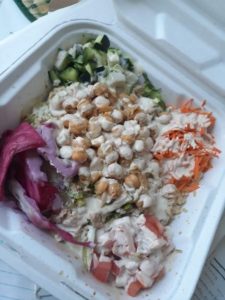
On my first visit to the Cross Street Market in Baltimore where one Gangster Vegan Organics is located, I had a tour of what foods people near the harbor like to eat. During the time of COVID-19, businesses have been hit hard and seeing all of these small businesses in one place made me feel relieved. Gangster Vegan Organics has wonderful options from sweets, to green juices, to burgers, to bowls, to smoothies, and even salads; there are so many options to choose from, which put me in a dilemma. The prices of the items for the quality seemed like a great deal as well. After making a tough decision, I decided to get the Alchemy (Mediterranean) which has: pickled cabbage, tomatoes, carrots, cucumbers, brown rice, romaine, Mediterranean marinated garbanzos, ginger date sauce, and cashew cheese. I have never had cashew cheese before, which made me very curious to see what they all tasted like.
As soon as I got my bowl, I was in awe of how beautiful the
colors of the veggies looked together. From the dark fuchsia-colored cabbage to
the green cucumbers and orange carrots, this bowl was a beauty. In my first
bite, I was shocked at how strong the pickled cabbage and its addition to the
bowl really stood out. The combination of the tomatoes, carrots, garbanzo
beans, and cucumbers helps to clean the bite and smooth out the bowl from the
strong Mediterranean and
ginger sauces. Overall, this was one of the most delectable bowls I have had in
a while. This made me want to explore more of the menu the next time I come to
this place. I would rate this restaurant a 9.5/10 because of the great service,
location, and food variety.
If you haven’t been to Gangster Vegan Organics or you don’t
live in Baltimore/Riverdale, MD, whenever you find yourself in these areas
looking for a healthy place to grab food, with an expansive menu, and a great
area to explore, I highly suggest you try Gangster Vegan Organics (and what a
cool name too).
Arpi wrote, “Knowing that millions of animals are suffering
and being killed in factory farms each year, just to be served as school
lunches that would usually be left uneaten, completely broke my heart. I knew
that something had to change … I decided to create a plant-based survey and
send it out to students across my school district. In this survey, I questioned
if the student would want to have more plant-based options, what plant-based
meals they are interested in, and what their reasoning was behind their answer.
I then used ArcGIS (an online mapping application) to create a dashboard
displaying the survey results. I included bar graphs, pie charts, and maps to
demonstrate the percentage of students who wanted vegan and/or vegetarian
options and I displayed where the data was gathered from with the use of a pie
chart and a map. I then set up a zoom meeting with my school’s nutritional
services director where I pitched my idea and used my survey and dashboard
results as evidence that our school district had a clear demand for more
plant-based options.” Arpi’s reference stated: “She got the whole district
food services administration to join Zoom, and led the meeting, presenting fact
based data to support incorporating vegan options on a regular basis for school
meals. Our district food services director was so impressed with the work she
had done researching affordable vegan options for our lunch and snack menu that
she thanked Arpi for doing the survey saying that data does make a difference,
and asked her to send her the data collected from her survey. Through her
efforts the food service director did commit to including falafel, soymilk,
fruit parfaits, and other vegan items to the school menu.”
Additionally, to further encourage vegetarianism in her
community, Arpi partnered with the Factory Farming Awareness Coalition to
represent them at her high school’s AP environmental science courses. As a
guest speaker, she spoke to two classrooms regarding the ethical and
environmental issues linked with factory farming. In addition, she also created
a quick-and-easy vegan recipe tutorial on her school’s tv show, Quarter Past
Clark.
For her senior thesis, Arpi did a paper on food subsidies.
She plans to focus her career around advocating for and creating new food-based
policies in the United States. She said, “Major topics that I am interested in
are transitioning governmental food subsidies away from animal agriculture
towards fruit and vegetable farms. … I believe that in order to further
spread the vegan and vegetarian movements, it is essential to stay
compassionate in all aspects of life, by treating everyone with kindness, both
humans and nonhuman animals alike.” Arpi will be attending UC San Diego for a
political science and public policy major, with a minor in climate change
studies.
The deadline for the next Vegetarian Resource Group
scholarship contest for high school seniors graduating in 2022 is February 20,
2022. To see rules and past scholarship winners, visit vrg.org/student/scholar.htm
To support additional scholarships and internships, donate
at vrg.org/donate,
call (410) 366-8343, or send donations to VRG, P.O. Box 1463, Baltimore, MD
21203.
The
availability of food made and marketed expressly for vegans in the last few
years has skyrocketed. The fact that one can pull up to a Burger King and order
a plant-based burger with fries would have been unthinkable 20 years ago. But
easy availability has its downside – particularly when it comes to cross
contamination. Were the burgers cooked on a separate grill? Were they
manufactured in a factory that provided separate processing? Is the packaging
cruelty-free? Where do these pickles come from? The same types of questions
that apply to eating out apply equally to shopping at the market. How many
times have you blocked the isle in your friendly neighborhood Safeway trying to
read the microscopic ingredients on a frozen vegan pizza? Or asked an
exasperated server at your favorite local haunt if the vegan soup has a fish
base, or if the chipotle ranch dressing is made with Vegenaise? For me at
least, this brings to the fore the vegan elephant in the room. Once we have
committed ourselves to this ethical, compassionate life, how far do we go up,
or down, the food chain to ensure that the food we eat, and that we feed our
loved ones, is truly vegan? How certain can we ever be that the food we eat is
vegan?
The Food and Drug Administration (FDA) is
responsible for assuring that food sold in the U.S. is safe, wholesome and
properly labeled. Federal Food, Drug, and Cosmetic Act and the Fair Packaging
and Labeling Act (1) are the Federal laws governing food products under the
FDA’s jurisdiction. But the question “is it vegan?” has so far not come to a
top priority. Generally the FDA does not require manufacturers to disclose
specific food content if it is below a set minimum and the ingredient does not
have a health, functionality, or safety impact – so trace amounts of animal
related ingredients do not have to be disclosed on labels. This exception also
covers a variety of “unintended” ingredients it’s best not to contemplate.
However The Food Allergen Labeling and Consumer Protection Act of 2004 (FALCPA)
(2) does provide some help to vegans. This Act requires food manufacturers to
label food products that contain ingredients from a specific list of food allergens.
This list includes any flavorings, colorings, or incidental additives. Of note
for vegans and vegetarians the presence of milk, eggs, crustacean shellfish,
and fish must be disclosed. So at least we as consumers can rely, with a
reasonable degree of certainly, on the presence or absence of these particular
animal sourced ingredients, but no provision under this Act is made for
ingredients that may be derived from other animal sources.
WHAT
CAN BE CALLED MILK OR MEAT?
Plant
milk producers have scored a key victory in the 2018 US Court of Appeals case
Painter v. Blue Diamond Growers (3). In a nutshell the Court ruled that calling
almond milk “milk” is not deceptive. At stake is what the FDA calls “standards
of identity (4),” legally binding definitions of products to ensure consumers
know what they’re buying. The dairy industry has complained for years that the
FDA hasn’t policed the definition of “milk” and has allowed products made from
soy, almonds, cashews, rice, hemp, and oats to fill shelves in the dairy aisle.
In this case, the dairy industry alleges that these products shouldn’t be
allowed to use the term milk because they are nutritionally inferior. But the
court said the complaint does not plausibly allege that a reasonable consumer
would be deceived into believing that Blue Diamond’s almond milk products are
nutritionally equivalent to dairy milk based on their package labels and
advertising.
The Real Marketing Edible Artificials
Truthfully (MEAT) Act (5) seeks to require plant-based meat packaging to
prominently feature the word “imitation,” along with a statement that clearly
indicates the product is not derived from or does not contain meat. This is
strongly backed by traditional meat producers and it was in committee as of
this writing. (Though if it passed, depending on the regulations, we still may
not know if an items is vegan.)
A
New York case involving an alleged violation of New York’s Deceptive Acts or
Practices Law is somewhat helpful, if only for the result and not for any
precedent it may establish (8). In Borenkoff v Buffalo Wild Wings Inc et al,
2018 U.S. District Court, Southern District of New York (9) plaintiff alleged
that defendants use beef tallow to fry non-meat food items like mozzarella
sticks and French fries, whereas the “industry standard” is to use non-beef
cooking oil to fry such items and that a reasonable consumer would assume that
non-meat oil would be used for non-meat foods. The court dismissed the
complaint, deciding that the plaintiff failed to state any “actual injuries” over
and above the monetary cost of the purchase. It remains subject to conjecture
what the Court would have decided if the case was differently pled.
The New York State Department of
Agriculture & Markets generally regulates food manufactured and packaged
for retail sale in New York and local Departments of Health, mostly at the
county level, regulate restaurants and menu labeling. I can say from years of
experience that there is often a huge disconnect between State, County and
Municipality rules and regulations and their implementation. That being said,
there is scant New York State Law on this front for them to interpret or
implement anyway.
One bright light on the local level
however is the New York City Bar Association’s Animal Law Committee. They have
championed numerous anti-animal cruelty initiatives over the years (10). As an
apropos example, they issued a report on the use of the names of dairy foods in
the labeling of plant-based products. They argued that “the standard of
identity for milk (limiting it to the lacteal secretions of cows) was
established to address the rampant adulteration of dairy milk products in the
early 20th century that harmed consumers who wished to purchase cows’ milk, not
to preclude or hinder the marketing of truthfully labeled new variations or new
foods” (11).
As far as any additional, specific
guidance, there is this statement from the New York State Department of
Agriculture and Markets about “Imitation Foods” which may by extension apply to
vegan food: “If any food product is an imitation of another, and is
nutritionally inferior to that product, it must be labeled “Imitation _____,”
with the space being filled in with the name of the food imitated, and with the
word “imitation” in type of uniform size and prominence as used for the name of
the food.” (12) Query what “nutritionally inferior” means in this context.
However, as far as I can tell, there are no New York State regulations specific
to the use of the term “vegan” in food labeling. This being the case, are there
any other cases or statutes that address the government’s role in the
regulation of food that may help us in our quest? The answer lies, perhaps, in
the regulation of kosher food.
Outside of Israel, New York has the
largest population of kosher consumers with more than 135,000 products
available on the market shelves (13). Possibly as a consequence of this, New
York State has had one form of kosher labeling law or another since 1915 – most
recently the Kosher Law Protection Act of 2004 (14). Basically the act
requires those who market their food as kosher to label it kosher and to
identify the individual certifying the food by filing with the New York State
Department of Agriculture. The Act has been challenged as unconstitutional in
Commack Self-Service Kosher Meats, Inc. v. Hooker 680 F.3d 194 (2d Cir. 2012)
(15) where the court, applying the Lemon test from Lemon v. Kurtzman, 403 U.S.
602 (1971) (16), rejected plaintiff’s contentions and decided that the act is
constitutional. Even though it’s a small victory and may be more related to
religious questions, it’s one that could have an impact on vegan food
labeling.
For now, we as vegans and vegetarians need
to remain vigilant. I guess I’ll see you at the supermarket. I’ll be the one
studying the ingredients on a bag of chocolate covered pretzels. Happy “hunting.”
This is not legal advice, for
which you should consult your own legal professional. Emilio
Gironda practiced law for 35 years. He has come to the vegan table late in his
journey of self discovery and evolution. He believes that all living beings
deserve our love and compassion and that to live any other way is to fill our
lives with dust.
The contents of this posting,
our website, and our other publications, including Vegetarian Journal, are not
intended to provide personal medical or legal advice. Medical advice should be
obtained from a qualified health professional. We often depend on product and
ingredient information from company statements. It is impossible to be 100%
sure about a statement, info can change, people have different views, and
mistakes can be made. Please use your best judgment about whether a product is
suitable for you. To be sure, do further research or confirmation on your own.
Jasmine stated, “In Arabic, the word ‘AtIka’ means noble born. But in my family, it’s the name of the thirteen-year-old grey Lincoln town car we turned into a taxi … It was where Atika carried us in her arms for two years.” Jasmine began to work nine years ago to help her family. She said, “On the bus ride to my client’s home, I read the fact that promoted my conversion to veganism: Animal Agriculture produces more greenhouse gas emissions than the entire transportation sector … I made the connection between human lives and animal lives clear to my family and forged my own path to cruelty-free, noble living. Following my ninth-grade conversion to veganism, I was compelled to tell the stories of those lives because in Atika they had become an extension of my own.”
In high school, Jasmine was one of seven Americans selected for an international scholarship to study microbiology, robotics, and Arabic in Cairo, Egypt for four weeks. She chose to do a plant-based project, posing diet change as a viable method for reducing suffering. At the same time, she interacted with Egyptian families and registered 23 members to a vegan coaching program, as well as distributed veggie pamphlets.
Back in Miami, Jasmine set up tables on the Florida International University Campus and discussed veggie diets with students and faculty. She also worked long distance with an English vegan group to help them apply for grants, and supervised eight adults in this process. In addition, she worked to bring the vegan group’s school lunch information to Florida.
Jasmine’s high school science teacher stated, “Jasmine effectively communicates the intersectionality of sustainable consumption. Her discussion consists of science, but also of ethics, poverty, racism, and fiscal policy; this makes her outreach intellectually stimulating for all participants, myself included. I along with a majority of faculty and the student body, have started to transition to plant-forward diets as a result of her advocacy. It is due to her passion that I have been vegan since March of last year.”
Jasmine will be pursuing a college degree in Biological Physics with a minor in Middle Eastern Studies or Environmental Studies. She hopes to create a nonprofit that will provide environmental, STEM-geared, plant-forward education to inner-city youth. Jasmine sums up her message this way: “I want to help people find their kindness.”
The deadline for the next scholarship contest for high school seniors graduating in 2022 is February 20, 2022. To see rules and past scholarship winners, visit vrg.org/student/scholar.htm
To support additional scholarships and internships, donate at vrg.org/donate, call (410) 366-8343, or send donations to VRG, P.O. Box 1463, Baltimore, MD 21203.
My kitchen cabinet always has had one shelf devoted to
cookbooks. Although some move into this place of honor and some move away to
the less-used living room bookshelf, there are a few cookbooks that are always
there. They’re the ones I turn to when I’m looking for a favorite recipe or,
sometimes, just for nostalgia’s sake.
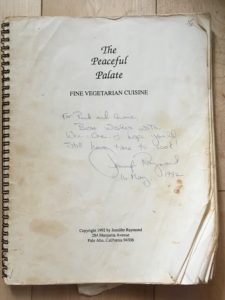
One classic that
has lived on the kitchen shelf for the past 30 years is Peaceful Palate by Jennifer Raymond. As you can see, it’s been used
frequently and is missing the cover and has some loose pages that are tucked
into the book. A newer edition is available, but I plan to keep this one. It
has a note from my mother who used it to make banana muffins for us when our
first child was born. There are my notes on various recipes – “also works with
TVP,” “nice crunch,” and “EVERYONE ate this one.” There are marginal notes from
doubling and tripling recipes for potlucks and other gatherings. The tofu
burger recipe is almost unreadable; it’s been used so many times and shared
with friends. No matter, I have this one memorized. There’s the Spicy Pumpkin
Soup I’ve brought to friends who needed comforting, the Bread Dressing that’s
always on the Thanksgiving table, and the Fresh Peach Cobbler that I make most
summers.
It’s funny how one
spiral-bound book can hold so many memories. Thanks to Jennifer for her gift of
this cookbook.
More and more vegan food
items are now available in quantity size for restaurants and other food service
settings. Here are two new offerings:
Upton’s Naturals’ 100% vegan and versatile meat alternatives are coming soon to restaurants and foodservice providers across the country through a new partnership with Dot Foods, the largest food industry redistributor in North America.
Photo from Chicago Vegan Foods
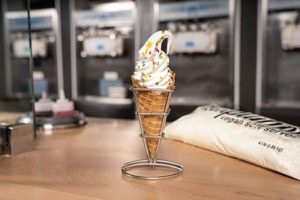
Chicago Vegan Foods has introduced a new Temptation
Vegan Soft Serve made with whole oat flour. This is dairy-free, 100%
vegan soft-serve mix.
The Vegetarian Resource Group maintains an online Guide to
Vegan/Vegetarian Restaurants in the USA
and Canada.
Here are some recent vegan restaurant additions. The entire guide can be found
here: http://www.vrg.org/restaurant/index.php
To support the
updating of this online restaurant guide, please donate at: www.vrg.org/donate
Here are some new
additions to VRG’s guide (Note: Due to the COVID-19 pandemic many are doing take-out
and/or delivery now):
Burrito Burrito, 333 Broadway, Troy,
NY 12180
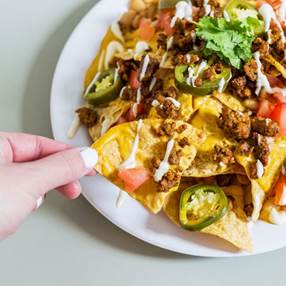
They have Burritos,
Tacos, Nachos, Burgers, Sides, Bowls, Salads, Drinks, and Desserts. Specialties
include spicy soy ‘steak,’ fried chickpea patty, BBQ jackfruit, seitan with
house-made hemp queso, and ‘feesh’ (kelp marinated tofu cornmeal crusted and
fried). They are a nut-free establishment.
Col’s Kitchen, 55 S. Main St.,
Concord, NH 03301
They offer a special
Sunday Brunch menu, plus daily Beverages, Starters, Salads, Sandwiches and
Wraps, Burgers, Entrées, and Dessert. Some of their interesting and unique
offerings include house made falafel burgers, seitan broccoli stroganoff, and
pie shakes.
Magic Vegan Café, 1723-B 25th Ave.,
Gulfport, MS 39501
Magic Vegan Café is
an all-vegan café serving southern-style lunch and dinner. Dishes include a BBQ
Sandwich, Steak and Cheese, a Bean & Cheese Burrito, and Mac & Cheese.
Sides include potato salad, coleslaw, and house-made wheat-based fajita strips.
Don’t forget to try the mini chocolate pie or cheesecake for dessert!
Roots, 6 Third St., Dover, NH 03820
At Roots juice bar and café you can find a plethora of
menu items often composed of locally sourced, organic, or from scratch
ingredients. Customers can also check out their weekly specials that may be
black bean and sweet potato burgers or a pear cucumber chiller! All this can be
found in their nature and pastel themed storefront. Hours vary by season.
Stand Up Burgers, 2000 Kala Bagai
Way, Berkeley, CA 94704
They represent bold
flavors and decadent burgers, completely without the guilt of eating meat.
Sample menu items include a BBQ Burger, a Tex-Mex Burger, Flip the Bird Salad,
and Picnic Slaw. Also enjoy their smoothies! This burger joint wants to empower
freedom and environmental justice through their food.
Terror Tacos, 3919 S. Grand Blvd., St.
Louis, MO 63118
Terror Tacos offers
a 100% vegan Mexican food experience, along with some death metal and horror.
This restaurant serves various vegan Mexican dishes from scratch, including
ingredients like vegan cheese, cilantro rice, and sour cream. You can also
order their tacos, burritos, tamales, quesadillas, and more online!
Vegan Soul Bakery
offers wholesale vegan soul food and baked goods to the public! Baked goods
include Apple Pie, Red-Velvet Birthday Cake, and Lemon Heart-Shaped Cake. Meals
include Magnificent Mac & Cheese, Curry Chick-Un & Roasted Veggies,
Vegan Southwest Egg Rolls, and Vegan Crab Cakes. Consider signing up for their
subscription box if you want to try a monthly dessert assortment!
Always be wary when you are comparing polls, such as those
calculating the number of vegetarians/vegans. We’ve been seeing articles that
say that 5% of Israelis are vegans and 8% more are vegetarians. We do know
there are plenty of vegan options in Israel. One member living there told us
that even when visiting a Russian grocery store known for its meat, he saw a
whole row of frozen veggie meat alternatives. However, we asked Richard
Schwartz, author of the Vegan Revolution to
try to track down that Israeli poll figure. He was told that it appears that
the 5% and 8% figures are self-defined vegetarians and vegans. So that would be
people that call themselves vegetarians or vegans, which as we all know can have
different meanings to people. That is important information; however, it should
not be compared directly to polls such as The Vegetarian Resource Group’s
polls, which ask about foods people do not eat, rather than what they call
themselves.
The Vegetarian Resource Group (VRG) is a non-profit organization dedicated to educating the public on veganism and the interrelated issues of health, nutrition, ecology, ethics, and world hunger. We have been helping health professionals, food services, businesses, educators, students, vegans, and vegetarians since 1982. In addition to publishing the Vegan Journal, VRG produces and sells a number of books.
Sign up for our newsletter to receive recipes, ingredient information, reviews of new products, announcements of new books, free samples of products, and other VRG materials.