Posted on
November 24, 2020 by
The VRG Blog Editor
The Vegetarian Resource Group is a vegan activist non-profit
organization that does outreach all-year-long. For example, VRG responds to the
public’s questions every day and sends literature free of charge to other
groups/individuals doing educational activities in schools, hospitals, camps,
restaurants, libraries, offices, etc. Our ability to continue doing this
depends on people like you! Your donations allow us to promote the vegan
message whenever we’re called upon for assistance. Please consider becoming a
monthly or quarterly donor to The Vegetarian Resource Group.
During these challenging times, thanks so much for your support.
You can donate online here: vrg.org/donate
Posted on
November 24, 2020 by
The VRG Blog Editor
By Reed Mangels, PhD, RD
From non-dairy milks and cheese to unchicken to burgers that taste like
meat, the food industry is capitalizing on the public’s interest in vegan and
plant-based foods. There’s a huge market for processed vegan foods. In July
2019, the U.S. total plant-based market value was estimated to be $4.5 billion.1
The same study found that retail sales of plant-based foods grew 11 percent in
the past year. 1 “Plant-based” is often a vague term. In this study,
it apparently referred to vegan and vegetarian products although most product
categories appear to be vegan.
Vegan or plant-based foods
are often promoted as healthy, as “cleaner” than animal -based foods, and as a
way of eating a purer diet. Others, however, are calling for avoiding vegan processed
foods, saying that they are “Frankenfoods” and that they violate Mother Nature.
Is there a middle ground?
Are processed foods the miracle foods that some claim or a sure path to
nutritional ruin? Stay with us as we explore these and other issues.
For starters, there is the
question of just what is a processed food? The UK’s National Health Service
provides this definition2: “A processed food is any food that
has been altered in some way during preparation. Food processing can be as
basic as freezing, canning, baking, or drying.” The Academy of Nutrition &
Dietetics3 echoes and amplifies this definition saying that processed
food “includes food that has been cooked, canned, frozen, packaged or changed
in nutritional composition with fortifying, preserving or preparing in
different ways.” So, anything from cooked dried beans to a veggie burger
containing heme produced with genetic engineering to a vegan dessert with 2 dozen
ingredients (most unpronounceable) is considered a processed food.
The Academy of Nutrition & Dietetics
proposes a classification system ranging from minimally processed foods to
heavily processed foods.3 Minimally processed foods could include a bag
of chopped vegetables or roasted nuts. It’s clear what the ingredients are in
these foods. Heavily processed (also called highly processed or ultra-processed)
foods undergo several processing steps, contain multiple ingredients, and may
contain artificial colors and flavors and preservatives. Examples of heavily
processed foods include some crackers, some breakfast cereals, frozen dinners,
and meat analogs. We’ll focus on heavily processed foods in this article.
Concerns with Heavily Processed
Foods
If you read the nutrition facts label on many vegan heavily processed
foods you’ll notice that not uncommonly they contain a lot of fat, sodium, sugar,
calories, and sometimes saturated fat. Often, they are as high or higher in
these substances than similar non-vegan heavily processed foods. Take frozen
pizza for example. A serving (5-ounces) of a popular vegan “pepperoni” pizza
has 410 calories, 17 grams of fat, 7 grams of saturated fat, and 830 milligrams
of sodium. The same serving size of non-vegan frozen pepperoni pizza has 375
calories, 19 grams of fat, 9 grams of saturated fat, and 912 milligrams of
sodium. Neither of these could be classified as a food to eat every day. Or
consider a vegan frozen dessert. A 2/3-cup serving has 340 calories, 29 grams
of added sugar, and 13 grams of saturated fat. Surprise – a similar dairy-based
product has the same amount of calories and saturated fat and slightly less
added sugar. Vegan does not necessarily mean healthy.
One issue to consider is
that heavily processed vegan foods used to be occasional treats. They were
expensive, harder to find, and, honestly, some just didn’t taste that good.
Thanks to demand, there are so many more vegan processed foods available and
many of them skillfully use salt, sugar, and fat to make them highly palatable.
Walk into almost any supermarket and you’ll find a selection of heavily
processed vegan foods.
This is not necessarily a
bad thing. It’s great to have options when you’re looking for a quick meal that
tastes like a well-remembered non-vegan convenience food. The problem comes
when these foods consistently replace the legumes, whole grains, vegetables,
and fruits that are the mainstays of a healthy vegan diet.
While prices have gone down
over the past twenty years, heavily processed vegan foods frequently cost more
than it would cost to make a similar food at home. Some may feel that the time
savings is worth the cost. Others may opt to use less processed foods like
canned beans, pre-cut vegetables, and quick-cooking pasta that cost less but
still save time.
Food manufacturers have
products to sell. They may promote heavily processed foods labeled as
“plant-based” or vegan as healthy choices. For instance, the ads may say, “eat
freely,” implying that you don’t need to consider the sodium, sugar, calories,
or fat in this vegan product. They may make it seem that these foods are what
you need to be a healthy vegan. Watch for label phrases like “high protein,”
“hearty” or “for meat lovers.” There are plenty of hearty sources of protein
and calories for vegans that are minimally processed.
Some heavily processed vegan
foods may use new techniques or ingredients. These processes or modifications don’t
have a track record of being consumed by humans. Is this a problem? It’s too
soon to know for sure. While many new ingredients enter the food stream without
incident, others are recognized as being problematic at some point. You may
remember Olestra which was marketed as a fat substitute in the 1990s. Once side
effects like diarrhea and malabsorption of some vitamins were reported,
Olestra’s popularity declined4 and today, it is banned by some
countries.
Benefits of Heavily Processed Foods
Heavily processed vegan foods have some attractive features. If you
don’t know how to cook, have a disability, or don’t have a lot of time or
energy, these products often require very little effort – reheat in the
microwave or oven or on the stove top. That’s a big advantage for those who
don’t have cooking skills or who have limited mobility. Results are predictable
– a frozen pizza will taste like a frozen pizza. It’s not like following a
recipe where you don’t have the ingredients the recipe calls for or don’t
really understand the directions.
For those with limited
cooking facilities, perhaps only having access to a microwave, heavily
processed foods make it possible to eat a meal that could be better
nutritionally than fast food or snack foods that don’t require any cooking.
When you’re traveling,
heavily processed foods can make it easy to have a decent meal, especially if
you look for products based on whole grains, vegetables, and legumes. You might
even find a lower sodium product. Frozen vegan burritos and canned soups have
been comforting foods when I’m in a motel room with no easy access to other
options.
Some of the ingredients on
the long ingredient lists that accompany heavily processed foods may be
vitamins and minerals that are added to the foods. Nutrients like vitamin D,
vitamin B12, and possibly calcium and iron can be low in vegan diets. Choosing
foods fortified with these nutrients is an alternative that some vegans choose
in place of using a vitamin-mineral supplement.
For new vegans, processed
foods often replace familiar non-vegan foods. Want something cold and sweet?
Vegan frozen desserts, while not necessarily healthier than their dairy-based
counterparts, can help to ease the transition to a vegan diet. And, if you’re
trying not to stand out as a vegan, eating a veggie burger or a sandwich of
vegan deli slices can help.
Based on our
limited observations, heavily processed vegan foods seem more likely to use
organic ingredients than similar animal-based products.
Practical Approaches
There are several approaches that you might choose when considering
whether or not to use heavily processed vegan foods. Each of these has
positives and negatives.
You might opt to never use these foods.
Positives:
You’ll avoid foods known to be full of sodium, fat, saturated fat, and sugar.
It’s likely your food costs will be lower. Potentially you’ll have less
packaging to dispose of. Avoiding these foods could be the incentive you need
to expand your cooking skills.
Negatives:
You may spend more time on food preparation, depending on which foods you
choose to replace heavily processed foods.
You could choose to use these foods occasionally
being aware of which ones are better choices.
Positives:
You can opt to use heavily processed foods selectively – when you’re in a
time crunch or in a situation where there aren’t other options. You’ll become
more aware of what you’re eating when you check labels for healthier options.
Negatives:
Most of the time you may be spending more time on food preparation, similar
to the person who never uses heavily processed foods. You’ll need to do some
research to identify better choices.
You might decide to use these foods fairly often
but combine them with healthier foods. For example, instead of eating two vegan
burgers, eat one burger with a salad and a sweet potato.
Positives:
You’re likely to spend less time on food preparation while still eating
some easy-to-prepare less processed foods. You don’t have to know how or be
able to cook.
Negatives:
Food costs are likely to be higher than for those using fewer heavily
processed foods. Although you’re reducing the amount of sodium, fat, and other
nutritional concerns that you’re eating, you can’t control this as much as you
can if you eat fewer heavily processed foods.
Depending on your situation, you might
move between all these options and that doesn’t mean that you’re doing
something wrong. Food choices are driven by many factors and there are many
ways to have a healthy vegan diet.
Alternatives to Heavily Processed
Food
Since our earliest days, The Vegetarian Resource Group has promoted
quick-and-easy meals. Many of our books feature simple recipes, relying on
basic techniques and unprocessed foods. Our website has a wealth of ideas for
simple meals.
Fresh fruits and vegetables
can be extremely easy to prepare. Just wash them and take a bite. If you prefer
to cook vegetables, you can easily sauté them in a little oil or water or steam
them in the microwave.
Canned beans (rinsed to remove some of the
sodium they’re processed with) can be seasoned and rolled in a tortilla or
mashed with a fork for an easy bean dip.
Potatoes and sweet potatoes can be baked or microwaved and topped with
canned beans or nut butter.
Look for processed foods
with only a few ingredients – a veggie burger made with grains, mushrooms, and
nuts, for example or a frozen entrée featuring brown rice, vegetables, and
beans.
The Food Industry
There are many companies and restaurants producing healthy whole vegan
foods. We hope that people will buy these products and support these
establishments. As a consumer, you can let companies and restaurants know when
you like their products. Write reviews, send in comments, and share your compliments
with them. If you’re concerned about the nutritional quality of a processed
vegan food, contact the company and let them know that you would be more likely
to purchase the product if it had less sugar, sodium, fat, or saturated fat or
had more whole food ingredients.
Conclusions
Ultimately the choice to use, limit, or avoid heavily processed foods
is up to you. We have many options available to us. Consider your health, your
budget, and other factors, as you decide which foods to purchase.
Posted on
November 23, 2020 by
The VRG Blog Editor
By Lucia Rivera, VRG Intern
Vegan advocacy comes in many forms for Dilip Barman, a
twenty-year vegan himself. For over 20 years Barman has worked with the
Triangle Vegetarian Society, based in North
Carolina. “I’ve been a vegan advocate for a long
time. What interested me in vegan activism, was just helping to get the word
out. But the nice thing about veganism is it’s appealing on so many levels.
It’s, as you know, good for the environment, the best thing you can do for the
environment,” Barman said.
One of the biggest
projects Barman helps lead as president of the Triangle Vegetarian Society is
the largest vegan Thanksgiving dinner in the United States. “During the
pandemic, I’m ramping up for our big event. We host the country’s biggest
vegetarian Thanksgiving. So we’re recrafting it for takeout. But normally, you
know, we have Thanksgiving, which keeps me very busy in November and late
October. We used to sell out the restaurant in less than two minutes,” Barman
said.
In addition to the
big Thanksgiving dinner and other potlucks, Dilip maintains a social media
account and sends out a newsletter for the Triangle Vegetarian Society. The
pandemic has also impacted the way that Dilip does vegan advocacy and education
as a Food for Life instructor, as healthy eating plays an important role during
a health crisis. “[At] Food for Life we’re evidence based and so we can’t
promise that if you become vegan, or whole food plant-based, you won’t get
COVID. But something like 94% of the fatalities, people who’ve died of COVID
have had underlying conditions like diabetes, or heart disease or cancer, and
obesity, and every single one of these can be largely prevented, managed,
reversed perhaps with the whole plant-based diet,” Barman said. “We can’t
promise you won’t get it. But if you are whole food plant-based, the chances of
you dying from it or having terrible outcomes are greatly diminished. And so
that’s one thing we’ve been doing to address COVID.”
Barman became a
Food For Life instructor after the local instructor in his area retired and
Barman’s wife suggested he apply. After submitting cooking videos and
demonstrating he was qualified for the job, Dilip was accepted and now “loves”
being a Food for Life instructor and teaching groups of around 15 about whole
food plant-based eating. Being part of this program has helped him change his
own perspective on veganism. “I was a vegan, [but] I wasn’t whole food
plant-based and I wasn’t necessarily healthy. It’s funny, when I’d go grocery
shopping, I’d always pick up a bag of potato chips, or corn chips or something.
And my wife pointed out before I even became an instructor, this is just empty
calories, this junk food, ‘why are you buying it?’ And I tell my students the
same thing. So I stopped,” Barman said. “Two big impacts [from working with
Food for Life] is that I do some cool activism in the schools and I started a
healthy snack program, which has been really exciting. And it’s impacted K-4
directly and indirectly, fifth through eighth graders, and the nutrition
education director of a school.”
As part of Food for
Life, Dilip also is involved with the So Many Cooks in the Kitchen show, which
is aired by the Plant Based Network. “It’s really neat, because I’m the orchestrator
and it’s really fun just kind of organizing all of us. And so, Food for Life is
one of the only groups that I’m super, super comfortable with. What I like
about it is we’re all so good. We all have different ways of teaching and we’re
all super knowledgeable, by definition, the way Physicians Committee selects
us. I love it and I love the fact that we reach people all over the world. And
I love that we’re putting together all these recipes. I love that we have a
kids program.”
Beyond the So Many
Cooks in the Kitchen kids program, Dilip works with children in other ways.
However, he noted, educating kids on vegan diets differs from his work with
adults. “You really have to be careful. when I go into the schools, and even in
our kids class Physicians Committee has a Food for Life kids class. With kids,
we don’t pass value. What I do in my classes is, I say, ‘I know something about
nutrition, but I’m going to share with you ways that I know that are healthy
eating, but always ask your parents what’s the best thing because I don’t know
you as well as your parents,’” Barman said. He also runs the Healthy Snack
Program, influenced by his work as a Food for Life instructor, which funds
healthy eating in schools where there are often kids facing food insecurity.
Dilip also was
Executive Producer for the documentary Code Blue, and regularly writes for
local papers and magazines about vegan eating. He also is the North American
Representative for the International Vegetarian Union. Although he balances his
time through so many varying causes and programs, Dilip finds that it all comes
down to teaching others. “One way [all my jobs intersect] is through my
daughter, because she’s a sixth grader, and we homeschool. She’s my priority
and where I spend most of my time. And she’s, in many ways, more ethical vegan
than I am. She’s really neat. So I guess it all comes together really in
teaching her and teaching other people. I love teaching.”
For those who are
not yet vegan, but want to develop a healthier vegan diet, Barman expresses the
need for good education. “If you’re not a vegan, I’d encourage people to find
out about it. Read any number of books, read the VRG [Vegetarian Resource
Group] VegetarianJournal, which is an excellent vegan magazine,
and join the Plant Based Network, watch So Many Cooks in the Kitchen. Take a
Food for Life Class, there’s so much so much good information out there. So
find out about it, and try to improve your diet. Understand that most doctors
don’t know much about this, but take charge of your own health and eat more
plants,” Barman said.
On the other hand,
Barman expressed the importance of gentle vegan advocacy, and meeting people
where they are. “If you are a vegan, try to be a better role model. I would
encourage people, if you’re vegan, to also focus on being a healthy vegan and
consider moving, you know, a little bit closer to whole food plant-based, which
means eating foods with minimal processing, that looks more or less the way
Mother Nature grew it,” Barman said. “Consider moving more towards a whole food
plant-based diet, limiting your fat and maximizing your fiber. So that you’re a
good role model, so you live for a long time, and so that you’re healthy.”
Posted on
November 23, 2020 by
The VRG Blog Editor
By Julia Stanitski, VRG Intern
Are you a teenager and worried about going vegan? When
changing your diet, it can be really tough dealing with the stresses of school,
parents, and friends. Here are some common questions that, as a teen, you may
have about transitioning to eating vegan. I’ll be answering them personally,
from my own experience, as I became vegan at 17.
My parents don’t agree with me going vegan. How do I
deal with this?
Sometimes, we wish our parents were more
supportive of our diet change. It can be hard for them to understand why you
are going vegan, as they may not even know what it means! If you have eaten
meat, dairy, and/or eggs for your entire life, suddenly not eating those foods
could be a huge change for them. The first thing I did was explain to my
parents WHY I wanted to go vegan, and made sure they understood the reasoning
behind it – my personal reasoning was the incredible short and long-term health
benefits.
Do not expect them to automatically make
vegan meals for you. When you start, you may have to make many meals yourself.
This can be a big adjustment, but it definitely helps your parents get used to
you eating differently.
It may take them a long time to “agree” with
your decision. It is your choice what goes into your body, but for me, it was
very important to remember to be considerate of my parents’ feelings. Many
cultures have traditional foods your parents may be worried about you not
consuming. Online, there are vegan recipes for almost every cultural dish that
you can think of and try out!
What if my friends make fun of me for going vegan?
I have had a lot of experience with backlash
from friends about my diet. It can be very hard to deal with, and hard to
understand why they would make fun of you for eating differently – but it
happens. We have to explain to them why we choose to eat this way. YOUR
reasoning, what you are most passionate about, will help them understand the
most. It may be something they have never experienced before, so it is okay for
them to be confused.
Making fun of you is something different
and more serious – explain you would really appreciate if they respected your
decision, and did not mock you. Tell them they can ask you any questions they
may have about being vegan, too, as they might actually be interested in it at
some point.
I personally have had friends that just think
vegans eat vegetables or salads, and they poke fun at that. This simply isn’t
true, but they may not know exactly what can be vegan and what can’t – show
them the huge variety of food you can eat! Eating vegan is not just chomping on
“rabbit food,” as many like to say – just show them the reality.
When I plan on going out to eat with friends, what do
I order?
When you go out with your friends, what you
order depends on the restaurant you go to. Whenever my friends want to eat out
at a restaurant, first I try to recommend 3 or 4 options of places I know that have
vegan dishes. Out of those choices, my friends will normally like one or two of
them and we end up going there.
Always look at online menus beforehand. Then,
you can determine if they have vegan options, or dishes that you can ask to be
made vegan. For example, there may be a Mediterranean Veggie Sandwich that has
veggies, feta, hummus, and olives. This could easily be vegan if you asked them
to prepare it without the feta cheese! And don’t worry, you aren’t bothering
the waiter with your requests – they’re used to it!
What do I do if I accidentally eat something that
isn’t vegan?
Everyone makes mistakes! It is totally fine if
you accidentally eat something not vegan – you will be okay. There have been
many times when I misread labels on the back of food items, forgot to ask the
ingredients of something, or felt bad saying no when someone made me something
not vegan to eat. Over time, this gets much easier and 1) you get used to
reading labels better to avoid the ingredients of dairy, egg, and meat, 2) you
remember more often to ask what is in food, and 3) as time goes on, more and
more people will recall that you are vegan and will not offer you non-vegan
items.
I am going to a friend’s house. What do I eat when I’m
there?
When I go over to a friend’s house, I always
bring food. For example, if I know I will be there for most of the day, I will
bring at least one big meal in a lunchbox with a bunch of snacks, too. If I
forget to bring my food, I try to stop at the grocery story on my way there, or
offer to go to a restaurant I know has vegan options with my friend. This makes
it easier to not feel the pressure of having to eat non-vegan food at their
house if you get hungry.
After your friends get used to you eating
vegan (and understand what you can eat), they may realize they have vegan food
in their house. For example, peanut butter, hummus, or fruit. These are things
they may offer to you if they know you can eat them!
Will my dining hall at college have vegan options for
me?
Every dining hall will vary from school to
school. It is best to contact whoever is in charge of Food Services at your
college to ask what vegan food is available for you. Most colleges are very
accommodating!
It would also be great to find someone who is
vegan at your college, and has experience going to the dining halls. You could
find someone like this by contacting your school’s vegetarian or vegan
extracurricular club, perhaps.
My parents make dinner for the whole family every
night. How do I eat something separate without being disrespectful?
In my experience, I felt really bad for not
eating my mom’s homemade meals. She spent so much time on preparing them, so
how could I not eat them? I realized I would begin prioritizing my own health
over the home cooked meals, and I explained that to her. I would make my own
meals sometimes, and then I would also try to accommodate some of her meals
into mine. For example, if she were making pasta with meat sauce, I would
kindly ask her to leave out some of the pasta for me so I could eat it with my
own sauce. Or, if she were making tacos, I would still use the same tortillas,
salsa, lettuce, corn, etc., but buy vegan taco meat to use with mine instead.
I think as long as you tell your parents you
are not trying to be rude or disrespectful toward their cooking, they will
understand.
I don’t have a lot of money to spend. How can I afford
vegan food?
Vegan food does not have to be expensive! Many
people think it is, but if you purchase the right foods, it can be very
budget-friendly. My 1st tip is to decrease the amount of times you
eat out at a restaurant, as the cost adds up. The 2nd tip is to buy less
processed foods. The more fruit, veggies, legumes, and grains you eat, versus
vegan ice cream and junk food, the more money you save. My 3rd tip is to find
out what stores have the cheapest prices of what you purchase regularly. I have
three major grocery stores near me, and found one in particular has awesome
sales on fresh fruit and veggies – I always go there! Lastly, the 4th
tip is to buy in bulk. I get tons of my shelf-stable items (like brown rice,
canned beans, quinoa, seeds, etc.) at Costco, where I can get a high amount of
the food for a lower price.
I normally pack my lunches since I am out of the house
during that time. What do I pack?
Pack anything you like! A lot of my lunches look
like some sort of sandwich (peanut butter and jelly, hummus and veggie, or a
veggie burger) with a few sides. These are range of veggies with dip, chopped
fruit, crackers, homemade baked goods, applesauce, and more. Choose what is
easy to make in the morning and is transportable. It is a great idea to invest
in a big lunch box, heavy duty Tupperware containers, and a thermos for hot
meals.
How do I explain to my family and friends what I eat
now that I am vegan?
Your family and friends may not know what vegan
means. You can tell them you no longer eat any animal products – that’s dairy,
meat, eggs, honey, and whatever else you have decided to exclude. You slowly
can show them what you now like to eat now. Also, point out what foods/dishes
they have seen you typically eating in the past that you will not be eating any
longer. This will help them to understand your diet and also help them remember
what foods to offer you.
We hope these FAQs were helpful. As you can see, becoming
vegan may seem difficult, but you will get through the tough parts. For more
information, see https://www.vrg.org/teen/
Posted on
November 20, 2020 by
The VRG Blog Editor
Due to the generosity of an
anonymous donor, The Vegetarian Resource Group each year will award $20,000 in college
scholarship money to graduating U.S. high school students who have promoted
veganism/vegetarianism in their schools and/or communities. Vegetarians do not
eat meat, fish, or fowl. Vegans are vegetarians who do not use other animal
products such as dairy or eggs.
One award of $10,000 and two awards
of $5,000 will be given. Entries may only be sent by students
graduating from high school in spring 2021. Deadline is February
20, 2021. We will accept applications postmarked on or before February
20, 2020. Early submission is encouraged!
Applicants will be judged on having
shown compassion, courage, and a strong commitment to promoting a peaceful
world through a vegan/vegetarian diet/lifestyle. Payment will be made to the
student’s college (U.S. based only). Winners of the scholarships give
permission to release their names to the media. Applications and essays become
property of The Vegetarian Resource Group. We may ask finalists for more
information. Scholarship winners are contacted by e-mail or telephone. Please
look at your e-mail.
Posted on
November 20, 2020 by
The VRG Blog Editor
Matcha Pistachio Croissants from Viridis
The Vegetarian Resource Group maintains an online Guide to
Vegan/Vegetarian Restaurants in the USA
and Canada.
Here are some recent vegan restaurant additions. The entire guide can be found
here: http://www.vrg.org/restaurant/index.php
To support the
updating of this online restaurant guide, please donate at: www.vrg.org/donate
Here are some new
additions to VRG’s guide (Note: Due to the COVID-19 pandemic many are doing take-out
and/or delivery now):
Dirty Lettuce, 5240 NE 42nd Ave.,
Portland, OR 97218
If you’re looking
for some vegan, Cajun-flavored comfort food stop by Dirty Lettuce and bring
your non-vegan friends for some fried chicken that “honestly can’t be put into
words.” Also enjoy Southern Style Greens, Mac and Cheez, Southern Fried
Cauliflower Bites. There’s often a line but the food is well worth the wait!
Dutch’s Cakes and Cones, 2 Prospect
St., Pawcatuck, CT 06379
If you’re looking
for 100% vegan, delicious, and unique desserts, make sure to drop by Dutch’s to
try their mouthwatering specialty cupcakes and soft serve ice creams. There are
endless opportunities to customize the sweet treats to your preferences. The
waffle cones alone come in every imaginable flavor, ranging from dark chocolate
to pumpkin spice, and all the ice creams have unlimited toppings! The cupcakes also
come in a wide range of flavors, with some of the staples being triple
chocolate peanut butter and cinnamon apple pie. These treats are perfect for
any gathering, and with the online ordering and catering and delivery, it is
ultra-quick and simple.
Glowing Juices, 1557 Echo Park Ave.,
Los Angeles, CA 90026
Glowing Juices is
making everything from juices, smoothie bowls, sandwiches, salads, and more.
You may want to try the Italian Sandwich made with sun-dried tomatoes, spinach,
vegan Italian salami, basil aioli, and more or The Reuben, a sandwich stuffed
with tempeh, vegan cheese, pickled cabbage, Russian dressing on rye bread.
Glowing Juices is a great place if you’re looking to eat healthy, replenish
after a workout, or just enjoy great food.
Plant Joy, 5622 Wyandotte St. E.,
Windsor, ON N8S 1M1 Canada
Stop by Plant Joy
and step into a whole new world full of tasty vegan donuts! From basic glazed
to decadent maple bacon, the flavors are endless. What are you waiting for?
Grab a friend and in the words of Plant Joy owner Jordynne Ropat, “treat yo
self!”
Project Pollo, 723 Alamo, San
Antonio, TX 78215
Project Pollo’s
mission is to give vegans the chicken hut experience in San Antonio, Texas. You
can still enjoy the taste of a spicy chicken burger while having it completely
plant-based. Project Pollo has anything from buffalo chicken strips to a Pico
de Pollo to a Chipotle Chicken Wrap. The majority of their items are loaded
with spices and flavor to enhance the closeness of chicken to their burgers and
strips. You can of course get French fries for the side!
Shelter Lounge, 4910 Leary Ave. NW,
Seattle, WA 98107
Head to Shelter
Lounge for incredible vegan food and drinks! First try out the Basil Cucumber
Fizz cocktail or the Margarita of the Week, then grab the PB & J Jalapeño
Poppers, Brie Burger, and Cubano sandwich. Everything is fresh and modern,
offering such a wide variety of options for vegans and non-vegans alike. Look
out for a brunch menu coming soon!
Underground Vegan, 3439 Lorna Ln.,
Hoover, AL 35216
Underground Vegan is
committed to serving sustainable food to the community and operating in an environmentally-friendly
way. Cooking out of a food truck, this restaurant is serving up items like the
Rancho, a homemade vegan “chickun” patty on a pretzel bun with ranch and other
toppings, and Shrimp Po Boys lathered with special sauce and more. Underground
Vegan is adding to Alabama’s lively food scene by aiming to stay innovative and
seasonal.
Vida’s, 24 Northwest Blvd., Columbus,
OH 43212
This innovative
restaurant – an entirely vegan butcher shop – makes a great lunch and dinner
stop for both vegans and nonvegans. The menu consists of various deli-style
sandwiches, such as smoked ham, corned beef, and sausage. Aside from their
plant-based meats, Vida’s offers a wide variety of house-made cheeses – from
cheddar to smoked Gouda. Sandwiches can be eaten inside the shop or on the
surrounding patio.
Viridis Café, 1506 East Carson St.,
Pittsburgh, PA 15203
A minutes’ walk from
the Monongahela River, grab breakfast or lunch from Viridis and eat with a
view. Food options range from pastries such as the Glazed Brioche Doughnut, to
sandwiches such as the Seitan Club. Viridis takes a vegan approach to American
classics with the Biscuits and Cashew White Gravy, the Lobster (Mushroom) Roll,
and the Chick’un Salad Sandwich. Drink options include numerous espresso drinks
– cappuccino, Americano, latte, etc. – as well as hot or iced tea.
Posted on
November 19, 2020 by
The VRG Blog Editor
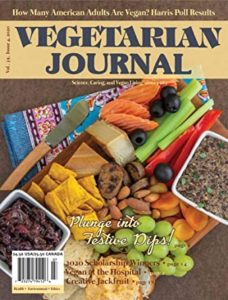
You can now read the latest issue of Vegetarian Journal on Kindle. Some of the articles in this issue
include Heavy Lifting (a wide variety of vegan sweet and savory dips, gravy,
and sauces for winter; You Don’t Know Jack (creative jackfruit recipes);
Nutrition Hotline: Vegan Food During Hospitalization; Scientific Updates;
Product Reviews; Harris Poll Results: How Many Vegans and Vegetarians in the
USA; VRG’s 2020 Scholarship Contest Winners; and More!
Posted on
November 19, 2020 by
The VRG Blog Editor
There are so many ways to prepare vegan stuffing for Thanksgiving! We
thought we’d once again share an article by Chef Nancy Berkoff that previously
ran in our Vegetarian Journal that includes recipes for
Eggplant-Tomato Stuffing, Oatmeal-Walnut Stuffing, Goodies-From-the-Garden
Stuffing, Chock-Full-of-Corn Stuffing, Fruited Bread Stuffing, Apple and Raisin
Stuffing, and Spinach and Roasted Pepper Stuffing.
Posted on
November 18, 2020 by
The VRG Blog Editor
Because the standard deduction has been raised to over $12,000 for individuals and over $24,000 for married couples filing jointly, some people may lose the advantage of deducting charitable donations, since their itemized deductions won’t exceed those amounts.
So for donors who are over 72 years old, they may want to use the charitable IRA rollover. The charitable IRA rollover is a distribution from an individual retirement account directly to a charity, such as The Vegetarian Resource Group. The distribution from the plan administrator directly to the charity counts toward the donor’s required minimum distribution for the year, but the charitable donation is not included in the donor’s adjusted gross income.
Others may use a donor-advised fund. Donor-advised funds (DAFs) are accounts where the donors can advise on where and when to distribute funds. Donors claim the charitable deduction in the year the money is transferred to the DAF even though the funds have not been given to the final specific charities. This allows donors to consolidate several years of charitable gifts into one year for their income tax returns. For example, married donors who usually give $3,000 per year to their favorite charitable organization can create a Donor-Advised fund, deposit $21,000 in it for a current year tax deduction, and then distribute $3,000 per year as annual gifts in future years. For example, here is information about a few Donor Advised Funds.
Posted on
November 18, 2020 by
The VRG Blog Editor
By
Katelynn Budzich, VRG Intern
Plant-based
eating has long been seen as a diet craze; however, recently the number of
people who are vegans and vegetarians has been continually growing; and along
with this surge, the size of the vegan food market has been increasing as well.
There are more and more plant-based food products popping up on grocery store
shelves each year. Companies selling plant-based offerings go about marketing
them to the public in various ways. In this article, I will be sharing what a
sample of vegans, vegetarians, and
non-vegetarians think about the ways Beyond Meat, Blue Diamond, Gardein,
MorningStar Farms, and Ben & Jerry’s advertise their products and how these
companies’ commercials represent veganism. All opinions are taken from a sample
of Vegetarian Resource Group interns.
“This commercial, targeted towards a non-vegan audience, does a nice job of encouraging the average American to consider eating meatless meats. I like that the commercial embodies the American culture – grilling, diners, cookout, farming – while managing to incorporate a meatless meat into that. Meat is usually a significant aspect of American culture, so it is encouraging that the commercial displays American life without genuine meat.”
“I really liked this commercial. They were painting a vision of a world that was so positive and enticing, that you just wanted to be part of it. They show all different types of people of all ages, across different environments and situations. They appealed to men barbecuing, which is a masculine activity, as well as men working out which is important to appeal to them since guys think they need to eat meat to be strong. I also liked their tagline “go beyond” since it is catchy and makes me want to contribute to a better world by buying their products.”
“Music was very inspirational and motivating – same with the voice they used. The people they showed were diverse and of all different occupations, showing that Beyond Meat is for everyone. It seemed very inclusive and tried to make it seem like everyone can eat their product!”
A vegetarian for ten years who became a vegan within the last year, “…really liked this commercial! The music was motivational and uplifting and the images were all feel-good ones that gave the viewers positive feelings about the product being advertised. I also thought that the actors helped make it more personal since they represented people in our everyday lives, like ‘Grandpa’ or ‘the team.’… The narration was also key in helping to convince the viewer that Beyond Meat are great options!
A contributor from the UK gave a nice counterargument to the other opinions, thinking the advertisement “felt very slick and professional, and they had clearly thought about how to appeal to non-vegetarians using vegetarian/vegan arguments but framing it without making them defensive (I thought the ‘what if’ framing was good for this, although a little annoyingly upbeat, same with the images and music). I thought it was a bit weird that the shot they used of being ‘friends with’ the cow was the cow just [standing] on the beach, not looking particularly happy, rather than showing the cow being visibly very happy and friends with the humans (this kind of thing). I also personally would have liked the comments about emitting less greenhouse gas and using less land and energy to include some kind of statistics (how much less gases/land/energy?).”
What vegetarians thought:
“I liked this Ad a lot… they didn’t shove it down your throat on
the ideas, which I thought was helpful to people who aren’t vegan/vegetarian”
“Ad is effective in addressing the potential concerns surrounding Beyond
Meat burgers through imagery… The two main concerns of Beyond Meat are the
health and cultural impact of meat. Showing people running and working out
shows that Beyond Meat burgers are beneficial to health. For cultural impact,
showing these Beyond Meat options – burger, hot dog, etc. at the dinner table,
at the grill, show the replaceability of meat with Beyond Meat products”
A contributor who is a lacto-ovo vegetarian (eats eggs and dairy
products, but no meat), said, “This is the commercial I liked the most because
I find it more inspiring. The music is energizing and positive, and they refer
to a lot of different consumers, represented by a different story, age, and
skin color. It is especially inspiring the last image with the two little girls
looking at the dawn. This ad really gets into me!”
What non-vegetarians
thought:
“The images shown
throughout points towards the fact that no matter what stage of life someone is
at, eating plant-based is for the young, the old, athletes, families, and
anyone in between. To me, this shows how accessible and easy to prepare the
product is… From a marketing perspective… vegetables and grains are shown to be
hand-picked and people seem to be happy while eating a Beyond Burger, which further
emphasizes how much Beyond Meat can become a staple product in one’s life.
Finally, the question, “what if,” is simple and repetitive, making it stand out
and stick in the viewer’s head. This choice is strategic as it helps to define
what the company stands for and also what they don’t stand for.”
Overall,
this commercial was well liked by vegans, vegetarians, and non-vegetarians.
Many thought the video was inclusive and painted a vision of a better world
that doesn’t consume meat. Although, what is most interesting to note is how
more than one vegan thought this commercial was geared more towards
non-vegans/vegetarians, as it appeared Beyond Meat was trying to convert
non-vegetarians into eating plant-based, instead of marketing directly to
people who are already vegans.
“The little girl introducing the almond milk sets a wholesome tone for the commercial. I think it’s nice that the commercial emphasizes the company being family-run – if a family uses this product, then it must be reliable. The family and the cute children advertising the products helps to appeal to pathos, convincing me that this product is pure and trustworthy. I also appreciate that the commercial shows the almond milk being poured into a glass, as the silky texture looks appetizing.”
“The commercial was staged as a family affair, showing that almond milk is enjoyable for everyone. I liked how it was in an orchard surrounded by beautiful blossoming trees.”
“I have actually been seeing this ad a lot on YouTube and that might be influencing my response, but I personally do not get super excited or motivated by this ad. I feel like it is not very easy to feel connected to the characters used in the ad, although there is an element of pathos from the little children being featured. The aesthetic is very calm, as is the music, which also sounded a bit generic to me.”
“Music is very happy and uplifting – almost making you think that drinking almond milk is a very fun, joyful thing to do. Family-oriented, so it makes parents want to buy it for themselves and their kids. Also gave options – milk and creamer available.”
“I didn’t really like this one; the family looked a bit creepy… and the whole thing felt very fake, I think because all the shots were from ground level with perfect lighting in the almond orchard and you couldn’t see beyond the forest, so it had a bit of a Disney-family-living-alone-in-a-magical-forest vibe. Also, not sure why they mentioned California so much – I guess if the ad only aired in CA that would make sense but off-putting to others.” This contributor also noted that from a British perspective, this commercial “would come across as abrasively cheerful/fake/arrogant/saccharine, and without enough jokes compared to the ads one would usually see on British TV.”
What vegetarians
thought:
“Cute and family-oriented. An uplifting ad.”
“Ad is effective in its appeal to family and family audiences.
Overall putting a focal point on families can make the product more appealing
because it implicitly shows that a lot of care and personalization goes into
each carton. The child adding that it is her job to test them shows that likely
no harmful products are used because they give it to their own children.”
“The little girl and the music are very sweet, but somehow
this ad does not really invite me to buy its product. I think that a
disadvantage is that they do not show people’s diversity. Besides, it makes me
think about the environmental implications of almond milk (worse than other
plant milks).”
What non-vegetarians
thought:
“I like the first question this ad asks: “where does your almond milk
come from?” As a consumer, I want to know where the product I am buying is
produced. However, overall, the ad really does not say much else about the
product. It states the almonds are sourced from a family owned farm in
California, but it does not show any of the processes and techniques used to
make the milk, leaving out what seems to me a crucial detail I would like to
know. From a marketing standpoint, it is interesting that this ad does not
mention anything about cows or cow milk; pointing out that almond milk is not
necessarily a dairy substitute, but an everyday product. Also, the kids are
primarily narrating the commercial so connecting the almond milk with a
wholesome family immediately associates the almond milk with a good, pure, and
nutritious connotation.”
Many
of the participants noted the use of a family and the ties that image has to
reliability and trustworthiness. However, three people had the opinion that the
ad was exclusive and lacked diversity.
“This commercial is targeted towards non-vegans. Therefore, the
commercial is not as convincing for me to try the product because the concept
is not as relatable. Though, I do like that the commercial takes advantage of
New Year’s resolutions to advertise because not only is it advertising a line
of meatless meats, but it is also encouraging an entirely meatless diet. Both
the idea of New Year’s resolutions and the scrolling through Instagram photos
of meat are very relatable for the average American. A criticism I have for
this commercial is that they should have shown more clips of their meatless
meats. The Instagram introduction with meat photos was unnecessarily long, and
there should have been a clip of the actual product being cooked or eaten.
Showing less real meat and more of their meatless meats would have been more
encouraging for vegans and vegetarians to try the product as well.”
“This commercial was okay, they gave close up of really gross
looking pieces of meat, which I think was supposed to deter us from it. Gardein
made their food look really appetizing in comparison. I didn’t like the music
though, it sounded like a lullaby. Also, at the end of the commercial they said
something like ‘trust me you’ll thank yourself for eating this food,’ but
didn’t say why, which I think is an important thing to include to give people
more of a reason to try it.”
“I personally am biased with this one too because I love Gardein
products, yet I was not super fond of this commercial. The images of meat
probably appeal better to a meat eater, as they mostly just made me want to
stop looking at the video. Yet, I think the idea was probably relatable for a
lot of other people. I did find the music nice, though.”
“Background music seemed almost Christmas-y and joyful, kind of
sucked you into the commercial. Made you realize how much meat you probably ate
over that year, and think about change for the next year. Nice use of social
media visuals to draw people in as everyone loves Instagram. Good videos of
food that looks yummy making people want to buy it.”
“I didn’t really get this ad at all. First, I didn’t eat any meat
at all in 2017 so I guess it wasn’t aimed at me anyway, but the tone of
the opening was very weird (“You ate a lot of meat” sounds strangely
accusatory…). I also didn’t understand if the shots of meats at the beginning
were shots of actual meat or Gardein’s alternative: given that they only seemed
to be advertising meatless meatballs and chicken tenders, probably it was
real meat. But if that’s the case, it’s very odd as the meat at the start was
presented in such a way that it looked markedly tastier and healthier than the
Gardein meatballs and chicken tenders. They also didn’t really explain why one
would eat their products instead of meat: are they supposed to be healthier?
And what does ‘meatless’ mean – are they vegan, or do they contain eggs/dairy
instead?”
What vegetarians thought:
“…No reasons [as] to why you should eat meatless… [commercial]
said, ‘you use to eat a lot of meat, try not to now,’ but why?”
“This ad was an interesting one in terms of the way it approached
promoting the product. Showing several meat dishes in a row appears to be
effective because they seem repetitive and not really appetizing when put in a
row. Followed by this, a transition to the products offered by Gardein appear
to be more aesthetically pleasing. As a result, the comparison of large, messy
meals vs. aesthetically pleasing meals makes meatless meats an enticing
product. I don’t know if this is the most effective way to approach an
advertisement, but it was somewhat effective.”
“I find this ad funny at the beginning because even if I do not
eat meat, it reminds me of the [plenty] of food I ate during winter
festivities with my family. Regarding the images of the product, I find them
tasty and inviting. Even if the ad is short, I do think it can influence me to
buy its products.”
What non-vegetarians thought:
“Referring to meatless foods, specifically the meatballs and
chicken tenders in the commercial, without any mention of them being
plant-based or having veggies in them, makes the product seem more approachable
and easier to switch to if never having gone plant-based before. The ad is
definitely geared more towards non-vegans/vegetarians. From a marketing
perspective, this ad had great timing airing it around New Years’ when people
set resolutions and want to eat healthier and make lifestyle changes. It also
paints meat as gluttonous and heavy, especially by choosing a whole turkey and
beef roast to show, which are two very large and indulgent dishes. Also, the
pictures of the meat seem very gray and unappetizing, almost looking like they
were “mistreated.” However, when it turns to Gardein’s food, the meatballs and
chicken tenders are bright and very enticing in appearance.”
This
commercial received mixed reviews. Generally, many of the opinions stated the
images of real meat dishes were unappealing and lacked any information about
what the product was. No one found this ad to be highly effective, whether they
were vegan, vegetarian, or non-vegetarian
“This quick-paced, simple commercial kept me interested. The close-ups of the nugget being broken in half and dipped in ketchup made it look very appetizing. The girl trying the product looked like she not only enjoyed the ‘meat,’ but was also having a fun time. I like that the commercial immediately showed someone eating it – very straight to the point. The editing was super fun and bubbly, making me believe this ‘meat’ would be delightful to try.”
“I didn’t like this commercial very much. Don’t have much to say here but I didn’t like the music and the whole commercial was very green which is their brand color scheme, but there wasn’t much substance to it or a reason why it was America’s favorite.”
“This commercial also seems to be targeted to meat eaters since the focus is on how their nuggets taste like chicken. I think the actress’s interactions with the product helped make the ad more exciting too. I think the music was also a fun component. If anything from this ad threw me off, it was when they dropped all the nuggets from the sky because to me it looked like they were wasting food, which gives me a negative connotation to the company (which I assume is not their goal).”
“Another very happy and cute feel-good video. Emphasizes “made from plants” so people don’t automatically think it’s super processed or junk food. Product looks like real chicken, so people will be familiar with product. Actor looks like she loves eating them.”
“I thought this was good: had a consistent cheery tone, nice colors, got to the point. If I were to change anything, I’d add another actor so that she’s eating these things with friends/family etc., and maybe change the line the actor gives (obviously everyone saw it coming that they would claim these taste like chicken, given that they are clearly modelled on chicken nuggets).”
What vegetarians thought:
“Won the hearts of plant-based eaters”
“This ad was very simple. By listing the two most blunt facts:
made from plants and tastes like chicken, the ad really simplifies the message.
A plate of meatless chicken nuggets that appear and taste just like its meat
counterpart, and a lady that appears to be enjoying the nuggets are
complementary images that add to the message in a very simple ad. I think this
is the least effective advertisement of the five, I believe the overall general
statements are not that convincing.”
“I do not find this ad so inviting. First of all, I think that it
does not really show images from the product that would make you salivate.
Secondly, I think it might be too short to be able to influence you. Thirdly, I
do not find pleasant the sudden classic music. It does surprise me, but it also
irritates me.”
What non-vegetarians thought:
“I see why MorningStar Farms would state that their product
‘tastes like chicken,’ in order to make plant-based foods seem less imitating
by comparing it to something people already consume large quantities of chicken.
However, personally, I don’t really like that comparison. Instead, I would like
to hear why it is better than eating chicken, what it is made out of and what
ingredients make it supposedly taste like chicken. As for marketing, the
commercial is simple and to the point. Also, when the Chick’n Nuggets are being
dropped from above, the music sounds almost like angels and as if they are
falling from the heavens, subconsciously putting in viewers minds how divine
this product is.”
To
sum up participants opinions on this advertisement, most did not find the
product to have been positioned as looking delicious or the slogan, “tastes
like chicken,” to be an enticing saying or good marketing approach. The
consensus appears to be that this ad was not successful in gaining any of the
three groups’ attention.
“Immediately the commercial begins by showing a variety of the ice cream flavors, which all look very tasty. The commercial’s premise is that Ben & Jerry’s listened to vegan consumers and finally created an entirely vegan ice cream line, which shows that they care about their consumers. I like that they show the woman who decided on the recipe and show her actually making the ice cream. It’s nice to see what goes into their ice cream – it seems of a high quality and convinces me to want to try it.”
“I really liked this commercial since it was relatable, modern, and it told a story! That’s what I really liked about it. It showed they’re listening to their customers; they made the ice creams look so good and enticing. I also liked how they gave a behind the scenes look into how they made it and the customer service behind it… [and] the upbeat music and narration. They didn’t just tell a story, but showed it to me as well!”
“Okay, this ad really made me want to get some Ben & Jerry’s vegan ice cream. I liked the storytelling throughout the video and I also liked how they used a real person to show the process of bringing these non-dairy ice creams to life. I thought the music helped add momentum to the story and ad as well. Additionally, the inclusion of real comments was a nice touch.”
“Commercial tells you a story, similar to one you would see while on a tour of the Ben and Jerry’s facility! So, the vibe was just simply exciting. The story pulled you in and you wanted to see the result. People in it seemed happy about the product. When they showed the ice-cream, it honestly just looked really delicious and the same as normal ice-cream looks-wise, so people would definitely be interested in purchasing it!”
“This was a solid ad. I understood what the new products were and their point, appreciated that they openly used the word ‘vegan’ while staying on brand and keeping the upbeat tone, and it was believable that the woman actually was one of their product developers. I think the music was significantly better than most ad music too, and very on brand for them with a bit of a late 60s/early 70s vibe.”
What vegetarians thought:
“Responding to requests from consumers. Putting in the effort to make
the perfect dairy-free pint. Had a flavor specialist to make the ice
cream. Everything looked appealing”
“This ad was effective in two ways. First, it shows that Ben &
Jerry’s are receptive of their consumers, and they accept feedback and care for
their feedback. Second, it has a very happy, upbeat mood throughout, which
emphasizes how good ice cream is. Further, the ad had an expert, and they
talked about how they would substitute dairy, which was convincing. Overall, I
think the advertisement also took away from the difference between dairy and
non-dairy by emphasizing the chocolate, peanut butter, and other auxiliary
ingredients that help create flavor. I enjoyed this advertisement.”
“This is my second-favorite commercial (but I think that the
reason behind it might be heavily influenced by the fact that the last weeks I
have been trying to eat less dairy and eggs, and I have had crazy cravings for
an ice cream without dairy). The ice creams’ images at the beginning are
already influencing me to stand up and run to buy them, and the moment in which
the woman is mixing the ice cream with the cookies is just so inviting to me.”
What non-vegetarians thought:
“This is a fun commercial overall. I like how actual tweets from
customers were highlighted, showing that Ben & Jerry’s is really listening
and taking feedback. The commercial does a good job at clearly stating what the
ice cream is made out of and what flavors are available. I think introducing
who created the new dairy-free ice cream is a really great marketing tactic as
it puts a kind and caring face behind the product. It also emphasizes the large
amount of time, effort, and commitment the company put into making a product
that is comparable to its beloved regular dairy ice cream. Also, the scene when
the Oreos are being folded into the ice cream looks extremely creamy and
definitely drool worthy.”
As
a whole, this advertisement seems to be a favorite among vegan, vegetarians,
and non-vegetarians. The use of real people and real feedback stood out to most
of the participants. Also, the commercial told a story and very clearly
marketed to both vegans and vegetarians, but also made sure not to leave out
attracting the viewers that do consume dairy, as many noted the ice cream looks
creamy and mouthwatering.
These
5 commercials show the disparities between effective versus ineffective
advertisements. After reading participants’ opinions, it became apparent that
some commercials fail to reach their target audience, while others hit the nail
on the head, as can be seen between MorningStar Farms and Ben & Jerry’s.
And for instance, certain ads do a good job showing a wide range of consumers,
like Beyond Meat, while others do not, like Blue Diamond. The most liked
commercial was Ben & Jerry’s, as it had no negative comments from
participants. On the other hand, discerning which commercial was liked the
least is not as clear, reminding people that overall, advertisements are a
matter of one’s own personal perspective.
Thank
you to the following individuals for contributing: Audrey Hunt, Clarissa Hauber, Daniella Eisenstadt, Julia
Stanitski, Lucia Rivera, Odette Sanchez, Rithvik Swamynathan, and Simon Brown
Katelynn
is a VRG intern and completing a college marketing major.
The Vegetarian Resource Group (VRG) is a non-profit organization dedicated to educating the public on veganism and the interrelated issues of health, nutrition, ecology, ethics, and world hunger. We have been helping health professionals, food services, businesses, educators, students, vegans, and vegetarians since 1982. In addition to publishing the Vegan Journal, VRG produces and sells a number of books.
Sign up for our newsletter to receive recipes, ingredient information, reviews of new products, announcements of new books, free samples of products, and other VRG materials.