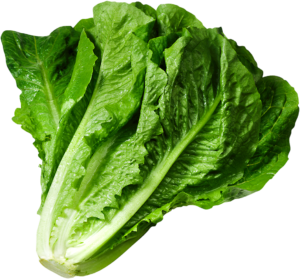
The U.S. Food and Drug Administration published the findings of an investigation into the contamination of romaine lettuce implicated in three outbreaks of E. coli O157:H7 during the Fall of 2019.
“The FDA considers adjacent or nearby land use for cattle grazing as the most likely contributing factor associated with these three outbreaks. While the agency could not confirm a definitive source or route(s) of contamination of the romaine fields, the agency considers indirect transmission of fecal material from adjacent and nearby lands from water run-off, wind, animals or vehicles to the romaine fields, or to the agricultural water sources used to grow the romaine, as possible routes of contamination.These findings, together with the findings from earlier leafy greens outbreaks, suggest that a potential contributing factor has been the proximity of cattle—a persistent source of E. coli O157:H7 …”
Each year The Vegetarian Resource Group holds a video contest. Last year’s winners were recently featured in Vegetarian Journal. You can view these winning entries here:
Vegetarian Journal often features ethnic cuisine. Here are some vegan Italian cuisine articles we previously in the magazine.
Chef Nancy Berkoff, EdD, RD wrote an article titled “Regional Italian and Sicilian Pasta Sauces” featuring tomato sauces, green sauces, a Roasted Vegetable dish, Garlic and Oil Sauce aglio e olio, and Pasta Pugliesi. See: https://www.vrg.org/journal/vj2001nov/2001_nov_pasta.php
Chef Berkoff also wrote “sicilian-Style Vegan Cuisine” featuring Soupe au Pistou (Bean Soup with Basil); Stuffed Savory Pepper Appetizer; Caponata; Panzanella (Bread Salad); Spinachi in Tegame (Spinach sautéed with garlic); Radicchio e Finocchio (Radicchio and Fennel Sautéed with Onions); Salsa Verde (Green Sauce for Vegetables); Stuffed Dates; Almond Sweet Meats; and Almond Sweet Bites. See: https://www.vrg.org/journal/vj2005issue1/2005_issue1_sicilian_style.php
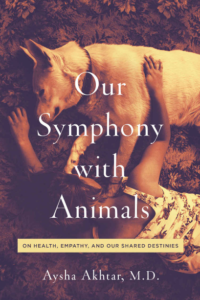
Each issue of Vegetarian Journal includes book reviews. In the most recent issue, Amy Dell reviews Our Symphony with Animals, by Aysha Akhtar, MD. Amy states, “In her collection of heart-warming and gut-wrenching stories, Dr. Akhtar draws an indisputable connection between humans and animals. The narrative format of the book provides a beautiful backdrop to the scientific- and research-based information she provides. If anyone ever doubted that animals hold a special place in our hearts, this book would call their beliefs into question.”
The second book review focuses on An Unordinary Lion, a children’s book written by Dragana Vucic Dekic. Marcy Schveibinz’s review begins with “Young readers will enjoy this rhyming tale about a ferocious lion who was pretty ordinary until the day he injures himself. He becomes unlike other lions that can run fast to catch their prey and must rely on plants for nourishment. He learns from other plant-eating animals, and realizes that he, too, can be plant-strong.”
Before 1964 Courts considered prisoners to be charges of the state with minimal rights even when their constitutional violations were at issue. Since then the Supreme Court and Congress have given, and often taken away, prisoners’ basic constitutional protections. For our purposes, these protections filter down to the issue of vegan meals for vegan prisoners with broader implications as to what constitutes religion and also what it means to be vegan.
I will start by tracing the evolution of prisoners’ rights to the free exercise of religion, then review what constitutes “religion” and finally try and discover how veganism fits into this schema. Should vegans in prison receive the same constitutional protections that members of religions are given? In the larger sense, at least as far as the right to vegan meals in prison is concerned, it comes down to whether or not veganism needs to be a formal religion to be protected under the Constitution. From there the inquiry leads to a very fundamental and almost existential question—what is a religion?
Being vegan myself, I do, of course, have my own ideas on religion and veganism. For me veganism is not a religion, nor does it need to be one to qualify for constitutional protection. It does not involve any formal rituals, it does not involve any worship services, it does not have a deity, it does not have a priesthood, it does not have any idols, no sacred texts, no holidays, no Mecca, no Jerusalem, no St Peter’s, no Buddha, no Jesus, no Moses…you get the idea. Here is a brief summary of prisoners’ rights to practice religion and how they impact vegan prisoners’ rights to vegan meals.
The Right to Practice Religion
My investigation starts by tracing the earliest articulations of prisoners’ rights to basic constitutional protections and the subsequent expansion of those rights insofar as they impact the free exercise of religion.
In 1964 the Supreme Court in Cooper v. Pate (1) held that the Bill of Rights applies to prisoners, finding that they have the right to possess religious texts.
Ten years later, in 1974, the Supreme Court in Wolff v. McDonnell (2) and Procunier v. Martinez (3), established that inmates have a First Amendment right of free speech.
In 1987 the Supreme Court, in Turner v. Safley (4), held that restrictions can be placed on inmates’ First Amendment rights if they have a “rational basis” —but the Court stressed that deference should be given to prison policies.
Also in 1987 in O’Lone v. Estate of Shabazz (5) the Supreme Court held that restrictions on inmates participating in religious services were constitutional when they conflict with prison safety policies.
In 1989 Thornburgh v. Abbott (6) the Supreme Court somewhat backtracked on prisoners’ rights holding that restrictions on publications and letters did not violate their First Amendment right to free speech.
In 1990 the Supreme Court held in Employment Division v. Smith (7) that the First Amendment does not require religious exemptions from a “neutral law of general applicability,” further backtracking on earlier decisions.
In 1993 Congress, perhaps in reaction to the watering down of prisoners’ rights by the courts, passed the Religious Freedom Restoration Act (RFRA) (8) which mandated strict scrutiny for all government actions burdening religious exercise.
In 1997 in the Boerne v. Flores (9) case the Supreme Court held that the RFRA was unconstitutional as an improper exercise of Congress’s enforcement power.
After Boerne v. Flores, the states began to pass their own versions of RFRA or to reinterpret their state guarantees of religious freedom to require strict scrutiny.
The Religious Land Use and Institutionalized Persons Act (RLUIPA)(10)
In 2000 Congress passed the RLUIPA which clearly states that prisons cannot impose substantial burdens on the religious exercise of prisoners. It defines religious exercise as any exercise of religion, whether or not compelled by, or central to, a system of religious beliefs. These two cases based on the RLUIPA, articulate a three pronged analysis:
In a decision from 2014, Haight v. Thompson (11), the Court established that a prison can restrict the religious exercise of prisoners if the restriction furthers a compelling governmental interest and does so in the least restrictive way.
In 2018 New Doe Child #1 v. Congress of the United States (12) the Court decided that when considering a plaintiff’s allegation concerning a protected religious exercise, the court must ensure that the claim is based on a sincere religious belief.
The Equal Employment Opportunity Commission (EEOC) (13)
With restrictions imposed on RLUIPA by the Courts, we can also come at the right to practice religion from the perspective of the Equal Employment Opportunity Commission, which protects against employment discrimination in the workplace, including religious discrimination. As part of that function, the Commission has had to address and determine what constitutes a religious belief to be protected. The basic statute states that religion or religious practice includes #1 beliefs that are not part of a formal church or sect, #2 non-theistic, moral or ethical beliefs as to what is right and wrong, and #3 beliefs that are “religious” in the person’s own scheme of things. This sounds promising.
BUT it goes on to say that social, political, or economic philosophies, as well as mere personal preferences, are not religious beliefs to be protected. It further states that whether or not a practice is religious is a situational, case-by-case inquiry. The same practice might in one case be subject to reasonable accommodation because an employee engages in the practice for religious reasons, and in another case might not be subject to reasonable accommodation because the practice is engaged in for secular reasons. In law school, we were taught that the Law gives with one hand and takes away with the other. This is a perfect example.
Other Cases on Religious Belief
In 1944 the Supreme Court in US v. Ballard (14) held that whether a religious belief is true or false is irrelevant, as long as the belief is sincerely held.
In the 1965 case US v. Seeger (15) the Supreme Court held that religion includes any “sincere and meaningful” belief that “occupies a place in the life of its possessor parallel to that filled by the orthodox belief in God.”
In 1970 the Supreme Court in Welsh v. US (16) held that if “an individual deeply and sincerely holds beliefs that are purely ethical or moral in source and content…those beliefs certainly occupy in the life of that individual a place parallel to that filled by God in traditionally religious persons.”
Do Vegans, Unconnected to Any Religion, Get the Same Constitutional Protections as Members of Religions?
It was not until 1964 that the Supreme Court first held that the Bill of Rights applies to prisoners. Almost 100 years after the Civil War, and, for someone born in 1957, a date not so distant. It was almost 35 years later that Congress codified the rights of prisoners to the free exercise of their religion. Push back was almost immediate, but the basic protections are still in place. Prisoners’ rights to dietary restrictions in conformity with their religious precepts have been granted, again with push back and restrictions. The fate of vegan meals being served prisoners outside of religious dictates still has not been specifically addressed by the Supreme Court.
As I see it, the strongest argument on the side of vegans is that veganism, though not a “religion,” qualifies for the protections given religions as an ethical, moral, sincere, and meaningful belief that occupies a place parallel to that filled by the orthodox belief in God. Any decision that gives veganism the same standing and protection as, say Jainism, (which by the way is non-theistic) will not only be subject to push back, it will be subject to all of the restrictions already imposed on religious practice. It will not be a panacea. As vegans, and vegetarians, we know about push back. Vegans in prison, if granted some sort of protected status, will still have to deal not just with push-back, but with surfing the sea of bureaucracy. But, as Taoist’s say, a journey of 1,000 miles starts with one step. Step away!
References
1 – Cooper v. Pate, 378 U.S. 546 (1964)
2 – Wolff v. McDonnell, 418 U.S. 539 (1974)
3 – Procunier v. Martinez, 416 US 396 (1974)
4 – Turner v. Safley, 482 U.S. 78 (1987)
5 – O’Lone v. Estate of Shabazz, 482 U.S. 342 (1987)
6 – Thornburgh v. Abbott, 490 U.S. 401 (1989)
7 – Employment Division, Department of Human Resources of Oregon v. Smith, 494 U.S.
872 (1990)
8- Religious Freedom Restoration Act https://www.law.cornell.edu/uscode/text/42/chapter-21B
9- City of Boerne v. Flores, 521 U.S. 507 (1997)
10 – The Religious Land Use and Institutionalized Persons Act https://www.justice.gov/crt/title-42-public-health-and-welfare
11 – Haight v. Thompson, 763 F.3d 554 (2014)
12 – New Doe Child #1 v. United States, No. 16-4440 (8th Cir. 2018)
13 – The Equal Employment Opportunity Commission https://www.eeoc.gov/
Emilio Gironda grew up in the beautiful Mid-Hudson Valley of New York where he practiced law for 35 years. He has come to the vegan table late in his journey of self discovery and evolution. He believes that all living beings deserve our love and compassion and that to live any other way is to fill our lives with dust.
This is not legal advice, for which you should consult your own legal professional.
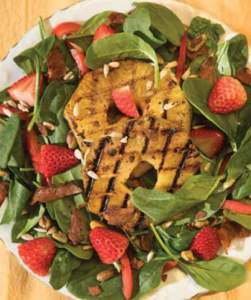
Each issue of Vegetarian Journal runs a column called Vegan Cooking Tips, by Chef Nancy Berkoff, EdD, RD. In the most recent column Nancy focuses on spinach and offers many ideas for preparing spinach-focused dishes that are quick and easy. For example, Nancy states, “Use spinach anywhere you normally use lettuce—on sandwiches, chopped in wraps or tacos, or in salads. Fresh spinach is a hearty base for entrée salads. Toss fresh spinach with finely diced pineapple, sliced strawberries, chopped pistachios, sunflower seeds or soy nuts, and nutritional yeast. Create a dressing with balsamic vinegar, pineapple juice, and touch of mustard.
“To quickly (and we mean quickly) cook spinach, spray a frying pan with vegetable oil, sprinkle in some chopped fresh or dried garlic, and get the pan hot. Toss in the spinach and flash sauté, turning constantly. This should take one or two minutes, tops.
“Use your stove-sautéed spinach as a hot or cold vegetable with your entrée, as part of a sandwich filling, to top pizza, or added to a tofu scramble. If you would like to make “creamed” spinach, whisk crumbled silken tofu or vegan sour cream into the sautéed greens, just as you are removing them from the stove. If you have leftover cooked spinach, you can purée it and add it to hummus, salad dressings, or soups.”
Look No Further! Chef Nancy Berkoff, EdD, RD has written two articles on French Vegan Cuisine in Vegetarian Journal.
The first article, “Voila! Vegan Does French,” includes the following recipes: Sauce Tomate; Salade Nicoise Tofu; Vegan Demi-glace; Marinated Vegetable Brochette; Filet Charlemagne; and Mushroom “Mille Feuille.” Read the article here: https://www.vrg.org/journal/vj98nov/1998_nov_french.php
The latest issue of Vegetarian Journal features the great work of Ana Negrón, a medical doctor. Lucia Rivera’s piece describes how Dr. Negrón educates every patient on how to adopt and sustain a whole foods vegan diet. Negrón runs a nutrition consultation firm called Practice Wellness: Beyond a Wish in Haverford, Pennsylvania. In addition, she educates resident physicians about the role of food in medicine and does community work to spread the benefits of plant-based food…Having attended medical school in Puerto Rico, where she grew up, Negrón also offers medical care in her native tongue, Spanish. “There are not that many plant-based physicians and even fewer fluent in Spanish,” she stated.
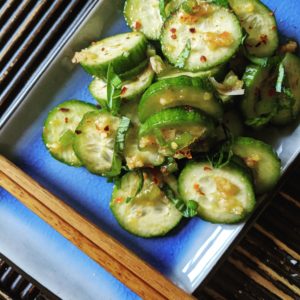
This salad celebrates the contrasting flavors of mellow, cooling cucumbers and spicy chili paste. The two balance each other beautifully in a crunchy salad perfect as a side dish on any warm afternoon, or for a light lunch. Want to bulk it up? Add some or all of the optional toppings, and make it into a meal by adding tofu, a red bell pepper, and noodles.
Asian-Inspired Cucumber Salad
(Serves 3)
3 cups cucumbers, sliced into bite-size pieces
1-3 cloves garlic, minced (to taste)
2 scallions, finely chopped
Dressing:
juice of 1 lime
1 Tablespoon rice vinegar (or white vinegar)
1 Tablespoon chili paste (or less, to taste)
1 Tablespoon low-sodium soy sauce or tamari
1 Tablespoon agave syrup
1 Tablespoon water
1 teaspoon peanut or sesame oil
Pinch red pepper flakes (optional, to taste)
Toppings: (optional)
4-5 slivered fresh basil leaves
1-2 Tablespoons chopped peanuts
1 teaspoon sesame seeds
Add all dressing ingredients to a bowl and whisk together. Add cucumbers, garlic, and scallions, and toss to coat. Top as desired and serve chilled. Even tastier the second day!
Make it a meal:
To bulk this salad up into a hearty lunch or dinner, double the dressing and use half to marinade a block of pressed, firm tofu overnight. The next day, cube the tofu and add to the cucumber salad. Also, add a sliced red bell pepper. Serve over prepared rice or cellophane noodles.
Each issue of Vegetarian Journal features a column called Veggie Bits where we review vegan products. Miyoko’s Roadhouse Cheese Spreads are cashew cheese spreads that are available in Biergarten Garlic Chive, Cheers to Cheddah, and Spicy Revolution flavors. They are perfect for any party! Next, we looked at Better Wine low-alcohol cans available in four tasty options: Dry Rosé Cider, Nitro Rosé Spritzer, Red Wine Spritzer, and White Wine Spritzer.
Daiya’s burritos are easy-to-heat. For breakfast, try Homestyle or Fiesta varieties. Savory burritos include Santa Fe, Santiago, Tex-Mex, and Tuscan. The Sante Fe burrito has a mix of saucy and spicy ingredients, including peppers, potatoes, rice, and meatless crumbles, making it one hot enchilada! Tex Mex includes beans, rice, and a variety of spices that combine for a complex, bold taste loaded with different textures.
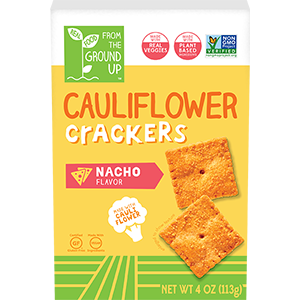
Finally, From the Ground Up’s Cauliflower Crackers are really made from cauliflower and come in cheddar, nacho, and sea salt flavors. You can also get them shaped like stars (adorable floating in tomato soup) in cheddar and pizza flavors.
The Vegetarian Resource Group (VRG) is a non-profit organization dedicated to educating the public on veganism and the interrelated issues of health, nutrition, ecology, ethics, and world hunger. We have been helping health professionals, food services, businesses, educators, students, vegans, and vegetarians since 1982. In addition to publishing the Vegan Journal, VRG produces and sells a number of books.
Sign up for our newsletter to receive recipes, ingredient information, reviews of new products, announcements of new books, free samples of products, and other VRG materials.