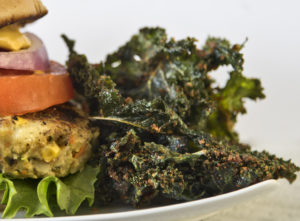
Like most people, I fell in love with store-bought kale chips. They’re crunchy, leafy, garlicky, and so good. But they’re also really pricey for a small bag or box. So, why not make your own? Kale chips are surprisingly easy to put together and once you give it a try, you’re going to want to make them all the time! This is a super anytime snack, great for lunch, TV time, or as a green leafy side for sandwiches and veggie burgers. They work best in a dehydrator, but if you don’t have one, no worries. Any oven will do the job just fine. This recipe will work with all kinds of kale, but if you crave those crisp ruffles of the store-bought kind, you’ll want to shop for curly kale.
Homemade Kale Chips (Makes 8 portions)
2 large bunches kale, washed, stemmed and shredded (about 10 cups) 1 lemon, juiced 1/4 cup olive oil or grape seed oil 1 Tablespoon low-sodium soy sauce 1 Tablespoon apple cider vinegar 2 Tablespoons smoked paprika 1 teaspoon cayenne pepper (or to taste) 1-1/2 cups nutritional yeast
Add all ingredients to a large mixing bowl and massage together by hand. When ready, the kale will be well coated and the leaves will be tender.
To use a dehydrator, arrange on dehydrator tray as desired. Big clumps make large crunchy chips or; spread out completely for small chips. Dehydrate on high for about one hour (145 degrees) and turn to low (about 105 degrees) for 10-12 hours.
To use an oven, preheat to the lowest possible heat your oven offers. Most are around 200-250 degrees. Place cookie cooling racks on baking sheets and drape kale over racks, so air circulates around them. Bake about 4 to 6 hours on lowest heat, until kale chips are crisp and crackly.
Allow to cool slightly before eating and store in air-tight container.
Cook’s Note: Save time by buying pre-washed and chopped kale in a bag.
Have you ever wondered how much and which types of foods should be eaten on a vegan diet? For example, you should consume 6-8 servings of whole grains each day. The Vegetarian Resource Group created a Vegan Food Guide. Like any food plan, this should only serve as a general guide for adults. The plan can be modified according to your own personal needs. Individuals with special health needs should consult a registered dietitian or a medical doctor knowledgeable about vegetarian nutrition.
Note: This information comes from Simply Vegan, published by The Vegetarian Resource Group. Join The Vegetarian Resource Group for 2 years and receive a free copy of Simply Vegan: https://www.vrg.org/member/2013sv.php
Warmer weather has arrived in many parts of the world and you may need a new pair of vegan sandals. Here are online shops selling a wide variety of vegan sandals from various countries:
Avesu: German company that offers world-wide shipping on sandals for women and men.
The Coronavirus pandemic has created a situation where many parents are working at home, helping their kids do school work, and at the same time cooking veggie meals. Certainly this can be overwhelming. Even so, you can prepare quick healthy dishes for your pre-school age children.
Lisa Rivero’s previous Vegetarian Journal article “Healthy Fast Food for Pre-Schoolers” offers numerous tips and suggestions, as well as recipes. Lisa offers several sauce recipes that can be used to create meals young children would enjoy:
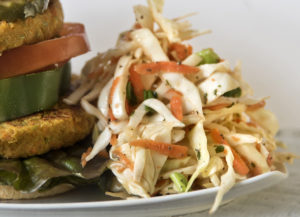
A crisp bite of fresh cole slaw takes me back to childhood picnic birthday parties and family BBQ gatherings. My mom’s cole slaw will always live on in my mind as the standard by which all others are measured. And I still love to make it just like she did, in large quantities. It’s great with sloppy joes, vegan BBQ, veggie burgers, and more. As an adult, I’ve come to see the fresh side a little differently. No longer do I make mine with calorie-heavy mayo. I keep my mom’s spices but lighteted up the recipe to an oil-free version. Oh—one more thing about cole slaw—it’s inexpensive to make! A head of fresh cabbage doesn’t cost much and goes a long way. Hope you enjoy this revamped family favorite.
No-Oil Cole Slaw (Makes 6 portions)
4 heaping cups cabbage, shredded 1 carrot, shredded 1/2 cup green onion, minced 1/4 cup apple cider vinegar 2 Tablespoons maple syrup 2 Tablespoons Dijon mustard 1 teaspoon celery seed 1 teaspoon dried parsley pinch ground white pepper
Toss all ingredients together until veggies are evenly coated. Serve chilled.
Cook’s Note: Save time by purchasing pre-chopped slaw mix with cabbage and carrots.
– Shared veggie-themed games for young kids that can be printed out and done at home
– Cooking demo video done by young vegan child posted
– Parents shared kid-friendly blog postings and vegan videos they created
https://www.facebook.com/groups/VRGparentsandkids/ is intended to be a group that offers support for families raising children on vegan diets and for vegan kids. We envision it as a place to get advice about a wide-variety of topics: pregnancy, birthday parties, school lunches, Halloween, non-leather apparel, cruelty-free products, summer camps, and more. Please use it as a place to share your wisdom, seek advice, or just find a sympathetic ear. The goal is to offer support.
Consequently, any profane, defamatory, offensive, or violent language will be removed. Feel free to disagree, but do so respectfully. Hateful or discriminatory comments regarding race, ethnicity, religion, gender, disability, sexual orientation, or political beliefs will not be tolerated. We expect that posts should relate to vegan diets and lifestyles. The Vegetarian Resource Group reserves the right to monitor all content and ban any user who posts in violation of the above rules, any law or regulation, SPAM, or anything otherwise off topic.
Please share this information with any veggie families that you know! Thanks.
The Vegetarian Resource Group received an email from a reader about Papa John’s pizza. He asked: Do the Papa John’s pizza doughs…contain any animal products? There is some confusion about their source of “whey protein concentrate”?
“Approximately 90-95% of the rennet used to curdle milk into cheese remains in the whey.”
We also told our reader that most rennet used commercially in the USA is microbial, not animal-derived. Long ago, genetic material was isolated from rennet taken from a calf’s stomach and inserted into microbial genetic material to produce “microbial rennet.” It may also be called “vegetarian rennet” on some labels.
Isolating rennet from a calf’s stomach is NOT done for each batch of “microbial” enzyme today.
There may be some “microbial rennet” made differently, where no calf gene was ever used, even at the very start of the microbial line, decades ago. In this case, ALL genetic transfer occurs between microbes.
But this method is uncommon. It’s not the way that the majority of rennet is manufactured on a commercial basis. Companies may not be willing to find out definitively which way was used if you inquired. Or, they may say “it’s proprietary.” More often than not, they’ll just say “microbial rennet” and leave it at that.
To answer the reader’s first question, The Vegetarian Resource Group turned to Papa John’s for an update. Unlike many restaurant chains, Papa John’s lists a direct link to its pizza ingredients on the bottom of its homepage:
In February 2020, we first sent in our questions through their website, and then called their customer service line. After a few inquiries, we were told:
“The 2-cheese blend, made of Parmesan and Romano cheeses, is made with animal rennet. The mozzarella cheese is made with microbial enzymes. The 3-cheese blend, consisting of Asiago, fontina and provolone cheeses, is made with animal rennet.”
We then asked about the natural flavors in the two types of pizza doughs listed on their website.
Here is an answer from their email with the subject line: “Rennet in Cheese, Animal Enzymes, Vegan Concerns.”
The majority of our products contain biosynthesized and/or vegetable-derived enzymes, including our mozzarella cheese. Our mozzarella cheese contains no animal-derived enzymes. The enzyme used is from a microbial source. However, our two- and three-cheese blends do contain animal derived enzymes. There are no animal products in our original crust, pizza sauce, or pizza cheese (other than milk).
Our pizza dough contains fungal or bacterial derivatives.
Our garlic sauce contains lactic acid, which is not classified as an animal derivative because it has been fermented.
Blue cheese and ranch [dressings] do contain animal-derived rennet.
The rennet that is used in the Papa John’s Parmesan cheese is a GMO-free microbial rennet. It is not animal-derived. It would be suitable for vegetarian consumption.”
The Vegetarian Resource Group asked if the “fungal or bacterial derivatives” in the pizza dough, since they are not listed on the website’s ingredient statement, could be the natural flavors.
We also asked about the microbial rennet in the Parmesan cheese. Since we were told the cheese blend with Parmesan had been made with animal rennet, we wanted clarification on this point. We don’t have an answer to this question yet.
Based on a careful look at the Allergen Guide, which lists all menu items, and the information from the email that Papa John’s sent to us, (see above), The VRG believes that the Parmesan cheese containing the microbial rennet is in the Parmesan cheese packet and/or the cheese dipping sauce. (NOTE: We have not received confirmation from Papa John’s on this point.)
After a closer analysis of the pizza crust ingredients listed on the Papa John’s website and the email that Papa John’s sent (see above), it appears that the natural flavors are “fungal or bacterial derivatives.” They are not specifically listed as such, but by a process of elimination, The VRG concludes that the natural flavors are most likely microbial derivatives, and, therefore, not animal-derived. (NOTE: We have not received confirmation from Papa John’s on this point.)
Papa John’s Pizza Crusts
According to the Allergen Guide on Papa John’s site, along with information from the email we received (reprinted above), as well considering what we had discovered a few years ago, it appears that:
Gluten-Free dough contains milk and egg ingredients (whey and egg whites).
The VRG encourages readers who have questions not answered here to contact Papa John’s directly.
The contents of this posting, our website, and our other publications, including Vegetarian Journal, are not intended to provide personal medical advice. Medical advice should be obtained from a qualified health professional. We often depend on product and ingredient information from company statements. It is impossible to be 100% sure about a statement, info can change, people have different views, and mistakes can be made. Please use your best judgment about whether a product is suitable for you. To be sure, do further research or confirmation on your own. Everyone does the best they can, so don’t be judgmental or critical of yourself or others.
Especially during these times, check the restaurant website or Facebook account to see if they are open or delivering. Restaurants are obviously having a very hard time, and they will greatly appreciate your support.
Perhaps you’re still stuck at home due to the Coronavirus pandemic and looking for a soothing bowl of soup. Look no further! Chef Nancy Berkoff provides recipes for a wide variety of vegetable chowders in her previous Vegetarian Journal article: https://www.vrg.org/journal/vj2000sep/2000_sep_vegetable_chowders.php
Enjoy these recipes (most are inexpensive to prepare): Southwestern Green Bean and Red Pepper Chowder, Carrot, Pear, and White Bean Chowder, Brunswick Stew à la Vegan, Marrano Chowder, Potato and Kale Chowder, and Lentil Chowder
If you live in an apartment or a house at college, you find yourself staring at the stove once in a while not knowing what to do. For me this usually happens when I get home from classes and my biological clock has me sitting on the couch waiting for the dinner my mother would otherwise have provided me. At least at my school, where only the kids in dorms have access to a food hall by way of a meal plan, these moments on the couch after class are times of contemplation between picking up my phone and spending a thousand dollars on Ubereats or spending my last moments of energy for the day by using the oven or stove-top I fear so much.
For my roommates this event is typically solved by throwing some chicken nuggets in the toaster, and if they’re feeling fancy, dipping them in Peter Luger’s steak sauce. If you’re a college student daring enough to adopt a vegan lifestyle however, you may have to get more creative. Lucky for you, I have a solution. I am a certified lazy, unhealthy college student – but I’m also vegan. And I’ve got a few quick and easy recipes for those lacking nuggets and Peter Luger’s sauce.
Recipe #1 Stir-Fry Ramen
All you need for this one is a packet of ramen noodles that is vegan. I like the Chili flavor. These packets can be easily recognized because certain companies have begun putting the “vegetarian” or “vegan” label on the package.
Simply set some water to a boil. If it’s taking too long just get the water hot enough to soften the noodles. Personally, I like my ramen al-dente for the texture.
Once the noodles are cooked to your liking, strain them and remove the water from the pot. From there all you need to do is throw the noodles into a pan with a little oil. Add a little bit of soy sauce, or even the flavor packet (although both have a lot of sodium) and fry the noodles, making sure to cover them so the steam can envelope the dish. Quickly throw in any desired vegetables (onions, spinach, etc.) or any mock-meat product you desire. Firm tofu also works very well with this dish.
Cooks in about five minutes and tastes great enough to beat most obscure stir-fry restaurants you’ve reluctantly stopped at because your one friend “knows Asian food.”
Recipe #2 Pasta with Beyond Meat Sauce
For this recipe all you need is your favorite type of pasta, although I recommend noodle forms like spaghetti or fettuccine. There are plenty of vegan, non egg-based pasta brands one can choose from. You will also need a package of Beyond Meat sausage. I prefer the Hot Italian Flavor.
Don’t be intimidated, but there is a little bit of prep required here. Simply take out a sausage or two, and gently mash them up with your hands till they become more ground. Beyond Meat sells a ground version, but it tastes nowhere near as good as the method I am recommending. Once you’ve ground the sausage, season it however you want. I like to put on cayenne pepper and paprika. At this point you should begin boiling the water for your pasta. Once the pasta is cooked to your liking, strain it and then put it back into the pot.
While the pasta is boiling you should have the crumbled sausage frying in a pan with a little oil to get it browned. After the pasta is back in the pot and the sausage is appropriately cooked, throw the sausage into the pot with the pasta. Then add some tomato sauce and other spices to your liking.
This cooks in about 7 minutes once you’re good at it and even has my meat-eating friends poking their heads in the kitchen asking what smells so amazing.
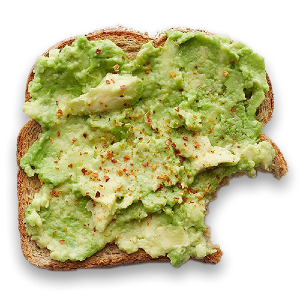
Recipe #3 Avocado Toast
Our third recipe is a classic brunch go-to and a well-known dish. Even though you may already know the dish, many vegan college students may fail to realize how easily they can pull off some of the classics that are tasty and healthy.
You simply need toast and avocado for this one. I like to make avocado toast because it’s filling and very quick.
For the toast, I recommend Tuscan Pane, an Italian bread sold at Trader Joe’s. This bread is a bit thicker, closer to a sour dough style but with great texture and easily cooks.
Either throw the toast in your toaster oven or heat on a pan with a little margarine to begin. Then take your avocado and slice it open. Next, remove the pit. Scoop out the green part of the avocado with a spoon and use a knife to make slices about half an inch thick each.
Gently lay these slices on the hot toast, then season with a little salt and pepper. This is easy to make and quick.
VRG Co-Director Debra Wasserman is author of Simply Vegan and several other cookbooks. With shopping being difficult these days, she’s been creating meals with ingredients on hand. Here’s some dishes she has prepared since limiting grocery shopping:
Potato/Kale Soup
Vegetable Soup
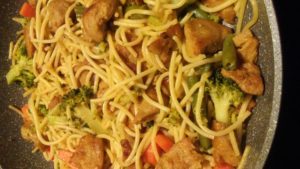
Vegetable Lo Mein with Seitan (see photo in this posting)
Potato Salad
Chickpea Burgers
Veggie Curry with Tempeh
And during Passover: Mushroom/Potato/Onion Croquettes and Fresh Tomato Soup
Please share some dishes that you’ve enjoyed recently! We’d especially like to hear about creative substitutes you’ve made for missing ingredients.
The Vegetarian Resource Group (VRG) is a non-profit organization dedicated to educating the public on veganism and the interrelated issues of health, nutrition, ecology, ethics, and world hunger. We have been helping health professionals, food services, businesses, educators, students, vegans, and vegetarians since 1982. In addition to publishing the Vegan Journal, VRG produces and sells a number of books.
Sign up for our newsletter to receive recipes, ingredient information, reviews of new products, announcements of new books, free samples of products, and other VRG materials.