The Vegetarian Resource Group Blog

Creative Way to Show Non-Vegans What Vegans Can Eat

Posted on May 02, 2019 by The VRG Blog Editor

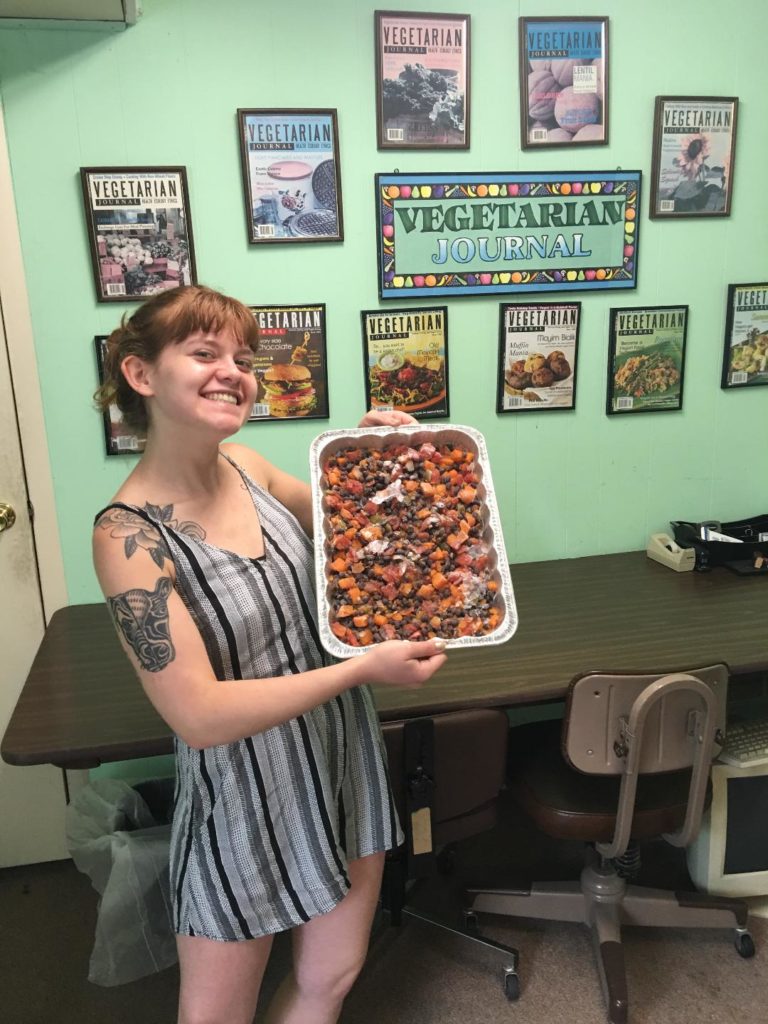
The Vegetarian Resource Group does vegan outreach year-round. On several occasions we’ve set up a display similar to the one shown in the photo above. This is especially useful when teaching non-vegetarians about vegan diets. Of course, we encourage individuals to eat mostly fresh produce, beans, grains, etc. However, the fact is that today many people use convenience foods and we want to show them vegan products that are available in supermarkets today. If you show them how easy it is to go vegan, they just may give it a try!

Evergreen Fest at Loyola University of Maryland

Posted on May 01, 2019 by The VRG Blog Editor

By Taylor Gale, VRG Intern

Every year, Loyola holds an Evergreen Fest to celebrate environmentalism and sustainability. A few Loyola clubs, including surrounding environmentally conscious organizations are provided a table to showcase their product or serve as a platform to educate others about the environment. This past Friday I had the opportunity to represent The Vegetarian Resource Group at one of the tables for Evergreen Fest. The festival went from 12-3pm, but with a cast of rain I only stayed until 2pm. The Environmental Action Club at Loyola hosts Evergreen Fest every year. This year they offered vegan pizza for free as well as a smoothie bike!! Students were able to bike to create their own delicious and nutritious smoothie, while being environmentally conscious by skipping using electricity. Various tables offered products, such as succulents, vegan cookie decorating, face scrubs, raffle prizes and many more!

Students kept coming up to the VRG table asking questions about vegetarianism and what VRG offers. I really enjoyed my time because I was able to discuss the detrimental environmental costs of the meat industry, explain how to cook a meat-free diet, and hand out journals to any students and faculty that passed by. The best part of it all was being able to hold conversations with others about how to go vegan or sustain the lifestyle. At one point, a prospective student and her mother came to the VRG table and told us about their tribulations with being a teen and vegan. Luckily, VRG provides support and journals for teens’ frequently asked questions— https://www.vrg.org/teen/ —so I was able to provide them with guidance and essential information. Overall, the event went very smoothly, that is, before the rain came pouring down. Although, the timing was short, I was able to reach out to many students and faculty about making healthier and more sustainable options for what goes on their plate!

For information about VRG internships, see https://www.vrg.org/student/index.php

To support Vegetarian Resource Group outreach, donate at www.vrg.org/donate
Share Vegan in Volume with Local Restaurants, Campus Dining Services, Senior Housing Settings, Hospitals, etc.

Posted on May 01, 2019 by The VRG Blog Editor

Vegan in Volume is published by The Vegetarian Resource Group and has been greatly received by people working in the food service sector, as well as those that enjoy throwing parties in their own home or simply cooking in volume. This book by Chef Nancy Berkoff, EdD, RD offers 125 vegan recipes serving 25. It also offers a lot of helpful advice including A Fast Course in Vegan Nutrition, The Mechanics of the Operation, Food Safety Pointers, and a section on Vegan Ingredients.

The quantity recipes greatly vary depending on the audience you’ll be serving. Nancy includes recipes for breakfast such as Lots of Grains Pancakes and Peachy Keen Breakfast Crumble. A section for kids serves up Squiggly Noodles and “Not-Meatballs.” For dinner parties and elegant dining for adults try French Onion and Olive Tart and Eggplant “Caviar.”

You will also find quantity recipes for special occasions such as weddings, anniversaries, birthdays, bar/bat mitzvahs, communions, and more. Enjoy Watermelon Gazpacho, Spicy Bean Cakes with Fruit Salsa, Curried Vegetables with Polenta, and Sophisticated Poached Pears. Next, move on to college campuses and try Vegetable Tagine, Two Alarm Four Bean Chili, Jumpin’ Veggie Jambalaya, and Gooey, Chewy Peanut Butter Bars.

Grab and Go Fast Food recipes include Sweet Potato Burgers, Cold Noodles with Peanut Sauce, and Fragrant and Fast Tofu Sandwich. Un-Hospital Food items include Orange and Wild Rice Salad, Sweet Potato Soup, New England Baked Beans, Eggplant Lasagna, and Cinnamony Baked Apples. And a section for senior citizens includes recipes for Chesapeake Corn Chowder, Southwest Tomato Rice, Pasta with Vegetable-Marinara Sauce, and Homestyle Molasses Cookies.

Vegan in Volume can be purchased (USA only) from The Vegetarian Resource Group Book Catalog: http://www.vrg.org/catalog/

BLAZE PIZZA CARRIES VEGAN CHORIZO

Posted on April 30, 2019 by The VRG Blog Editor

According to the Blaze Pizza website, they carry vegan chorizo. Ingredients are: Water, Soy Protein Concentrate, Corn Oil, Onions, Spices, Garlic (garlic, water), Paprika. Contains 2% or less of Sea Salt, Soy Protein Isolate, Cooked Onion and Carrot Juice Concentrate, Garlic, Onion Powder, Apple Cider

They also offer vegan cheese containing: Filtered Water, Tapioca Flour, non-GMO Expeller Pressed Canola and or non-GMO Expeller Pressed Safflower Oil, Coconut Oil, Pea Protein, Salt, Vegan Natural Flavors, Inactive Yeast, Vegetable Glycerin, Xanthan Gum

Their classic dough contains: Extra Virgin Olive Oil, Flour (Wheat Flour, Malted Barley Flour), Flour Mix (Durum Semolina, Sugar, Salt, Spice), Yeast, Water

For more information, see: https://blazepizza.com/menu/

SUPPORT THE VEGETARIAN RESOURCE GROUP THROUGH AMAZON SMILE

Posted on April 30, 2019 by The VRG Blog Editor

Please book mark and use this link. Eligible shopping will support our vegan education and activism. http://smile.amazon.com/ch/52-1279034

About Amazon Smile: https://smile.amazon.com/gp/chpf/about/ref=smi_se_rspo_laas_aas

QDOBA Mexican Eats® Adding Impossible™ to Restaurants Nationwide by May 28, 2019

Posted on April 29, 2019 by The VRG Blog Editor

QDOBA Mexican Eats® is adding the Impossible beef like product to its restaurants’ menus across the U.S. Following a product test in Michigan, the brand is broadening its offering of the Impossible product with rolling availability that began April 23 at select restaurants in Brooklyn, Denver, and Los Angeles. By May 28, Impossible will be available at more than 730 locations across the country.

MADGE DARNEILLE

Posted on April 29, 2019 by The VRG Blog Editor

The following is a note from the Vegetarian Society of DC. Madge Darneille was also a Vegetarian Resource Group life member. 

VSDC is saddened by the loss of Madge Darneille who died on April 5, 2019, just shy of her 99th birthday. A vegetarian since the age of four, Madge has been called the First Lady of Vegetarianism in North America and served off-and-on as president of VSDC for 22 years, most recently in 1996. VSDC history has been referred to as “before Madge” and “after Madge.”

She was also a founder and board member of the North American Vegetarian Society (NAVS) and the Vegetarian Union of North America (VUNA), and Assistant Secretary of the International Vegetarian Union (IVU). She co-founded World Vegetarian Day in the 1970s.

We are grateful to Madge for her many years of pioneering leadership and inspiration, and we send our deepest sympathy to her family and friends.

Vegan Restaurants Added to The Vegetarian Resource Group’s Guide to Veggie Restaurants in the USA and Canada

Posted on April 26, 2019 by The VRG Blog Editor
VTrap Kitchen photo

The Vegetarian Resource Group maintains an online Guide to Vegan/Vegetarian Restaurants in the USA and Canada. Below are some recent additions. The entire guide can be found here: http://www.vrg.org/restaurant/index.php

To support the updating of this online restaurant guide, please donate at: www.vrg.org/donate

Here are some new additions to VRG’s guide:

Broadfork Café

4757 12th Ave. NE

Seattle, WA 98105

and

111 Queen Anne Ave. N. #102

Seattle, WA 98109

The menus vary dependent upon which location you go to, but for the most part they are very similar. They have residence in Lower Queen Anne/Uptown and University District Menu. They offer a bunch of items that are tasty but healthy at the same. Some options include, cashew curry bowl, yam and kale bowl, ginger tempeh tacos, and macrobiotic bowl. The décor is filled with an abundance of plants, setting up a peaceful and earthy environment.

Celeste Café

1100 N. 115th St.

Seattle, WA 98133

Celeste Café serves gluten free, soy free dishes that are all-vegan! Try their tacos or cashew quiche, or ask about the daily special!

Green Love Kitchen

6989 Main St.

Lithonia, GA 30058

Green Love Kitchen is a farm-to-table restaurant experience with the popular café partnering with local farmers to bring in fresh fruits and vegetables. The idea for the restaurant was born out of a lack of access to fresh food and vegan options in Lithonia. Their menu is full of delicious wraps, sandwiches, salads, and juices. Their Thai Kale Wrap even won an award!

Mama Rosa’s Kitchen

69 Chenango St.

Buffalo, NY 14213

Mama Rosa’s Kitchen is an all-vegan bakery and caterer. Call ahead for special orders. They ship all across the US and Canada.

NoW Sushi

3852 Mission Blvd.

San Diego, CA 92109

It’s not just kappa maki and avocado rolls, though both are available. Beyond the basics, NoW also has a variety of specialty rolls with ingredients such as vegan cream cheese, sweet potato tempura, vegan tuna, vegan crab, and more!

Rawnaissance Desserts

1759 Bardstown Rd.

Louisville, KY 40205

Rawnaissance Desserts is raw dessert shop and cafe, where you can get an espresso or a fresh squeezed orange juice, along with any number of raw desserts, from cake by the slice, to truffles and pies.

RÜT

901 W. 14th Ave.

Spokane, WA 99204

RÜT is an all-vegan gastropub, featuring a full bar, and a variety of upscale comfort food and unique flavors, including a jalapeño mushroom Impossible burger, truffle mac, and white bean queso dip. Whether you’re looking for a small bite or a full meal they should satisfy. Gluten-free options are available too.

Three Girls Vegan Creamery

645 Boston Post Rd.

Guilford, CT 06437

Three Girls Vegan Creamery services vegan catering and wholesale products, including artisanal vegan cheeses, meat substitutes, and desserts. Their menu changes weekly; however, sample items include lasagna, mac n cheese, eggplant parmesan, scalloped potatoes au gratin, and calzones.

V-Trap Kitchen & Lounge

607 N. Lincoln St.

Wilmington, DE 19805

V-Trap Kitchen & Lounge takes a holistic approach to serving delicious and healthy vegan food by exploring multiple cultures and cuisines, including American, Mexican, and Indian. They also have many gluten-free options. Join them for a variety of special events including live music, poetry, cooking classes, and more!

Verdura

5555 N. 7th St. #108

Phoenix, AZ 85014

Verdura’s diverse menu features savory dishes such as the anarchy burger, avocado mofongo, and the carne asada nachos.

MY EXPERIENCE AS A PRESIDENT AND FOUNDER OF A VEGAN CLUB

Posted on April 26, 2019 by The VRG Blog Editor

By Déborah Dauly

This article will describe my experience with creating a vegan club as an engineering student in France.

The idea of this club came because I wanted to participate in more actions to promote animal rights. At that time, I was vegan for seven years and veganism became my way of life, just that. I did not have the feeling of fighting for animals. This is when I thought I had to join an association! The problem was that my courses were quite difficult and I did not have lots of time to spare. I was so looking for an association near my school to not waste time in commuting. And then I heard about Sentience: a national association of activists for animal rights. Sentience is a national student association fighting for a better world for animals. If you are interested, you can find their website in English here: https://asso-sentience.net/?lang=en. The idea came here: Why wouldn’t I create Sentience in Toulouse, the city where I am studying?

I had two possibilities: Create an association (like Sentience ) or create a club. The difference is that the club belongs to an association: there is less freedom but it is easier to manage. As veganism still suffers from a bad image in France, we took the decision to create a club attached to the student association of our college. In France, to create a club, you should have at least two people: a president and a treasurer. I was lucky, as two of my friends were enthusiastic with this idea and so, after some papers signed, the club was created. With the agreement of Sentience organizers, we called our club Sen’tience and I became the president. The advantages of being a club is that it is easier to become known at the college (because we are attached to the student association of the school). Moreover, we can ask for school grants or financial support to organize events or activities

As the association Sentience says, “Animals are sentient beings: They feel emotions, are conscious of the world in which they live, and are capable of subjective and abstract thought processes.” The name itself delivers a message: animals do feel emotions. After choosing the name of Sen’tience, we had to create a logo which represents the club. The secretary drew it with our ideas combined: the logo represents three animals living in different environments. It characterizes one who lives in water, another on the ground, and the last one in the air. The idea is that whoever they are, wherever they live,  animals should be treated equally and have the same right. It is a message against speciesism. 

In France it is easier and easier to be vegan (vegan products and restaurants are much more present than before). Despite this, there is still a long way to go before everyone accepts veganism and I do not talk about changing their consumption. Some people have difficulty considering that a person could be vegan. That is why the main goal of the club is to show a positive image of veganism. Another objective of the club is to demonstrate that alternatives to animal exploitation exist!

  • Sale of Vegan food (especially cakes)
    This activity permits people who do not have the chance to try vegan pastries to do it. In my college, food selling is something that needs an administration approval, but which is quite quick and easy to organize. We do it during class breaks and it always attract lots of people. It is a great activity to start with because it permits vegan food to become known and to demonstrate that vegan cakes can be as good as any cakes. Students and even teachers can take this moment to ask us about the ingredients. A question that often comes is: how do you replace eggs? This is why, every time we sell pastries, we come with a binder filled with several sheets: how you can replace egg, milk, meat… We have also lots of questions about the nutrition: where protein and iron can be found in a plant-based food diet. It is important that everyone who participates in the selling in the club has some knowledge about veganism and responses to questions that are often asked. All food selling is always prepared by members of the club. One time, we had the chance to sell unsold cakes from a vegan restaurant. Do not hesitate to contact vegan companies close to your university: they are often happy to see these kinds of initiatives and may help you!
  • Quiz
    This is an efficient tool according to the students. The principle is simple. We asked students a few questions linked to veganism. Subjects can be animal’s condition, environmental issues, health, ethics in the world, etc. If they have a majority of good answers, they can have a free slice of cake. If they have too many wrong answers, they can take another quiz. We had really good feedback about this: student were highly surprised about some answers (mostly about animal’s terrible conditions). Some of them, after successfully respond to one quiz, asked to do another one just to learn more about the subject.
  • Debate
    To encourage dialogue, we also organized debates. The past year, we had the chance to have a philosophy club and we organized a debate with them. The subject was the following: Do animals have a conscience? Is it ethical to consume products from animals? We were actually surprised about how open minded the students were! Some members of the philosophy club had more knowledge about animals than Sen’tience’s members. Most of them thought that consumption of animal-based products were needed for our health. It permits us to tell them that the only supplementation we need is B12 but that all other nutrients can be found in plant-based food! Finally, it was a great experience for both clubs. This debate lasted three hours. I personally experienced my first success with the club during this debate. After debating, a guy told me that before, he was totally against vegetarian and vegan people, but now, he listened to our point of view and understood better. He did not become vegetarian, but at least he now has a better vision of them and he said he would reduce his meat consumption.

When you talk with people, never forget that veganism has multiple advantages! Unfortunately, some people do not care about animals (sad but true), you have to talk about another subject to touch him or her: environment, health… Finally, never seem aggressive, stay smiling and patient, otherwise they will think that you are just an extremist (this advice is important in France) but anyway, I think that keeping a positive attitude is a good thing in every country. 

  • Participation in organized events
    We have been invited to participate in some events. The first one which comes to my mind is the “village for environment” organized by another university in Toulouse. We had a stand there and we chose to propose a quiz with free cakes. We were invited to participate in the Vegan Place organized by the association L214. Unfortunately, we could not respond favorably to this invitation. As a club (and not an association) we depend on the association of our college. This one has strict rules and one of them is that clubs cannot have a link to any groups which can be politically engaged. That explained why we could not participate in this event. Nevertheless, we attended the event as visitors. Once a year, we participate in the Day Club, a day where all clubs have a stand on the campus. It was actually our first event. We simply did the same as we did for the “village for environment.” These kind of events are a great opportunity to recruit! For the first time at my college, a three-day festival for sustainable development is organized and we were invited by the student association.
  • Lecture We had the chance to welcome two lecturers in our school (one per year). I have found the first lecturer by contacting a scientist who did a lecture in another city in France. So, in April 2018, Andre Menache came to give a talk called: How can we replace animals in laboratory? It was really interesting and a hundred people attended the conference. He is a scientist who works with the association Antidote Europe. After this, we proposed vegan food handmade by members of the club. At that time, the club had existed for four months only and we were eight members. The second lecture was organized in March 2019. I found Isabelle Richaud by contacting “l’association végétarienne de France” (the France vegetarian Association). “Modifying our plate to save the planet” was the title of her presentation. It was an alarming and interesting one which related the link between farms and environmental issues.
  • Discovery of Toulouse vegan restaurant and shop
    We are lucky to have a good vegan diversity in Toulouse. In fact, there are several vegan restaurants in the center and there is also a vegan shop. Sometimes, we go out to restaurants. All vegan-friendly restaurants can be found thanks to the application Happy Cow. The one I prefer is Veggie Corner! When the weather allows us, we also organize some picnics on the campus. We visited the Toulouse vegan place where we could have talked to many associates; it was really instructive for every one of us.

To finish, I will say that if you want to take action on your campus, first check if a club like this already exists or not. If not, remember that you can create it! And then, trust your imagination. I have listed a few ideas but you can do so much more. Be confident and do what seem right to you! For other ideas about organizing groups, see https://www.vrg.org/teen/#activism

How to Add More Vegan Foods to your College Cafeteria

Posted on April 25, 2019 by The VRG Blog Editor

By Taylor Gale

Being vegan in college can be tricky, especially if your dining halls do not have vegan options readily available. If there are no veg-friendly options, make your own! That is exactly what I did during my sophomore year at Loyola University of Maryland. I went into college as a vegetarian, but wanted to become vegan. The only problem was that the dining halls offered almost nothing for students who were vegetarian and forget about it if you were vegan! So, I decided to get involved in Student Government Association with the goal in mind of transforming the dining halls. The following year I was elected as Director of Student Affairs, which yep you guessed it, made me in charge of Loyola’s dining halls. The following steps are ways of how to add more vegan foods to your college cafeteria.

Firstly, do your research and find out exactly what vegetarian and vegan dishes, if any, they serve. Typically, college cafeterias have their menus online. Check what days any veggie options are available and what the ingredients are in these dishes. If they serve a decent amount of vegetarian options, you can suggest to veganize the dishes, which can easily be done in most cases. If you cannot find out enough information online or in person, ask to set up a meeting with the dining hall staff. Most times, they are happy to hear students out to learn about their needs and what can be changed within the cafeteria to make the students’ experience better. When you have a meeting with the dining hall staff, go in fully prepared with recipe ideas. You may have a proposal of converting one of the food stations to offer fully vegetarian and vegan items. Lay out what veg options they offer currently to show how much expansion could occur. Be creative when you create recipe ideas!

I cannot stress enough—be empathetic to the food service employees. Oftentimes, graduate students are the ones in charge of managing college dining halls, which means they may not have the knowledge that you as a vegetarian/vegan have. It is very hard to make visible changes within the food sectors and certain decisions may be out of the hands of whom you are meeting with, so remember to be patient and compassionate, always! Treat the staff as you would like to be treated. You can start easy by giving suggestions of how to create a veg-friendly dining experience, such as having the option of Meatless Mondays. If your small suggestions are being received well, later on you can present the idea of converting a whole station, but this is a big request, so work towards it.

A great starting point is to ramp up the salad bar. Firstly, the types of greens offered is important. If they do not have a variety of greens, I suggest asking them to incorporate kale, spinach, arugula, and mixed greens. If your salad does not offer any types of beans, firstly that is just tragic. In a nice way request the dining staff to incorporate various beans! I typically suggest to carry black beans, garbanzo beans, and edamame consistently, as well as offering a bean salad. You can advocate to incorporate the following ingredients: corn, sesame seeds, sunflower seeds, bell peppers (red and green), avocado, hummus, pasta salad that has a vinaigrette base, sautéed mushrooms, tofu or vegan chick’n, carrots, seaweed salad, tomatoes, cucumbers, red onion, red cabbage, quinoa, roasted squash and sweet potatoes, wild rice, dried fruit, and assortment of nuts—i.e., walnuts, silvered almonds and cashews, etc. For dressings, give them various options. You could propose getting a vegan sweet Thai chili vinaigrette, balsamic, zesty Italian, oil & vinegar, tahini, olive oil, lemon and lime juice, and spicy cashew dressing. Now some of these items will not be a viable option, depending on your dining hall’s space. These are just suggestions to make to the dining hall staff! With these options, having a salad everyday will not become so monotonous.

The sandwich bar line is another great place to start to incorporate more veg options. Similar to the salad suggestions you can recommend: carrots, assorted cooked vegetables, avocado, tomatoes, cucumbers, alfalfa sprouts, hummus, pickles, onions, lettuce, sweet potatoes, olives, peppers, etc.

Loyola utilizes Parkhurst dining’s food services. Parkhurst partners with local farmer’s markets, and offers brands, such as Gardein and Just Mayo to bring tasty foods to campus. You need to find out what foods your school’s distributors carry. If they do not carry the foods that you like, see if they can incorporate other items. You can go directly to the company and see if they are willing to bring their food items into the dining halls, but this may get complicated due to partnership clauses, higher pricing, etc., so I highly recommend asking the dining staff what types of foods are available to you and if those items can expand to other choices, specifically veg-friendly brands of vegan meat. This way you can have vegan chick’n to add some protein and a punch of flavor into your sandwich or wrap. You might be able to get the best brand names, wohooo, fingers crossed!  Do not be surprised if you cannot get them all incorporated into the cafeteria. It never hurts to ask though! You can also suggest to get vegan mayo. Just Mayo and Fabanaise are vegan mayo options I like.

Remember complex carbs are your friends. Eating various grains and starches, such as sweet potatoes and brown rice are perfect for retaining a healthy vegan diet. It is so effortless to incorporate these types of foods as sides or entrées within the dining halls! Just make sure to explain to them that there cannot be any dairy, specifically milk or cheese, honey, eggs, or any other animal product within these dishes.

For protein options, you can suggest offering veggie burgers, which can be made in so many different and simple ways! Steamed veggies, quinoa, tofu, tempeh, seitan, and any beans, nuts, or seeds are great sources of protein for vegans. Let the dining staff know this so that they are able to provide a protein sufficient meal for every vegan and nonvegan on campus.

Nowadays, dining halls have become increasingly veg-friendly—e.g., offering dairy substitutes such as, soy or almond milk. If your school does not offer this, make sure to bring it to their attention, so that you can have cereals and non-dairy substitutes in your coffee.

If your dining hall does not have a fruit stand, stop whatever you are doing and ensure that they get one! The classics should always be available to students—i.e., apples, bananas, and oranges. I would recommend setting up partnerships with local vendors and farmer markets so that the dining halls can buy fruits and vegetables that are in season. This is a great way to support the local community as well as promote a more sustainable and environmentally friendly diet.

In Loyola University of Maryland’s dining halls, where I currently attend, there is a bagel and bread section with an assortment of spreads. This is a quick and easy option for students on the go. Ask them what vegan breads and bagels are currently available. If none, advocate for bringing some in. For spreads, you can ask to have peanut butter, vegan jams and jellies, and maybe even vegan butter and cream cheeses, but again this will depend on your school’s budgeting and ability to partner with name brands.

Oftentimes, people assume that vegans do not have sweets, which is so false. Nowadays, there are so many dessert options for vegans.An easy place to start would be at the ice cream station, assuming that there is one. Sorbet is typically vegan, but check and make sure what flavors are vegan before you recommend any. Store brand names, such as Ben & Jerry’s and Luna & Larry’s Coconut Bliss, offer nondairy ice cream. See if this is a viable option for your cafeteria.

Remember that changing the dining halls is a long process. Be patient and calm when conversing with the staff. It is also important to not be timid. Be concise with your words and go into those meetings with an outlined plan of what you would like to say and get accomplished. Be confident, professional, and kind. This is the key to getting what you want across to the staff.

Yes, the staff may turn down most or some of your veg ideas/options, but any step in the right direction makes a world of a difference in the long run. You are not only making the dining halls better for yourself, but you are helping out other vegan and vegetarian current and incoming students!

From my experience, the payoff is well worth conducting research and multiple meetings! I am now a senior at Loyola and was able to comfortably convert to being vegan once I became in charge of the dining halls during my sophomore year. I had countless meetings with the managers, students, faculty, and the rest of the dining staff to figure out what Loyola’s community wanted to eat on a daily basis. It took a lot of convincing to bring vegan meats and other vegan substitutes to campus. At first, the staff looked at me funny and laughed in my face, because they simply had no clue what veganism meant. It was such a foreign concept to most of the individuals I met with, but I remained persistent, calm, educated the staff on what a vegan diet entails, and backed up the need for veg options by showing them how many students did not eat meat on campus. Although Loyola is not vegan heaven, the staff have made many efforts to help accommodate veg and nonveg students.

For recipe ideas, check out our recipe guides at: https://www.vrg.org/links/Recipes.htm

and https://www.vrg.org/fsupdate/index.htm

To learn more about ideas for college food service, see https://www.vrg.org/teen/#college

  • Donate

  • Subscribe to the blog by RSS

  • VRG-NEWS

    Sign up for our newsletter to receive recipes, ingredient information, reviews of new products, announcements of new books, free samples of products, and other VRG materials.

    Your E-mail address:
    Your Name (optional):


↑ Top