The Vegetarian Resource Group Blog

Vegan Restaurants Added to The Vegetarian Resource Group’s Guide to Veggie Restaurants in the USA and Canada
Posted on August 11, 2025 by The VRG Blog Editor

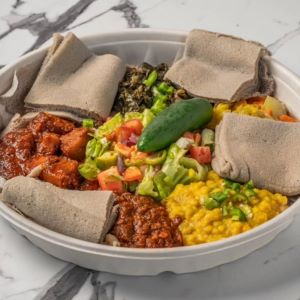
photo from EthioVegan

The Vegetarian Resource Group maintains an online Guide to Vegan/Vegetarian Restaurants in the USA and Canada. Here are some recent vegan restaurant additions. The entire guide can be found here: www.vrg.org/restaurant

To support the updating of this online restaurant guide, please donate at: www.vrg.org/donate

Here are some new additions to VRG’s guide:

Al-Andalus, E. 5th St., New York, NY 10009

The founding Chef draws on her Egyptian heritage to blend past and present cultures. For bread lovers, one possibility is Barbari, Persian flat bread with Toum, a creamy, boldly garlic sauce and Chermoula, a complex blend of fresh herbs and spices. A couple of the many Tostadas are Caramelized Peppers with Romesco (a sauce of roasted peppers and tomatoes blended with almonds and other items), espuma (whipped foam), and bay leaf oil, as well as Ajo Blanco (white Gazpacho,) with grape and celery. They offer a few Salatas such as Tomato Salad featuring, sumac dressing, vegan feta, oregano, and shallots. Here are a couple of Traditionals: Fava Falafel with tahini, herb salad, and preserved lemon and Papas Bravas (potatoes in a spicy, smoky, slightly tangy tomato based sauce). They have a couple of Olive presentations—one is fried, served with a vegan yogurt sauce, paprika oil, and fried parsley. They offer several grilled dishes such as Roasted Eggplant with tahini, pomegranates, and mint, or Confit Leeks with dukkah, (a blend of crushed toasted nuts, seeds, herbs, and spices), date vinaigrette, and dill fronds. For sharing there’s a Paella of smoked sofrito, vegetables and saffron broth. Here’s a peek at some of their Sweets try Turkish espresso featuring hawayej, (often a blend of ginger, cardamom, cinnamon, cloves, and nutmeg) with vanilla ice cream and pistachio, Rice Pudding with burnt cinnamon nut crunch and caramel, as well as Blood Orange sorbet with pomegranate and lime.

Ethio Vegan, 1362 H St., NE, Washington, DC 20002

Ethio Vegan is an Ethiopian restaurant offering vegan takes on traditional Ethiopian cuisine. The menu includes dishes like Doro Wot, beef tibs, shiro, collard greens, and “meat” and vegetable platters, highlighting authentic Ethiopian flavors. There’s also a kids’ menu with sliders, wings, and fries.

Nyla’s Petite Bakery, 405 W. 145th St., New York, NY 10031

Nyla’s Petite Bakery is a youth-run, 100% vegan mini bakery based in Harlem. Nyla Reese started the bakery at just age 13 as a passion project, and it’s grown so much since then. They offer a rotating menu of vegan miniature donuts with flavors like piña colada, cookies ’n’ cream, gluten-free maple cinnamon sugar, strawberry kisses, and limited-edition banana pudding. They also sell hibiscus iced tea. You can preorder boxes Monday-Thursday for weekend pickups.

Reverie, 135 Metropolitan Ave., Brooklyn, NY 11249

Reverie is a beautiful upscale restaurant and cocktail bar where the food is practically art. Especially known for their desserts, Reverie manages to create imaginative flavors and delightful plating with enticing desserts such as the Yuzu Cheesecake which features a coconut crust and vanilla Chantilly. They offer a wide variety of foods, all bursting with flavor. The vegan Lamb Tagine, Pulled Pastrami Sliders, and Citrus Salad are favorites among customers.

Tarrytown Bar & Bistro, 3110 Windsor Rd., Austin, TX 78703

With big screens showcasing live sports, Tarrytown Bar & Bistro aims to welcome guests in an upbeat atmosphere. Café Breakfast includes croissants, vegan donuts, pumpkin loaf, vegan bars, and more. For Starters/ Bar Menu, Texas Poppers and Garlic Eggplant are particularly popular. They serve salads and subs such as Grilled Vegetable Sub, Oyster Mushroom Po Boy, Panini, and others. Burgers include Portobello Mushroom Burgers, Black Bean and Classic Veggie. Some Entrées are Pasta Primavera, Stuffed Squash, Hill Country Vegan Chicken, and more. For Dessert there’s Nutella Chocolate Empanada, Italian Olive Oil Cake, Southern Decadent Chocolate Cake, and Vegan Cheesecake.

Veg’d Out, 119 Pelham Rd., New Rochelle, NY 10805

Veg’d Out aims to create flavorful, vegan dishes that diners enjoy whether they’re vegan or not. Miss Tuna? Join the Toonah Club featuring mashed chickpeas, lettuce, and tomato with or without melted cheeze. Pulled Jack celebrates BBQ Jackfruit with coleslaw and pickles. Many of the dishes are Shroom based such as Buffalo Mac’ n Shroom Mac and Cheeze with buffalo and ranch sauce. There’s also fried Cauli or Shroom Bitez with Buffalo, Lemon Pepper or BBQ and a few varieties of Fries. Beverages include various Culture Pop Soda Flavors and more. And let’s not forget, freshly baked, in house Chocolate Chip Cookies.

Zizi’s Vegan Food Truck, 1121 Beatties Ford Rd., Charlotte, NC 28216

Zizi’s Vegan Food Truck offers fantastic comfort food, pulling from a variety of cuisines. Their most popular dishes include the Chicken Cheesesteak, Tacos, and Bacon Egg & Cheese Sandwich. Packed with flavor, many of these dishes are essentially replicas of their meat counterparts. In addition, the staff is extremely friendly and happy to help you pick out the dish that’s right for you.
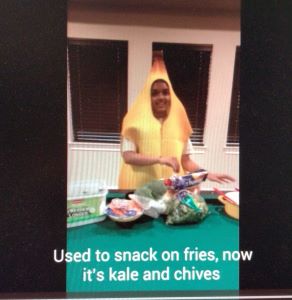
VANI PATEL FROM TEXAS IS A WINNER OF THE VEGETARIAN RESOURCE GROUP 2025 VIDEO CONTEST

Posted on August 11, 2025 by The VRG Blog Editor

Vani said: I believe being veggie is such a compassionate way to care for our planet, animals, and the environment. It shows that you are a kind and caring person. It is a small act but it is so powerful as it preserves our beautiful planet and protects the animals. I enjoy promoting healthy eating and I hope this video inspires others to consider choosing a plant-based lifestyle and the positive, impactful change it can bring.

Link: https://drive.google.com/file/d/1EV04gjHwau_PhzUMUoCDrnCW6fZkQtEl/view?usp=drive_link (You may have to download the video)

The deadline for the next Vegetarian Resource Group video contest is July 15, 2026. See www.vrg.org/videoscholarship.php

For information about VRG’s $5,000 scholarships for high school seniors who have promoted veganism, see www.vrg.org/student/scholar.htm  The next deadline February 20, 2026.

To support VRG’s outreach to young people, join at www.vrg.org/member/2013sv.php

Or donate at www.vrg.org/donate

HOW MANY VEGETARIANS AND VEGANS ARE THERE IN THE UNITED STATES?

Posted on August 08, 2025 by The VRG Blog Editor

By Reed Mangels, PhD, RD, Charles Stahler, and Debra Wasserman

How many vegetarians and vegans are there in the United States? To find out, The Vegetarian Resource Group and Vegan Journal commissioned YouGov PLC to ask the following question in a national poll:

Which one, if any, of the following best describes your eating behavior? Please select the option that best applies.

1) I never eat meat, fish, seafood, poultry, dairy, or eggs

2) I never eat meat, fish, seafood, or poultry

3) I sometimes eat meals without meat, fish, seafood, poultry, dairy, or eggs

4) I sometimes eat meals without meat, fish, seafood, or poultry

5) I usually eat meals without meat, fish, seafood, poultry, dairy, or eggs

6) I usually eat meals without meat, fish, seafood, or poultry

7) None of these

We found that 59% of U.S. adults always, sometimes, or usually eat vegetarian, including vegan meals. Thirty percent of U.S. adults always, sometimes, or usually eat vegan meals. This large market can be one reason that vegetarian and vegan options are now commonly found in colleges, supermarkets, and even quick service chains. Five percent always or usually eat vegan meals. This is most likely the group that will passionately promote vegan items to the larger market.

Of those that always or usually eat vegan meals, about the same percentage are male (5%) or female (5%), and the same percentage are from the Northeast, Midwest, and South (5% each), with a bit higher from the West (7%). Blacks (8%) and Latinos (6%) fall into this category at a higher percentage than Whites (4%). The largest group are 18-34 year olds (9%). City dwellers (8%) are more likely to always or mostly eat vegan meals than those that are rural (3%) or from the suburbs (4%). Income didn’t make that much of a difference, with 6% of those earning under $40k, and 5% each of those with from $40k to $79.9k and $80k plus always or usually eating vegan meals.

PERCENTAGE OF POPULATION

1%  Vegans

2%  Vegetarians (not including vegan)

3%  Total Vegetarians, including vegan*

25%  Sometimes eat vegan meals

22%  Sometimes eat vegetarian meals (not including vegan)

4%  Usually eat vegan meals

5%  Usually eat vegetarian meals (not including vegan)

30%  Always, sometimes or usually eat vegan meals

5%  Always or usually eat vegan meals

59%  Always, sometimes or usually eat vegetarian meals, including vegan

41%  Does not eat vegetarian or vegan meals

PERCENTAGE OF POPULATION THAT ALWAYS OR USUALLY EATS VEGAN MEALS

5% Total

5% Male

5% Female

9% Ages 18-34

4% Ages 35-54

3% Ages 55 Plus

5% Northeast**

5% Midwest

5% South

7% West

4% White

8% Black

6% Hispanic

5% High school graduate/no High school

4% College graduate

7% Post graduate

8% Parent of child under 18

6% Income under $40,000

5% Income $40,000 to 79,900

5% Income over $80,000

8% Urban residence

4% Suburban

3% Rural

**NORTHEAST includes: Connecticut, Maine, Massachusetts, New Hampshire, New Jersey, New York, Pennsylvania, Rhode Island, Vermont. SOUTH includes: Alabama, Arkansas, Delaware, District of Columbia, Florida, Georgia, Kentucky, Louisiana, Maryland, Mississippi, North Carolina, Oklahoma, South Carolina, Tennessee, Texas, Virginia, West Virginia. MIDWEST includes: Illinois, Indiana, Iowa, Kansas,
Michigan, Minnesota, Missouri, Nebraska, North Dakota, Ohio, South Dakota, Wisconsin. WEST includes: Alaska, Arizona, California, Colorado, Hawaii, Idaho, Montana, Nevada, New Mexico, Oregon, Utah, Washington, Wyoming.

*In another VRG YouGov poll, in February, 2025, in a similar question, we found four percent of adults were vegetarian, including vegan. If we estimate 263 million adults, (Kids Count Data Center), using 3%-4%, about 8 to 10 million adults in the U.S are vegetarian including vegan. About 13 million always or usually eat vegan meals.

* We define a vegetarian as someone who never eats/does not consume meat, fish, seafood, or poultry.

We define a vegan as a vegetarian who doesn’t/never eats meat, fish, seafood, poultry, dairy, or eggs.

This survey was conducted by YouGov. All figures, unless stated otherwise, are from YouGov Plc. Total sample size was 2,199 adults. Fieldwork was undertaken between June 27-July 1, 2025 online in the United States. The figures have been weighted and are representative of all U.S. adults aged 18 and over. Results are based on a sample and are subject to statistical errors normally associated with sample-based information. For the above questions, we can have a 95% confidence level that VRG’s numbers from YouGov are plus or minus one percent (margin of error). Figures between 15% and 40%, and between 60% and 85% are plus or minus 2 percent. Be careful when comparing poll numbers to other polls or countries, as questions and definitions of vegetarian and vegan are often different That is why we name foods, and use the word “never,” rather than just asking if you are vegetarian or vegan.

You can see other Vegetarian Resource Group polls at www.vrg.org/nutshell/faq.htm#poll

VRG’s Guide to Food Ingredients

Posted on August 08, 2025 by The VRG Blog Editor

Have you ever wondered if an ingredient listed on a food label is vegan or not? The Vegetarian Resource Group has an online guide to food ingredients that lets you now whether a specific food ingredient is vegan, vegetarian, non-vegetarian, typically vegan, typically vegetarian, may be non-vegetarian, or typically non-vegetarian.

You can search through this guide here: https://www.vrg.org/ingredients/index.php

To support this type of difficult research, please consider making a donation to The Vegetarian Resource Group: vrg.org/donate

Vegan “Fish” Products

Posted on August 07, 2025 by The VRG Blog Editor

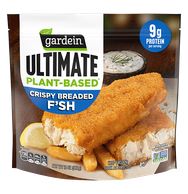
photo from Gardein

Are you searching for vegan “fish” alternatives? If so, here’s a list of some products you might want to try out. Many of these items are now sold in stores and online.

Akua Krab Cakes

Gardein Golden Frozen Fishless Filet

Gardein Mini Crispy Crabless Cakes

Jinka Tuna

Loma Linda Tuno in Three Varieties

Lily’s Vegan Pantry Vegan Fish

Lily’s Vegan Pantry Golden Fish Fillet

Lily’s Vegan Pantry Vegan Crab Steak

Lily’s Vegan Pantry Vegan Salmon

Lily’s Vegan Pantry Vegan Scallops

Lily’s Vegan Pantry Vegan Shrimp Ball

Lily’s Vegan Pantry Vegan Tuna

Lily’s Vegan Pantry Squid

Lily’s Vegan Pantry Vegan Lobster

Lily’s Vegan Panty Vegan Red Spot Shrimp

Mind Blown Coconut Shrimp

Mind Blown Crab Cakes

Mind Blown Dusted Shrimp

Save da Sea Salmon and Tuna Salad

Quick Solution for Growing Too Many Tomatoes

Posted on August 07, 2025 by The VRG Blog Editor

By Reed Mangels, PhD, RD

I don’t know about you, but tomato season is never long enough for me! Nothing compares to the flavor of a fresh, local tomato, preferably just picked and still warm from the sun. I reluctantly buy an occasional tomato in the winter and am reminded, once again, how these don’t have the taste or texture of summer tomatoes.

So, I accept surplus tomatoes from friends with gardens and, at the farmers market, buy more tomatoes than I could possibly eat. When that glut of tomatoes happens, I have 2 tried and true solutions for easily preserving summer’s tomatoes.

Easy solution Number 1: Cut and freeze

Supplies needed: Cutting board, knife, freezer containers, measuring cup or kitchen scale (optional)

Wash ripe tomatoes. Remove the core, cut into small pieces, place in freezer container and freeze until you need tomatoes. If you freeze 14 ounce portions (a scant 2 cups or use a scale), you can easily use a thawed portion the same way you’d use a 14-ounce can of diced tomatoes. I don’t mind tomato skin or seeds in my dishes but if that’s a concern, you can put tomatoes in boiling water for one minute, transfer them to an ice bath, and then easily remove the tomato skin with your fingers. Cut the peeled tomatoes in half and scoop out the seeds with clean fingers or a spoon and then cut into pieces for freezing.

Easy solution Number 2: Oven roast and freeze

Supplies needed: Cutting board, knife, baking sheet, immersion blender or food processor, freezer containers

Wash ripe tomatoes, core, and cut them in half. Place on a parchment-lined cookie sheet, place a clove of garlic in each tomato half, drizzle with a little olive oil and sprinkle with salt and/or pepper to taste. Bake at 225 degrees until they are very soft. This could take several hours or longer. Once the tomatoes have baked and cooled, you can put them, the garlic, and any juices left after roasting in a bowl and purée into a sauce with an immersion blender. Alternatively, put roasted tomatoes, garlic, and any juices into a food processor and pulse into a chunky sauce. Freeze in containers of your choice. When thawed, the sauce can be served over pasta or used as the base for a soup or sauce.

I should note that I haven’t tried canning tomatoes. It’s simpler, in my opinion, to freeze them. If canning is something you want to try, be sure to follow proper procedures including ensuring safe acidity by adding bottled lemon juice or citric acid. USDA’s Complete Guide to Home Canning is a reliable reference for canning tomatoes.

For more tomato ideas see:

What To Do With All Those Tomatoes

Quick and Easy Dishes Featuring Fresh Tomatoes

Tomato Heaven

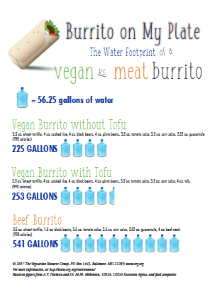
Burrito on My Plate shows viewers the water footprint of a vegan versus a meat-based burrito

Posted on August 06, 2025 by The VRG Blog Editor

The Vegetarian Resource Group has a graphic called Burrito on My Plate, which shows viewers the water footprint of a vegan versus a meat-based burrito. It takes 225 gallons of water to make a vegan burrito without tofu and 253 gallons of water to make a vegan burrito with tofu. In comparison, it takes 541 gallons of water to make a beef burrito.

The Burrito on My Plate Graphic can be seen here: https://www.vrg.org/environment/BurritoOnMyPlate.pdf

The article detailing how we came up with the numbers of gallons of water needed to produce each type of burrito can be found here: https://www.vrg.org/journal/vj2017issue2/2017_issue2_burrito_plate.php

WHAT DO YOU EXPECT FROM A VEGGIE BURGER?

Posted on August 06, 2025 by The VRG Blog Editor

istockphoto by franny-anne

The Vegetarian Resource Group and Vegan Journal commissioned YouGov to ask the following question in a national YouGov adult poll. Listed also are the results.

Which of the following, if any, do you expect from a food labeled as a veggie burger? Please select all that apply.

24%  To be able to use it in a similar way in cooking as a burger from a cow.

6%  To have the same amount of saturated fat and cholesterol as a burger from a cow.

6%  To contain meat from a cow.

9%  To only be something that I would purchase if costs less than a burger from a cow.

41%  The front of the burger package will identify the main ingredient (such as soy or beans) and say something like “black bean-based veggie burger.”

15%  The front of the burger package will say “veggie burger” but will not identify the main ingredient or ingredients.

11%  To have the same amount of iron as a as a burger from a cow.

10%  To have vitamin B12 added.

43%  To be labeled “plant based burger”

31%  To be labeled “vegan burger”

21%  None of these.

Most people (94%) would not expect a veggie burger to have meat from a cow, and only 6% expect a veggie burger to have same amount of fat and cholesterol as a burger from a cow. As few as 9% said they would only purchase a veggie burger if it costs less than a burger from a cow. Cost had less impact than we expected. Over four in 10 (41%) would expect the main ingredient identified on the front of the package. There was a large segment of the population (43%) expecting a veggie burger to be labeled “plant-based burger” and a large segment (31%) expecting it to be labeled “vegan burger.” So a marketer has to consider their strategy.

All figures, unless stated otherwise, are from YouGov Plc. Total sample size was 2,769 adults. Four percent were vegetarian (Never consume meat, fish, seafood or poultry) while around 96% consumed one or more of these products.  Fieldwork was undertaken between February 6–10, 2025 online in the United States. The figures have been weighted and are representative of all U.S. adults aged 18 and over. Results are based on a sample and are subject to statistical errors normally associated with sample-based information. For the above questions, we can have a 95% confidence level that VRG’s numbers from YouGov are plus or minus one percent (margin of error). Between 15% and 40%, and between 60% and 85%, the margin of error is plus or minus two percent. Be careful when comparing poll numbers to other polls or countries, as questions and definitions of vegetarian and vegan are often different.

You can see other Vegetarian Resource Group polls at https://www.vrg.org/nutshell/faq.htm#poll

Follow The Vegetarian Resource Group on Instagram!

Posted on August 05, 2025 by The VRG Blog Editor

Be sure to follow The Vegetarian Resource Group on Instagram: @vegetarianresourcegroup

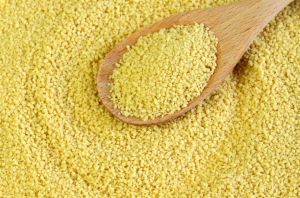
Celebrate National Couscous Day

Posted on August 05, 2025 by The VRG Blog Editor

Couscous istockphoto

Today is National Couscous Day! Here’s some quick and easy ideas on how to prepare vegan dishes with couscous: https://www.vrg.org/journal/vj2015issue1/2015_issue1_cooking_tips.php

  • Donate

  • Subscribe to the blog by RSS

  • VRG-NEWS

    Sign up for our newsletter to receive recipes, ingredient information, reviews of new products, announcements of new books, free samples of products, and other VRG materials.

    Your E-mail address:
    Your Name (optional):


↑ Top