The Vegetarian Resource Group Blog

Donate to VRG Through The Combined Federal Campaign (CFC)

Posted on September 05, 2014 by The VRG Blog Editor

If you are a Federal government employee, you can support The Vegetarian Resource Group through the Combined Federal Campaign (CFC). Look for us under Health & Medical Research Charities of America.

Please also remember The Vegetarian Resource Group in other workplace fund drives, matching gifts, etc. Thanks for your support!

Lutein Typically Vegan But May Be a Powder Microencapsulated in Gelatin

Posted on September 04, 2014 by The VRG Blog Editor

By Jeanne Yacoubou, MS

A long-time Vegetarian Resource Group reader asked us whether dietary supplements lutein and zeaxanthin were derived from all-vegetable sources. After careful review of the products offered by major manufacturers in 2014 The VRG reports that these compounds themselves are most often commercially produced from vegetable sources especially marigolds.

During our research we discovered a reply letter sent by The Food and Drug Administration (FDA) to Cognis Corporation: http://www.fda.gov/Food/IngredientsPackagingLabeling/GRAS/NoticeInventory/ucm153920.htm

In the fifth paragraph of the letter The FDA writes

Cognis prepares two commercial products from the concentrated form of its lutein ester product. One commercial product is a microencapsulated powder that is prepared by forming an emulsion, which is then dispersed with porcine gelatin under high speeds. The resulting paste is atomized at low temperatures to form beadlets that are dried. This powder is a six-fold dilution of the concentrate and, thus, contains a minimum of 10 percent lutein esters.

Cognis’ lutein product line was later purchased by BASF Corporation. The VRG contacted BASF to determine if lutein powder microencapsulated in gelatin was a current product offered by BASF. We received this reply from a BASF employee:

We do offer several forms of lutein esters which is a part of our Xangold line. This product line was acquired by BASF several years ago from Cognis. We offer three powder forms and five oil forms. Our oil products are concentrated oils that can be in either soybean, olive or MCT oil. Our powder forms…also are offered in several concentrated powder forms. Two of these powder forms are with gelatin and one is gelatin-free. Again, as I mentioned, these products are ingredients that would be sold to manufactures that would incorporate them into a consumer product. To understand if gelatin is in the product, you would need to contact the manufacturer for the full ingredient listing.

We later received confirmation from BASF that their medium chain triglyceride (MCT) oil is “of vegetable source.”

FenChem Biotek Ltd. is another company that also told The VRG that they sell lutein microencapsulated in gelatin.

Lutein

Alternate names: luteine, vegetable lutein, vegetable luteol, E161b
Commercial source: marigold, paprika (may be sold as a powder microencapsulated in gelatin)
Found in: green leafy vegetables, yellow-orange fruits and vegetables, egg yolk
Used in: dietary supplements, infant formula, beverages
Used as: nutritional supplement, colorant

Definition: A xanthophyll (oxycarotenoid) believed important for eye health, lutein cannot be synthesized by the human body but must be consumed in foods. Unlike another carotenoid beta-carotene, lutein does not exhibit pro-vitamin A activity.

Manufacturers:

Kemin told us that their lutein product is “free of animal ingredients as well as animal-derived processing aids.” It is also “free of bovine gelatin and has been for several years now” (http://www.dsm.com/markets/foodandbeverages/en_US/products/carotenoids/flora-glo-lutein.html).

Omniactives told us that their product “contains no animal products.” They do not offer a gelatin encapsulated form.

BASF told us that they do manufacture “two…powder forms with gelatin and one is gelatin-free.”

Fenchem Biotek Ltd. told us that they “can supply lutein available as microencapsulated powders in gelatin.”

Classification: Typically Vegan

Entry added: August 2014

Zeaxanthin

Alternate names: zeaxanthol, E161h
Commercial source: marigold, paprika
Found in: green leafy vegetables, yellow-orange fruits and vegetables, egg yolk, spirulina
Used in: dietary supplements, beverages
Used as: dietary supplement, colorant

Definition: An oxycarotenoid (xanthophyll) believed important for eye health, zeaxanthin is typically found along with lutein in food sources as it is in the eye. Unlike another carotenoid beta-carotene, zeaxanthin does not exhibit pro-vitamin A activity.

Manufacturers:

Kalsec told us that “our zeaxanthin is free from any and all animal or animal derived products.” We also learned that they “do have a manufacturing partner who does microencapsulation…It is not gelatin however but a non-gmo starch matrix that dissolves after consumption in order to enter the bloodstream.”

Kemin told us that their zeaxanthin product is “free of animal ingredients as well as animal-derived processing aids.” It is also “free of bovine gelatin and has been for several years now.”

Omniactives told us that their product “contains no animal products.” They do not offer a gelatin encapsulated form.

Classification: Typically Vegan
Entry added: August 2014

For information on other ingredients, see
http://www.vrg.org/ingredients/index.php

To support Vegetarian Resource Group research, donate at www.vrg.org/donate
Join at http://www.vrg.org/member/2013sv.php

The contents of this website and our other publications, including Vegetarian Journal, are not intended to provide personal medical advice. Medical advice should be obtained from a qualified health professional. We often depend on product and ingredient information from company statements. It is impossible to be 100% sure about a statement, info can change, people have different views, and mistakes can be made. Please use your best judgment about whether a product is suitable for you. To be sure, do further research or confirmation on your own.

VRG Events Fall 2014

Posted on September 03, 2014 by The VRG Blog Editor

Be sure to stop by The Vegetarian Resource Group table at these events this Autumn:

Greenfest Philly
Philadelphia, PA
September 7, 2014

Natural Products Expo East
Baltimore, MD
September 18-20, 2014

DC VegFest
Washington, DC
September 20, 2014

Charlottesville VegFest
Charlottesville, VA
September 27, 2014

Chicago Vegan Mania
Chicago, Illinois
Saturday October 11, 2014

FNCE
Atlanta, Georgia
October 18-21, 2014

Vegan Dinner
Atlanta, GA
Sunday, October 19, 2014

Vegan SoulFest
Baltimore, MD
October 25, 2014

Albany VegFest 2014
Albany, NY
Saturday, November 15

VRG Pre-Thanksgiving Potluck
Baltimore, Maryland
November 23, 2014, 5 PM

Update on White Castle’s Veggie’s Sliders

Posted on September 02, 2014 by The VRG Blog Editor

By Meredith Binder

Back in July, The Vegetarian Resource Group reported on White Castle offering veggie sliders in select New York and New Jersey locations. (See original article here: http://www.vrg.org/blog/2014/07/14/white-castle-welcomes-vegetarians/) VRG dug a little deeper to find out some more information on this veg-friendly fast food option. These small veggie burgers are served on a plain hamburger bun (ingredients listed below).

The sliders are served with an avocado ranch sauce (ingredients listed below), which contains eggs and milk. The burgers can be ordered without this condiment. White Castle told us that these non-meat sliders are cooked on a separate grill from their meat versions; however, they can not guarantee that this grill has not been used to cook hamburgers previously. In those instances, they ensure that their staff thoroughly clean the grill prior to cooking the veggie patties. Nutrition information on the veggie sliders including calories and total fat is also included below.

White Castle recently ran out of the veggie slider product so unfortunately, at this time, they are no longer offering it. White Castle will not release specific sales information because they are not publicly owned. However, a brand-manager there told us that the veggie sliders were positively received. That is great news for those of us that crave more animal-friendly products in restaurants like White Castle. The fast food chain is currently reviewing the sales performance and customer feedback of the veggie sliders to determine if it will offer them again and in more locations. VRG encourages interested readers to contact White Castle to tell them that you are interested in them providing veggie sliders, and animal-friendly buns, at a location near you. You can contact them via their Facebook page, https://www.facebook.com/WhiteCastle, and Twitter, @ WhiteCastle.

Bun Ingredients: (Bleached Enriched Wheat Flour (Malted Barley Flour, Niacin, Reduced Iron, Thiamine Mononitrate, Riboflavin, Folic Acid), Water, Sugar, Soybean Oil, Contains 2% Or Less Of The Following: Yeast, Salt, Sodium Stearoyl Lactylate, Diacetyl Tartaric Acid Esters Of Mono- And Diglycerides (DATEM), Calcium Sulfate, Enzymes, Ascorbic Acid, Potassium Iodate, L-Cysteine, Azodicarbonamide (ADA),

Veggie Slider: (Carrots, Onions, String Beans, Oat Bran, Soybeans, Zucchini, Peas, Broccoli, Corn, Soy Flour, Spinach, Expeller Pressed Canola Oil, Red Pepper, Arrowroot, Corn Starch, Garlic, Corn Meal, Salt, Parsley, Black Pepper).

Note: The patty is made in a facility that uses wheat. Dr. Praeger said they take cross contamination very, very seriously, “All of our gluten free items have been certified by the Gluten Intolerance Group. As part of this process, our facility had to be inspected by a 3rd party.”

Avocado Ranch Sauce Ingredients: (Soybean Oil, Water, Vinegar, Sugar, Egg Yolk, Buttermilk Solids, Contains less than 2% of: Salt, Monosodium Glutamate, Lime Juice, Modified Food Starch, Natural Avocado Flavor, Spices, Sodium Benzoate, Sorbic Acid and Calcium Disodium EDTA as preservatives, Garlic, Lactic Acid, Phosphoric Acid, Citric Acid, Xanthan Gum, Onion, Natural Smoke Flavor, Natural Flavor (Milk). CONTAINS: WHEAT, EGG, MILK, SOY

The contents of this article, our website and our other publications, including Vegetarian Journal, are not intended to provide personal medical advice. Medical advice should be obtained from a qualified health professional. We often depend on product and ingredient information from company statements. It is impossible to be 100% sure about a statement, info can change, people have different views, and mistakes can be made. Please use your best judgment about whether a product is suitable for you. To be sure, do further research or confirmation on your own.

Social Justice and Veganism poster

Posted on September 02, 2014 by The VRG Blog Editor

Vegetarian Resource Group member JoAnn Farb has created a Social Justice and Veganism poster that you may want to share with friends. See: http://www.vrg.org/animal_rights/all_social_justice_2.pdf

VEGAN NUTRITION FOR TEENAGERS: NEW BROCHURE FROM THE VEGETARIAN RESOURCE GROUP

Posted on August 29, 2014 by The VRG Blog Editor

The Vegetarian Resource Group has published a new brochure titled Vegan Nutrition for Teenagers. You can find this brochure online: http://www.vrg.org/nutrition/VeganNutritionForTeenagers.pdf

If you would like multiple copies of this brochure for outreach, please email your request to [email protected]

Donations towards VRG’s outreach are greatly appreciated: https://www.givedirect.org/give/givefrm.asp?CID=1565

The age of Information is also the age of misinformation – Claims regarding vegetarianism and vitamin A

Posted on August 28, 2014 by The VRG Blog Editor

By Riccardo Racicot

In today’s age of information we are able to access the answer to almost any question we have within seconds. With access to the Internet and search engines at our fingertips, thanks to smartphones and laptops, any inquiry or dispute can be settled immediately. Unfortunately this is a double-edged sword. While we may have swift access to information, there is no assurance that it is accurate. This is especially true regarding nutrition information. There are countless resources on the Internet claiming to be legitimate sources, many of which have an agenda. These sources include advocacy groups promoting a particular agenda and who may posture legitimate sounding ideas as science when the background information is not there. This, I believe, perpetuates myths and poor quality information, directly resulting in stigma and misinformation towards vegetarianism.

About a month ago I happened to see a Facebook post from one such advocacy group claiming “Carrots are not a source of vitamin A. Vitamin A is found exclusively in animal foods.” While I am not a vegetarian, this type of misinformation concerns me because it may dissuade people from pursuing a healthy vegetarian lifestyle. Claims such as this are unfounded and based on a poor understanding of science and I would like to dispel some common myths surrounding vegetarianism and vitamin A here.

Claim: Vitamin A is found exclusively in animal foods

Technically this is correct. However it’s highly misleading. Vitamin A in its complete form, retinol, is only found in animal products; however, the precursors to vitamin A are found in a plethora of fruits and vegetables including carrots, mango, spinach and sweet potatoes. When we eat foods containing these precursors, such as beta-carotene, our body converts them to vitamin A. The rate of conversion from beta-carotene to retinol varies widely depending on a number of factors and ranges from a 3.8:1 to 28:1 ratio, meaning it requires somewhere between 3.8 to 28 units of retinol precursors to make a single unit of retinol.¹ Because of the variation in the conversion rate of carotenoids to retinol, daily vitamin A requirements are expressed in micrograms (mcg) of Retinol Activity Equivalents (RAE), a unit that takes into consideration the ease of absorption depending on the source of vitamin A. Many plant-based sources actually have a higher RAE than their animal-based counterparts, with the major exception being beef liver. While plant-based foods are not a source of complete vitamin A, they provide our bodies with the necessary building blocks to meet our vitamin A requirements.

Source: U.S. Department of Agriculture, Agricultural Research Service. 2013. USDA National Nutrient Database for Standard Reference, Release 26. Nutrient Data Laboratory Home Page, http://www.ars.usda.gov/ba/bhnrc/ndl

Claim: Vegetarians cannot obtain enough vitamin A to meet daily requirements

In the United States, vitamin A deficiency is rarely an issue, so much so the newly proposed FDA Nutrition Facts label will not require the listing of vitamin A.² This is no exception for vegetarians. For adult males the Recommended Dietary Allowance (RDA) is 900 mcg RAE while for women it is 700 mcg RAE. These amounts of vitamin A are easily achievable by a few servings of yellow-orange fruits and vegetables and/ or dark leafy greens. For example a simple raw salad of spinach, Swiss chard, carrots, tomato and bell peppers is enough to fulfill the daily requirements for a woman. The salad, along with an additional whole, raw mango fulfills the requirements for a man.

Source: U.S. Department of Agriculture, Agricultural Research Service. 2013. USDA National Nutrient Database for Standard Reference, Release 26. Nutrient Data Laboratory Home Page, http://www.ars.usda.gov/ba/bhnrc/ndl

Other common sources of vitamin A that could help vegetarians meet their daily requirements include:

Source: U.S. Department of Agriculture, Agricultural Research Service. 2013. USDA National Nutrient Database for Standard Reference, Release 26. Nutrient Data Laboratory Home Page, http://www.ars.usda.gov/ba/bhnrc/ndl

Claim: Breastfeeding infants of vegetarian parents are at risk for vitamin A deficiency

Breastfeeding infants born to mothers with poor dietary habits who lack essential nutrients are those who are at risk for deficiency. A child being breastfed by a vegetarian mother is only at risk for vitamin A deficiency if the mother is not consuming adequate vitamin A. During lactation, the RDA for vitamin A increases to 1,300 mcg RAE per day. Again, this is easily achievable with several servings of yellow-orange fruits and vegetables and/or leafy greens. Consuming plant-based food containing vitamin A precursors allows the mother to convert them to vitamin A and pass them along to the infant through breast milk. Lactating mothers with adequate intakes of vitamin A precursors will provide their infants with adequate amounts of vitamin A.³

Claim: Vegetarian children are at risk for vitamin A deficiency

According to a recent study less than 5% of all children ages 2-8 years old have a daily intake of vitamin A less than what is recommended by the USDA.⁴ Along with this a 2002 study of children ages 11-18 years old showed vegetarians consume almost 1500 more units of vitamin A on average than their non-vegetarian counterparts.⁵ There is little risk of vitamin A deficiency in vegetarian children who regularly eat yellow-orange fruits and vegetables and/or leafy greens.

Claim: Fat is required for vitamin A absorption

Vitamins are generally classed into two categories; fat soluble and water soluble. Water soluble vitamins include the B vitamins and vitamin C. As their name implies, these vitamins dissolve in water. Vitamins A, D, E and K are fat soluble vitamins and dissolve in fat. Because of this, fat needs to be consumed along with the source of vitamin A for proper absorption. However, it has been shown that the amount of fat needed to promote vitamin A absorption is minimal at only 3-5 g of fat.⁶⁷ Consumption of a fat source, such as avocado has been shown to increase absorption of beta-carotene from carrots 6.6-fold as compared to eating carrots alone.⁸ Other fat sources that could potentially increase absorption include oils such as olive oil, salad dressing, nuts, and nut butters.

Conclusion

Adequate vitamin A intake is readily achievable by those practicing a vegetarian diet. A vegetarian diet offers the opportunity for adults and children to meet vitamin A needs through consumption of vitamin A precursors from fruits and vegetables and for breastfeeding infants through their well-nourished mother’s milk. Consumption of fat along with vitamin A and its precursors enhances absorption, with the amount of fat required being minimal. As with all types of diets, fulfilling the requirements for essential nutrients should be considered when making meal choices.

Riccardo Racicot recently graduated from the University of Massachusetts Amherst with a bachelor’s degree in Nutrition.

1. Haskell MJ. The challenge to reach nutritional adequacy for vitamin A: ß-carotene bioavailability and conversion—evidence in humans. Am J Clin Nutr. 2012;96(5):1193S-1203S.
2. U.S. Food and Drug Administration. Proposed Changes to the Nutrition Facts Label.http://www.fda.gov/food/guidanceregulation/guidancedocumentsregulatoryinformation/labelingnutrition/ucm385663.htm. Updated 2014. Accessed 08/05, 2014.
3. The importance of [beta]-carotene as a source of vitamin A with special regards to pregnant and breastfeeding women. Eur J Nutr. 2007;46(9).
4. Berner LA., Keast DR., Bailey RL., Dwyer JT. Fortified foods are major contributors to nutrient intakes in diets of US children and adolescents. J Acad Nutr Diet. 2014;114(7):1009-1022.
5. Perry CL, McGuire MT, Neumark Sztanier D, Story M. Adolescent vegetarians: How well do their dietary patterns meet the Healthy People 2010 objectives? Arch Pediatr Adolesc Med. 2002;156:431–437.
6. Roodenburg, AJ, Leenen R, van het Hof KH, Weststrate JA, Tijburg LB. Amount of fat in the diet affects bioavailability of lutein esters but not of alpha-carotene, beta-carotene, and vitamin E in humans. Am J Clin Nutr. 2000;71:1187-1193.
7. Jayarajan P, Reddy V, Mohanram M. Effect of dietary fat on absorption of [beta] carotene from green leafy vegetables in children. Indian J Med Res. 2013;137(5).
8. Kopec RE, Cooperstone JL, Schweiggert RM, et al. Avocado consumption enhances human postprandial provitaminA absorption and conversion from a novel high-β-carotene tomato sauce and from carrots. J Nutr. 2014;144(8):1158-1166.

Honor Labor Day with Terrific Vegan Recipes from Vegans Know How To Party Cookbook

Posted on August 27, 2014 by The VRG Blog Editor

Labor Day is right around the corner! Pick up a copy of Vegans Know How to Party and make your favorite festive dishes come to life! To purchase this book see: http://www.vrg.org/catalog/index.php?main_page=product_info&cPath=1&products_id=63

Colorful Fruit Parfaits
Serves 6

2 cups vanilla soy yogurt
1/4 teaspoon almond extract
1/2 cup chopped cantaloupe or Crenshaw melon
1/2 cup chopped fresh or frozen, thawed strawberries
1/2 cup peeled, chopped kiwi fruit
2 Tablespoons sliced almonds

Mix yogurt and almond extract together in a small bowl. Alternate layers
of fruit and yogurt mixture in parfait glasses, beginning and ending with fruit. Top with almonds. Chill for at least 1 hour before serving.

Note: Feel free to add even more chopped fruit on top for a pretty
presentation.

Total Calories Per Serving: 114
Total Fat as % of Daily Value: 5%
Protein: 4 gm
Fat: 3 gm Carbohydrates: 18 gm
Calcium: 118 mg
Iron: 1 mg
Sodium: 31 mg
Dietary Fiber: 1 gm

Fresh Fruit Crumble
Serves 8

Topping:
Vegetable oil spray
21/2 cups unbleached flour
1 cup apple butter
1/4 cup applesauce

Preheat oven to 375 degrees. In a large bowl, combine flour, apple
butter, and sauce until crumbly.

Spray a 9 x 13-inch baking dish with oil. Put aside 1/2 cup of
mixture and press remainder into dish.

Filling:
3 cups peeled and diced fresh fruit (berries, apricots, peaches, ripe
persimmons, nectarines, and plums work well)
1/4 cup peeled, diced fresh orange (seeds removed)
1/8 cup raisins (or dried berries)
1 teaspoon fresh orange zest
1 Tablespoon fresh lemon juice

Combine filling ingredients in large pot; heat over medium heat,
stirring constantly, until fruit is soft and mixture is slightly
thickened. If more sweetness is desired, add 2 teaspoons of orange juice.

Spread fruit over topping. Crumble remaining topping over fruit.
Bake 30 minutes or until bubbly.

Total Calories Per Serving: 253
Total Fat as % of Daily Value: 2%
Protein: 5 gm
Fat: 1 gm
Carbohydrates: 58 gm
Calcium: 24 mg
Iron: 1 mg
Sodium: 4 mg
Dietary Fiber: 4 gm


Chilled Tomato Gazpacho

Serves 8

1 cup tomato paste
2 stemmed, seeded, and diced fresh chilies (you select the heat)
1/3 cup balsamic vinegar
2 Tablespoons lime juice
1 Tablespoon sugar
1 Tablespoon minced garlic
1 Tablespoon ground cumin
1 teaspoon Tabasco sauce or other hot sauce
1 teaspoon freshly ground black pepper
7 cups tomato juice
3 cups seeded and diced fresh tomatoes
2 cups peeled, seeded, and diced cucumbers
2 cups peeled and diced fresh jicama (if jicama is not available, use 2
cups cooked, peeled, diced potatoes)
11/2 cups stemmed, seeded, and diced green bell peppers
11/2 cups stemmed, seeded, and diced red bell peppers
11/2 cups chopped green onion
1 cup each diced zucchini and diced summer squash
1/4 cup freshly chopped parsley
1/4 cup freshly chopped cilantro

In a blender or food processor, place the tomato paste, chilies,
vinegar, lime juice, garlic, cumin, Tabasco sauce, pepper, and 3 cups of
the tomato juice and process for 2 minutes or until smooth. Transfer the
mixture to a large glass or plastic (not metal) bowl. Add the rest of
the tomato juice and stir well to combine. Add the remaining ingredients
and stir well to combine. Cover and chill for at least 2 hours before
serving in chilled bowls.

Note: Will last well in the refrigerator for up to 3 days.

Total Calories Per Serving: 134
Total Fat as % of Daily Value: 1%
Protein: 6 gm
Fat: 1 gm
Carbohydrates: 31 gm
Calcium: 76 mg
Iron: 3 mg
Sodium: 1,074 mg
Dietary Fiber: 7 gm

COLLEGE STUDENTS NOW LIVING OFF-CAMPUS AND LOOKING FOR A TERRIFIC COOKBOOK – TRY VEGAN MEALS FOR 1 OR 2

Posted on August 26, 2014 by The VRG Blog Editor


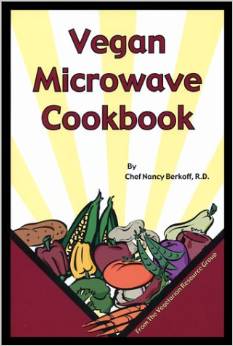
Vegan Meals for One or Two, by Chef Nancy Berkoff, is a terrific cookbook for college students living on their own. Start your day off with Breakfast Potato Burritos or Macadamia Nut Pancakes. Try one pot wonders including Kitchen Sink Minestrone, Asian Noodle Bowl, or Cauliflower Curry. Looking for some Grab-and-Go items, you may want to prepare Speedy Tostadas or Baked Beans Quesadillas. And if you have the time and want to prepare a more gourmet meal, try Almost Thai Spicy Peanut Pasta, Potato Tacos, or Quick Tofu Stroganoff. You’ll also find creative hot and cold beverages, and of course snacks and desserts.

Here’s one recipe from this cookbook:

Salsa Black Bean Salad

(Makes 2 servings)

1 cup cooked black beans (if canned, drain and rinse)
1/2 fresh orange, peeled and chopped
1/8 cup chopped green onions
1/4 cup prepared salsa
1 Tablespoon lemon or lime juice
1 minced garlic clove or a teaspoon garlic powder
1 teaspoon cumin
1 teaspoon red pepper flakes
Shredded lettuce, as desired
Tortilla chips or shredded tortillas, as desired

Mix beans, orange, onion, salsa, juice, garlic, cumin, and pepper flakes together in a medium bowl. Chill for at least 1 hour. Serve over lettuce and garnish with chips.

Vegan Meals for One or Two is published by The Vegetarian Resource Group and can be purchased online at http://www.vrg.org/catalog/ or you can send $21 (includes postage/handling) to Vegetarian Resource Group, PO Box 1463, Baltimore, MD 21203 or call (410) 366-8343.

MORE VEGAN RESTAURANTS ADDED TO THE VEGETARIAN RESOURCE GROUP’S ONLINE RESTAURANT GUIDE

Posted on August 15, 2014 by The VRG Blog Editor

These vegan restaurants were recently added to our online restaurant guide for the USA and Canada. To find restaurants in your area, please visit: http://www.vrg.org/restaurant/index.php.

Café Love
3219 Old Chapel Hill Rd
Durham, NC 27707
Café Love is a 100% vegan, gluten-free and raw restaurant currently serving take-out only. When the weather is nice, find a shady spot to enjoy these delicious dishes! You can choose from a variety of healthy entrees such as Pad Thai, Manicotti or Spicy Kelp Noodles. They also offer desserts like Chocolate and Blueberry Squares and homemade juices.

Jrink Juicery
1323 Connecticut Ave NW
Washington DC 20036
It is clear Jrink Juicery is a purist as fresh, cold pressed, 100% fruit and vegetable juices is all they serve in this cozy café with exposed brick and wood floors. Start your day off with a “Fuel Me Up” with pear, kale, romaine, cucumber and lemon or “The Hulk” with spinach, kale, raw almonds, cinnamon, vanilla and agave. Located near Dupont Circle.

Loving Heart
838 W. Montrose Ave.
Chicago, IL 60613
It is clear that a little bit of love is a key ingredient in all of Loving Heart’s fresh and wholesome dishes. Fresh veggies and herbs are a staple in their salads, wraps, and noodle bowls. Try the Green Deva salad with a host of vegetables, roasted peanuts, parsley, and a special ginger pesto. If you haven’t gotten your fill, check out their selection of raw cakes!

Nourished On The Go
16 Simcoe Street South
Oshawa, ON L1H 4G2 Canada
Located right down the street from Memorial Park. Nourished on the Go focuses on serving up health-conscious vegan food. The diverse menu has a selection of soups, salads, and wraps. Be sure to check out the desserts and smoothies as well. Many gluten free options available.

One Lucky Duck
125½ E. 17th Street
New York, NY 10003
(Gramercy)
75 9th Ave.
New York, NY 10011
(Chelsea)
One Lucky Duck has two small and cozy locations in the Chelsea and Gramercy neighborhoods of NYC. At the Gramercy location they offer fresh juices, smoothies, desserts, ice cream, and made to order dishes such as zucchini and tomato lasagna and falafel with tabouli. All of these items are available at the Chelsea location. However, it is served take-out style only.

Propulsion
1303 Sainte-Catherine Est.
Montréal, Québec H2L 2H4
Propulsion might seem like an unusual name for a restaurant until you realize you will be dining on a table made from the wing of a plane! Enjoy the funky atmosphere over unique sandwiches, salads and desserts. Try the Mungo Mango sandwich with Chinese mung beans and fresh mango and the homemade coconut-milk creamsicle with frozen banana!

Resonance Café
5175a av. du Parc
Montréal, QC H2V 4G3
Canada
Every day of the week Resonance Café serves breakfast, lunch and dinner and has live music for you to enjoy! Their menu is 100% vegan and full of goodies including breakfast items, soups, salads and sandwiches. Try the breakfast sandwich with tofu scramble and cashew cheese or the Victoria Rice Bowl with marinated tofu and kimchi!

Rockin’ Raw
171 Sullivan St.
(Off of Houston Street)
Greenwich Village
New York, NY 10012
Enjoy colorful and inventive dishes and a relaxing laid back atmosphere at the 100% raw restaurant, Rockin’ Raw. You will never look at raw food the same way again. Regulars rave about the Fully Loaded Nachos appetizer, their smoothies, and extensive menu of desserts!

Three Carrots
222 E Market St,
Indianapolis, IN 46204
Three Carrots offers a cozy environment with a variety of vegan breakfast and lunch options, many of which are gluten-free. For breakfast, try the Biscuits and Gravy or Sweet Potato Hash. For lunch, don’t miss Ian’s Chili or the Tofu Rich Girl, a cornmeal crusted tofu po boy!

The Urban Buggy
308 22nd Ave S, Suite 102
Seattle WA, 98144
The Urban Buggy is not only a 100% vegan deli but also an urban farm by the same name. This restaurant serves simple, yet tasty, lunch dishes with a menu that changes daily. Try the Gyro with mock “chicken,” tzatiki sauce, tomato, lettuce, cucumber in a pita wrap or BBQ Pulled “Pork” Sandwich with BBQ’d jackfruit , red onion and coleslaw.

  • Donate

  • Subscribe to the blog by RSS

  • VRG-NEWS

    Sign up for our newsletter to receive recipes, ingredient information, reviews of new products, announcements of new books, free samples of products, and other VRG materials.

    Your E-mail address:
    Your Name (optional):


↑ Top