The Vegetarian Resource Group Blog

Vegan food items at Publix and Target

Posted on October 14, 2011 by The VRG Blog Editor

In the summer of 2011, VRG Intern Rita Pruzansky investigated the vegan options available at her local supermarket chains. This is what she found.

Vegan Foods at Publix

Below is a table of the food items at Publix Super Markets that are labeled vegan on the front of the package or in the ingredients list. Many of these products are also labeled as “certified vegan.” This list was made based on the products available in May and July 2011 at a Publix in Coral Springs, Florida. Product availability and their locations within the store may vary. The information about these products was obtained from a regular Publix market, but products may differ at Publix Greenwise markets. There may be a Greenwise section or aisle within the store, containing vegetarian, vegan, organic, and other health foods. Greenwise items may also be mixed in with products in other aisles. Since Greenwise is not entirely vegetarian, keep in mind that meat items may be located in the same area as vegetarian items, and read the package carefully before purchasing.

Section

Product

Also Available In…

Notes

Greenwise Refrigerated

Smart Deli

Bologna Style Protein Slices

Pepperoni Style Veggie Protein Slices

Smart Wings Buffalo is available and NOT vegan, it contains eggs

Smart Dogs Veggie Protein Links

Regular and Jumbo Size Available

Smart Bacon – Bacon Style Strips

Gimme Lean – Ground Sausage Style

Tofurky – Italian Sausage

Kielbasa, Italian Deli, Hickory Smoked, Peppered, Oven Roasted, Roast and Gravy

Turtle Island Foods Tempeh – Smoky Maple Bacon

Sesame Garlic, Coconut Curry

Lightlife Tempeh – Organic Three Grain

Marjon Vegetarian Hamburger Tofu Crumbles – Politely Hot

House Foods Tofu Shirataki – Spaghetti

Fettucine

Greenwise Frozen

Gardein Homestyle Beefless Tips

Seven Grain Crispy Tenders, Lightly Seasoned Chik’n Scallopini

Amy’s Burrito – Non-dairy with organic beans and rice

The non-dairy burrito was the only vegan Amy’s burrito (other than the breakfast burrito) that was available when I looked.

Amy’s Rice Macaroni with dairy free cheeze

Amy’s Bowls – Teriyaki

Brown Rice and vegetables

Health is Wealth Chicken-Free Nuggets

This brand sells both real meat chicken nuggets and a vegan variety, and they are sold in the same location

Food for Life – Moophrey Vegan/Vegetarian Burgers

Cluckphrey Vegan/Vegetarian Patties

Bahama Rice Burger – Mediterranean

Bahama Rice Meatballs – Tuscany Italian

Boca Original Vegan Burgers

Greenwise Soups

Dr. McDougall’s boxed soup – Chunky Tomato

Roasted Pepper Tomato, Split Pea, Lentil, Black Bean, Vegetable

Dr. McDougall’s Single serving, Ramen-style – Hot & Sour Ramen

Split Pea, Split Pea with Barley, Tomato Basil Pasta, Whole Grain Lentil Couscous

Muir Glen Organic – Savory Lentil

Southwest Black Bean, Homestyle Split Pea, Garden Vegetable

Amy’s Organic Soups – Lentil

Lentil Vegetable, Black Bean Vegetable, Low fat minestrone, Vegetable Barley

Frozen Entrees

Kashi – Tuscan Veggie Bake

Kashi – Mayan Harvest Bake

Gardein – Mandarin Orange Crispy Chik’n

Amy’s Shepherd’s Pie

Amy’s Mexican Tamale Pie

Amy’s Non-Dairy Cheeze Pizza

Garden Lites Zucchini Marinara

Frozen Ethnic Foods

Macabee Kosher Eggplant Cutlets

Dr. Praeger’s California Veggie Burgers

Frozen Breakfast

Amy’s Organic Bowls Hot Cereal – Steel cut Oats

Cream of Rice

Amy’s Tofu Scramble with hash browns and veggies

Amy’s Breakfast Burrito

Frozen Dessert

Amy’s Organic Chocolate Cakes

Ice Cream

So Delicious Frozen Coconut Milk Dessert (1 pint) – Chocolate

Mint Chip, Vanilla Bean, Cookie Dough

So Delicious Frozen Coconut Milk Dessert (1 quart) – Creamy Vanilla

Chocolate

So Delicious Dairy Free Minis – Vanilla

Fudge

The fudge minis are organic.

Vegan Foods at Target

The chart below shows the vegan-labeled products at Target that were available in May 2011 at a Target in Coral Springs, Florida. All products were listed as vegan on the package. This information was obtained from a Target with a fresh foods section. Like Publix, product availability and location of products within the store may vary. Variety of vegan products will depend on which type of Target you visit. Some Targets do not have a fresh food section, and others, “SuperTargets” may have a full grocery store and a more extensive variety.

Section

Product

Also Available In…

Notes

Canned Soups (located in Soup and Bread Aisle)

Amy’s Organic Soups – Lentil Vegetable

Low fat Minestrone, Fat Free Chunky Vegetable

Other Amy’s soups are available that are NOT vegan.

Amy’s Organic Chili – Spicy

Low fat Medium Black Bean

Muir Glen Organic Southwestern Black bean soup

Frozen Dinners

Amy’s Burrito – Non dairy with organic beans and rice

Morningstar Hickory BBQ Riblets

Boca Chik’n Meatless Patties – Original

Spicy

Boca Meatless Ground Crumbles

By Rita Pruzansky, VRG Intern and Psychology Student

Many Northeastern Corridor 7-Eleven® Stores Offer Moshe’s Foods® Vegan Foods

Posted on October 13, 2011 by The VRG Blog Editor

by Jeanne Yacoubou, MS

VRG Research Director

For over twelve years, Moshe’s Foods® has offered its all-plant-based, fully prepared sandwiches, burritos, soups, and salads at an ever-growing number of 7-Eleven® convenience stores in Pennsylvania, New Jersey, and New York. The vegan items may also be purchased at many Northeast region oriental markets and natural foods stores. A partial listing of locations appears on the website: www.moshesfoods.com.

Complete ingredient and nutritional information accompanying photos of Moshe’s prepared foods may be located on the company website. Only all-plant-based cuisine is made at Moshe’s Philadelphia plant ensuring no cross-contamination with meat products, eggs, or dairy. Moshe’s Foods® are not certified Kosher or Halal. All of the vegan items are created with only a few very simple ingredients including fresh vegetables, organic tofu, and whole wheat breads.

To date, Moshe has developed approximately sixty food items that may be found at locations carrying Moshe’s Foods®. These include Seitan Steak; Moroccan Roll Burrito; Grilled Vegetable Pita; Tofu Edamame Salad; and Quinoa and Corn Soup. Available items vary weekly depending on sales, location, and customer preference. Moshe told The VRG that his prepared foods may be heated in a microwave or eaten as is if preferred. Soups are served hot.

Moshe also stated that although he has no plans to expand to all of the 7-Eleven® stores in the entire Northeast area, he would consider enlarging his radius from Philadelphia if the demand was great enough in other areas. The VRG encourages interested readers to state their preference for vegan convenience foods like Moshe’s to the managers of their local stores and to demonstrate their future loyalty now by regularly purchasing vegan items if possible.

The contents of this article, our website, and our other publications, including The Vegetarian Journal, are not intended to provide personal medical advice. Medical advice should be obtained from a qualified health professional. We often depend on product and ingredient information from company employees or company statements. Information does change and mistakes are always possible. Please use your own best judgment about whether a product is suitable for you. Further research or confirmation may be warranted.

For more information on food processing methods and food ingredients and to purchase our Guide to Food Ingredients, please visit our website at http://www.vrg.org/ingredients/index.php

For updates on ingredients and other information of interest to vegetarians and vegans, please subscribe to our free newsletter at http://www.vrg.org/vrgnews/

There are many ways to stay connected to The Vegetarian Resource Group!
Get our blog delivered right to your inbox: http://feeds.feedburner.com/TheVRGBlog
Visit us on Twitter: http://twitter.com/#!/VegResourceGrp and friend us on Facebook: http://www.facebook.com/thevegetarianresourcegroup

To support VRG outreach, join or donate at
https://www.givedirect.org/give/givefrm.asp?CID=1565

Q&A: Can a vegan eat at Tex-Mex restaurants?

Posted on October 12, 2011 by The VRG Blog Editor

Q: As a new vegan, I don’t know if I can still eat out in Tex-Mex restaurants.  What kinds of questions should I be asking to make sure there are no animal products in my food?

A:There are some questions that vegetarians and vegans have to ask when eating at Mexican food restaurants. They are crucial. The first one would be asking if lard is used for cooking or is used in the beans or to fry corn or flour for chalupa or nacho shells, because a lot of the time they will not say it is unless you ask. The second one is asking if chicken broth or beef stock is used in any of the foods like sauces for example, because sometimes it will not be listed. The third one is asking if the meat or dairy products are cooked on the same surface as the vegetarian meals. Sometimes only certain dishes are, so this is an important question. The fourth and final one for vegans is making sure there are no dairy products, like cream or sour cream for example, stuck secretly into the meal or served with it, because these ingredients are sometimes overlooked.

Written by Brittany Estes-Garcia while volunteering with The VRG.

For information about vegan & vegetarian options at fast food and quick service chains, visit:
http://www.vrg.org/fastfoodinfo.htm

For information about vegan, vegetarian, and veg-friendly restaurants in the U.S. & Canada, visi:
http://www.vrg.org/restaurant

If you would like to volunteer for The Vegetarian Resource group, please email [email protected].

World Veg Day & World Food Day Dinner at Mr. Chan’s Sunday October 23rd, 5:00 p.m.

Posted on October 11, 2011 by The VRG Blog Editor

Join The Vegetarian Resource Group as we come together to celebrate World Vegetarian Day & World Food Day on Sunday October 23rd, 2011 at 5:00 p.m. at Mr. Chan’s Szechuan Restaurant in Pikesville. Address: 1000 Reisterstown Road, Baltimore MD 21208-4206

The menu includes: tea, choice of veggie hot & sour soup or veggie wonton soup, veggie egg roll, white and brown rice, and 5 main dishes served family style: crispy orange seitan, tempeh with kale, garlic szechuan green beans, yuba with eggplant and basil, grilled tofu with black bean sauce and broccoli.

$20 per person. Reserve your spot today by calling (410) 366-8343 or by mailing a check to PO Box 1463, Baltimore, MD 21203.

PLEASE RSVP BY FRIDAY, OCTOBER 14.

*Refund made only if your seat is replaced*

*Menu subject to change*

For more information email Mary at [email protected]

CarbonFree® Domino® Sugar not Equivalent to “Bone Char-Free”

Posted on October 10, 2011 by The VRG Blog Editor

by Jeanne Yacoubou, MS

VRG Research Director

In September 2011 a VRG member asked us if the CarbonFree® Domino® Granulated Sugar, and sister brands, Florida Crystals® Organic Sugar and Florida Crystals® Natural Cane Sugar, meant that these brands had not
been filtered through cow bone char. She wondered if “CarbonFree®” implied that cow bone char, which is composed of carbon, had not been used during the sugar refining process to whiten the product.

Domino® Sugar has a FAQ page on its website, http://www.dominosugar.com/carbonfree/faq.html, which explains that its use of the CarbonFree® label relates to the products’ “carbon neutral footprint.” Domino® Sugar asked CarbonFund.org, a non-profit organization that certifies qualifying products as CarbonFree®, to perform a life cycle assessment (LCA) to determine “the products’ carbon footprint and greenhouse gas reductions” that existed because of company practices.

CarbonFund.org determined through a field-to-store analysis performed by The Edinburgh Centre for Carbon Management, that Domino® Sugar’s production and supply of renewable energy from “leftover sugar cane fiber and recycled urban wood waste” to power their sugar operations as well as some residential communities offset the carbon footprints of some of their products. Consequently, Domino® Granulated Sugar, and sister brands, Florida Crystals® Organic Sugar and Florida Crystals® Natural Cane Sugar became certified as CarbonFree®.

On its FAQ page, Domino® Sugar stated that the CarbonFree® label does not mean their products are “carbon free.” In fact, sugar itself, because it is a biomolecule, contains carbon. In terms of processing, only certified USDA organic sugar and sugar derived exclusively from sugar beets have not been processed through decolorizing filters, which, in most cases today, are composed of cow bone char.

For more information about sugar processing, interested readers may view our articles at
http://www.vrg.org/journal/vj2007issue4/2007_issue4_sugar.php and
http://www.vrg.org/journal/vj97mar/973sugar.htm

The contents of this article, our website, and our other publications, including The Vegetarian Journal, are not intended to provide personal medical advice. Medical advice should be obtained from a qualified health professional. We often depend on product and ingredient information from company employees or company statements. Information does change and mistakes are always possible. Please use your own best judgment about whether a product is suitable for you. Further research or confirmation may be warranted.

For more information on food processing methods and food ingredients and to purchase our Guide to Food Ingredients, please visit our website at
http://www.vrg.org/ingredients/index.php

For updates on ingredients and other information of interest to vegetarians and vegans, please subscribe to our free enewsletter at
http://www.vrg.org/vrgnews/

There are many ways to stay connected to The Vegetarian Resource Group!
Get our blog delivered right to your inbox:
http://feeds.feedburner.com/TheVRGBlog Visit us on Twitter:
http://twitter.com/#!/VegResourceGrp and friend us on Facebook:
http://www.facebook.com/thevegetarianresourcegroup

To support Vegetarian Resource Group research, donate at
https://www.givedirect.org/give/givefrm.asp?CID=1565

The VRG at the American Dietetic Association’s Food & Nutrition Conference & Expo

Posted on October 07, 2011 by The VRG Blog Editor

By Megan Salazar, VRG Dietetic Intern

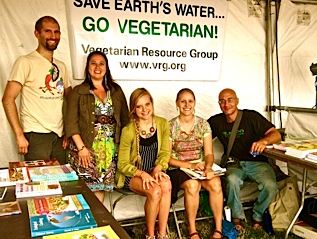
I was delighted to attend the annual Food & Nutrition Conference & Expo (FNCE) for the American Dietetic Association (ADA), which was held this year in San Diego, CA. During part of the conference, I helped out at VRG’s booth in the Expo area. Since I am doing my internship long distance in Denver, CO, it was wonderful to meet Reed Mangels, Dr. William Conway and Catherine Conway, all of whom were working the booth throughout the course of the conference and are valuable VRG contributors.

It was wonderful to see so many people come up to the booth, despite it being in between a fish vendor and a fast food marketer. Most visitors took the Vegetarian Journal initially, but were really captured by all of the materials and books that were on the table as well. These included educational pamphlets, Vegetarian My Plate flyers, coloring books/pages, and an assortment of the books.

What was even more encouraging were the Registered Dietitians or other nutrition professionals that came by just to comment that they always pointed their patients, clients, and friends in the direction of the VRG website for more information on becoming a vegetarian. They know that the information is invaluable in regards to beginning a vegetarian diet, or even improving upon a current lifestyle.

I also attended the session of the conference that highlighted the new Evidence Analysis Library on vegetarianism, entitled “Vegetarians in the Library: What’s the Evidence?” The presenters detailed the new section of the Evidence Analysis Library on the ADA website. Their presentation included much of the research and surveys that the VRG has done in the past, further highlighting the importance of this organization.

In the evening, the VRG also hosted a delightful vegan dinner at Royal India in downtown San Diego that I was privileged to attend as well. Not only was the food excellent, but the connection with other vegetarian dietitians and supporters of the VRG was unique. This conference was only a small part of my internship with the VRG, but it will probably make the biggest impact on not only my knowledge of the organization, but also the evidence behind the vegetarian diet as well.

To support The Vegetarian Resource Group outreach,
please donate at https://www.givedirect.org/give/givefrm.asp?CID=1565
or
http://www.vrg.org/catalog/index.php?main_page=index&cPath=4

L-CYSTEINE

Posted on October 06, 2011 by The VRG Blog Editor

A reader asked about L-Cysteine not being listed on labels. VRG Researcher Jeanne Yacoubou replied: L-cysteine can in certain situations be in products without it being listed on a label. This is the case, for example, in some prepackaged kits, such as pizza. The premade dough may have L-cysteine but it doesn’t have to be labeled since it’s not part of the finished product. This, and other similar products, could be other likely places for unlabeled L-cysteine.

L-cysteine may also serve as a reaction flavor which is used to make other flavors. Only the latter are in the final product and so only they need to be labeled.

For more information on food ingredients and to purchase our Guide to Food Ingredients, please visit our website at http://www.vrg.org/ingredients/index.php

For updates on ingredients and other information of interest to vegetarians and vegans, please subscribe to our free enewsletter on our homepage: www.vrg.org or at; http://www.vrg.org/vrgnews/

To support VRG research, you can donate at https://www.givedirect.org/give/givefrm.asp?CID=1565

The contents of our website and our other publications, including Vegetarian Journal, are not intended to provide personal medical advice. Medical advice should be obtained from a qualified health professional. We often depend on product and ingredient information from company statements. It is impossible to be 100% sure about a statement, info can change, people have different views, and mistakes can be made. Please use your best judgment about whether a product is suitable for you. To be sure, do further research or confirmation on your own.

“Surviving” in an agriculture high school

Posted on October 05, 2011 by The VRG Blog Editor

by Veronica Lizaola

How can a vegetarian teen “survive” and promote vegetarianism in an agriculture high school or one where there are many students who raise animals?

“Surviving” in an agriculture high school might present itself as a challenge as your own personal views are in opposition to the actions of students and teachers around you.

An agriculture school has an agriculture program and chapter, such as Future Farmers of America (FFA), that promotes agriculture education. In my high school, students involved with such chapters could either work with plants or raise various livestock such as pigs, goats, and chickens that were later sold off to slaughterhouses.

Even though in my high school I was not forced to raise an animal or participate in the agricultural program, I was initially discouraged as my fellow peers prepared for the judging of the animal they spent the whole year raising. What really affected me most throughout my experience in high school was that a couple of my friends, who were involved with the FFA, would often name the animal he/she was raising that year. It was so bizarre for me to see my friend develop a relationship with this animal that would later be sold off and killed. It was also disheartening seeing all the goats locked in their pens all throughout the year and then no longer see any animals after the judging season was over knowing that the animals had met their unfortunate fate.

Having spent four years in a high school that was dominated with the influence of the FFA, I also had to see animals being chased by a man on a lawnmower after school so that they would be kept under a certain weight range to bring in more profit.

However, being in an agriculture high school eventually reaffirmed and strengthened my beliefs and I know it can strengthen anyone’s as well. For me, it served as the ultimate motivating force to inform others about a more ethical lifestyle.

One way that I was able to do this was by being featured in our high school newspaper about being a vegetarian. Because vegetarianism was so uncommon in such an agriculture-driven high school, I was approached to be featured in the paper. I saw this as a great way to inform people about what exactly vegetarianism is.

However, that is just one way to gain support and inform fellow peers and faculty. I highly recommend becoming involved either on campus or off campus.

Starting a Vegetarian Club or an Animal Rights Club is a direct way to inform students around you about key issues. One student, Stacey Macias from Chowchilla Union High School that has a strong FFA program, was able to start her own club with the help of her culinary teacher. Being in a small town of approximately 17,000 people, she had to find creative ways to “inform people on healthier eating habits and more eco-friendly ways of life, as well as getting vegetarian/vegan food for the school,” Macias said. In order to start the club, Stacey had to “get permission from the school and get people interested in attending the meetings. I advertised the club through the school announcements every morning prior to our first meetings,” Macias said. Like the club Stacey started, a vegetarian club or an animal rights club does not have to be just for vegetarians or vegans, but for anyone who wants to live a healthier lifestyle and learn about vegetarianism and plant-based diets.

I went a different route when I was in high school and did not start a group. Instead, I did everything independently which was convenient since I did not have to rely on others and find a schedule that worked with everyone. On the other hand, I could have definitely used more help. I chose to inform others through pamphlets that I received from local San Antonio activists; t you can receive similar handouts and information from organizations such as the Vegetarian Resource Group. I also got videos and stickers that I would give to individuals that promoted a vegetarian, ethical lifestyle. The VRG has many different types of information pamphlets, bumper stickers, and even coloring books that you and/or your group can request.

Consider even hosting a viewing of an animal rights movie once a month, or on special days such as Earth Day. I found giving out the DVD’s of ‘Meet your Meat’ to work as fellow peers borrowed that movie from each other. However, there are certainly many more movie options that aren’t as visual and more likely to get approved by your school’s administration and draw in a larger crowd. One animated movie that I recommend showing would be The Plague Dogs, a story about two dogs that escape an animal testing facility. Another ideas is a documentary that promotes a plant based diet.

If you don’t want to start your own club, you can always join an existing club with similar interests such as the Environmental Club, which I eventually ended up doing. Your focus can be how more sustainable a vegetarian diet is and you can request pamphlets such as ‘Save our Water: The Vegetarian Way,’ from the Vegetarian Resource Group or other handouts from organizations such as FARM.

Now that I am a junior in college, I am finding that there exist so many possibilities I wish I had known about and explored while in high school.

Coffeehouses, which are very popular in my college campus, are a great way to get students and faculty together and you can introduce them to your high school! If you are in an organization on campus, this would probably be more beneficial in terms of setting everything up for it, especially if you have a teacher that is in charge of the group and that has more resources than students. You can have a ‘Veggie Coffeehouse’ and serve all vegan desserts and coffee while the event takes place. For example, you can set up a mini art show by talking to an Art Club on campus or putting up flyers for animal welfare-related art by students. Your club can even do some of their own! You can encourage all performers to read poems related to vegetarianism and even have a contest for the best ode to a vegetable/fruit. For those that want to sing, you can encourage songs/music related to vegetarianism or hand them a list of already existing popular songs they can perform by The Smiths, Nirvana, and Goldfinger to just name a few. Of course, for an event as big such as this, you would need to plan and be very prepared. A well-planned event can be extremely successful and can promote vegetarianism in many creative ways, not just through protesting.

Of course, this is just one idea but even if you do not host a coffeehouse, channeling your inner creativity is a great way to reaffirm your beliefs and express your views whether it is through music, art, dance, or writing. One student, Grace Trujillo from FFA school Hiawatha Community School District, wrote an animal rights poem while attending her school. After becoming a vegetarian overnight after watching Meet your Meat, “I had this pain in my heart and I wanted it out. I found a pen and paper and began writing. It was just going to be a few words to describe what I was feeling, but it turned into my poem, ” Trujillo said. ” I was very proud of it and every time I read it, it reminds me why I do what I am doing. When I read it to the audience I looked around the room and saw stunned faces. My poem showed people in my school that me being a vegetarian wasn’t some trend I was following or something I was doing to be cool. It was a choice I had made to live my life by and t I wasn’t joking around when it came to defending my choices,” Trujillo said. Grace was able to read it during Open Mic Night and it hung outside the school library for two months. You can read it here.

Hunger Monster by Grace Trujillo
I stole your life, Forgive me,
Ignorance made a home in my heart,
It stopped the truth from getting in.
Sixteen years I lived a lie.
I said I knew the truth
Yet I knew nothing.
I was cruel, evil, and greedy
I was the epitome of human nature

Now I know,
I don’t know how much
But it’s enough.
Enough to make me sick to my stomach.

I never hated anything like I hate what I did to you.
I close my eyes and hear your screams.
See the blood on my own two hands.

I’m a monster.
I’m the animal.
Forgive me.
How many times did I kill you?
How many more deaths will you face?

What can I do to save you?
I deserve your death.
No one will listen to me.
Laughter is my companion.

I chose to express my creativity and positive energy about vegetarianism through my art. I painted and drew several portraits of my favorite musician, Bob Dylan. I thought he was a vegetarian, although there does not exist any concrete evidence to prove that he is one, and I have seen many conflicting statements. I was inspired after I read that he refused to see a rabbit die in a science class. I did another piece that was even published in my high school’s literary magazine. Creativity is always a great venue and can help you survive agriculture and whatever comes next. In college, I was able to do a ‘Spine Series’ where some of the art that I painted on friends’ backs promoted vegetarianism. You can see some of my art here.


Another thing that you can do is to set up a veggie potluck at your school. Having an array of vegetarian choices that everyone can pick from is key. You want to consider your audience. For example, if most of the people that are planning to attend are non-vegetarians, have food that they are already familiar with and that is vegetarian. Foods like spaghetti, peanut butter and jelly sandwiches, rice, and cheese pizza are foods that many people already eat that don’t contain meat. You can even introduce such foods and recipes to a class you are enrolled in. For example, Stacey Macias, who as a student in a culinary class and Food Science TA, required that all recipes made in class have vegan adaptations for her and other vegetarian students. Taking advantage of the classes you are currently in is a great way to survive agriculture school and teach others something new. Stacey, for example, even taught the vegetarian students in her class how to decipher food labels to determine whether products were free from any animal by-products.

Another option would be talking to officers of an organization, such as the FFA, to see if they would be willing to only sell vegetarian items for their next fundraiser instead of the traditional BBQ plate. You can even try talking to the administration at your school to see if there can be more safety inspections done for the animals being raised to ensure they are being fed properly or given enough water to drink. Because of the cruelty of raising animals to be slaughtered, you can try getting a petition that bans raising animals for solely this purpose.

Petitions are a great way to let the administration at your school know how many students agree with one issue and stress the need for change. Student Grace Trujillo was able to ‘survive’ her agriculture school by creating a petition so that her school cafeteria offered more vegetarian options. She made a PowerPoint presentation that she delivered to her principal. As her introduction, Grace stated gruesome facts about meat consumption and then explained why more vegetarian choices should be implemented in the school cafeteria. She reasoned within the presentation that making a vegetarian purchase a whole tray (with non-vegetarian items), was unfair and spoke about health issues. Her presentation concluded with each of the vegetarians at her FFA school sharing his/her story about the decision to abstain from meat, fish, and fowl.

If school is not the best venue for you or you don’t feel comfortable getting involved on campus, there is always your city! You can ‘survive’ your agriculture high school by receiving support from those individuals around you by just having their encouragement. Research vegetarian groups in your city to see where and how you can get involved. I was able to find some San Antonio activists through popular social networking sites. The people I met were of all different ages and races, giving me a wider perspective for their reasons of becoming vegetarian. You might potentially even find someone you deeply admire and think would be a great fit to come and speak at your school. Overall, by deciding to get involved within your city can open up more resources that you can potentially bring to your school and local community if you wish to do so.

You might even eventually decide that you want to be a speaker yourself! Whether you request to use the school cafeteria, an auditorium, ten minutes of class time, or while going to the lockers, it is always great to voice your opinion and gain insight from others! Student Grace Trujillo always talked to her family and peers about vegetarianism, while in her school, the cool thing to wear was that blue FFA corduroy jacket. Stacey Macias, as a mentor to incoming freshmen, was able to talk to them about her vegan lifestyle.

If none of these options seem appropriate for you or you’d like to do this additionally, there is always literature and works on vegetarianism. I can’t count the times that I turned to a really great book when I would feel disappointed in what was going on around me. I highly suggest the classic Animal Liberation by Peter Singer, Dominion by Matthew Scully, and The Sexual Politics of Meat: a Feminist-Vegetarian Critical Theory by Carol J. Adams. Grace Trujillo, shortly after becoming a vegetarian, purchased Vegetarian Times: Vegetarian Beginners Guide to answer some of the questions she had about this new diet and found “the book was perfect because it covered every topic,” Trujillo said. “The book helped me by giving me solid facts that I could use in discussions with my FFA peers,” Trujillo acknowledged.

Although there isn’t a Surviving 101 pamphlet that comes with a canteen and compass, the best way to survive is by not becoming defeated by doubt and negativity, but instead gaining as much support and feeling satisfied with your work at the end of the day. Becoming involved with what does promote your beliefs will not only prepare you for the ‘real world’ in college and outside of academics, but it will make you and others more informed about issues that still need a solution.

Vegan Restaurants Around the U.S.

Posted on October 04, 2011 by The VRG Blog Editor

These vegan restaurants were recently added to our online restaurant guide. To find restaurants in your area, visit: http://www.vrg.org/restaurant/index.php

Cornbread Café

1290 W. 7th Ave., Eugene, OR 97401
(541) 505-9175

Vegan/café. Cornbread Café offers all sorts of vegan comfort food. Come and enjoy dishes like Mac-Un-Cheese or “Phish” Sticks. Open Tuesday through Saturday for lunch and dinner. Closed Sunday and Monday. Full service, take-out, catering, VISA/MC/DISC, $.

Happy Veggie

330 W. Felicita Ave., Ste. C7-9, Escondido, CA 92025
(760) 738-1100

Vegan/Vietnamese. Happy Veggie offers Vietnamese cuisine with some Thai and Chinese dishes. Enjoy their all-vegan menu and terrific prices. The restaurant is located in north/inland San Diego county. Happy Veggie is closed on weekdays between lunch and dinner, so please call ahead for hours. Open Monday through Saturday for lunch and dinner. Closed Sunday. Full service, take-out, VISA/MC, $-$$.

Vegeria

8407 Broadway St., Ste. 1, San Antonio, TX 78209
(210) 826-4223

Vegan/Tex-Mex/American. Vegeria Vegan Restaurant offers an all-vegan menu of Tex-Mex and American cuisine. Inspired by the owners’ grandmother, Vegeria features “Rosalie’s Daily Special” in honor of this special lady. Vegeria is located In the Viva Book Complex. Open Monday through Friday for lunch. Open Saturday for brunch. Closed Sunday. Full service, take-out, delivery, catering, VISA/MC/AMEX/DISC, $.

Please help us keep our restaurant guide current and accurate. Restaurants continually change locations, new ones open, and others close. To let us know about any restaurants we should add, delete, or if our existing entry should be changed, please complete the form here:
http://www.vrg.org/travel/restupdate.php

If you would like to volunteer with maintaining and updating The Vegetarian Resource Group restaurant guide, email us at [email protected]. Thank you!

Shop at TheVegetarianSite and support The VRG!

Posted on October 03, 2011 by The VRG Blog Editor

For the month of October, TheVegetarianSite will donate a portion of your purchase to The VRG. TheVegetarianSite offers non-leather shoes and clothing, cruelty free personal care products, books, videos, food, and more. We thank them, and we’d like to thank you for supporting The Vegetarian Resource Group!

  • Donate

  • Subscribe to the blog by RSS

  • VRG-NEWS

    Sign up for our newsletter to receive recipes, ingredient information, reviews of new products, announcements of new books, free samples of products, and other VRG materials.

    Your E-mail address:
    Your Name (optional):


↑ Top