The Vegetarian Resource Group Blog

Dairy- or Crustacean Shell-Derived Coatings on Vegan Foods? Still Mostly in the Lab

Posted on June 08, 2010 by The VRG Blog Editor

by Jeanne Yacoubou, MS
VRG Research Director

Edible food coatings that resemble plastic food wrap, such as carnauba wax on apples or shellac in confectioner’s glaze, are not new to the food industry. These films are commonly used to improve food quality and food safety or to minimize packaging cost. Today, edible films are very common in the breath mint and cough and cold over-the-counter medicine industries, bringing in millions per year. They are also common in the meat and fish industries.

What is new in edible films are various substances being tested for their ability not only to protect and preserve foods but also to enhance flavor and physical appeal. In several test labs around the country, various films are being applied to many different kinds of foods ranging from chocolate to nuts to doughnuts, French fries, battered and breaded food products, vegetables including eggplant and mushrooms, and a host of packaged foods including breakfast cereals and freeze-dried products. Readers may find out more information at www.ediblefilms.org.

Of interest to vegans and those with certain religious restrictions on what they may consume are the sources of the new classes of edible food coatings. While many of the films being tested are derived from plant materials including corn zein or sodium alginate from seaweed, others are derived from dairy (whey) or crustacean (crab, shrimp) shells. Some films being tested contain several different components of plant and animal origins.

Dr. Tara McHugh, a scientist working in the Agricultural Research Service (ARS) division of the United States Department of Agriculture (USDA), has developed a number of edible films derived from common fruits and vegetables including apples and carrots. They are usually thinner than paper, flexible, and have good oxygen barrier properties. She is currently investigating anti-microbial films made with oregano oil and purees from broccoli, tomatoes, mangoes, or other produce.

While in graduate school at the University of California at Davis, she worked under Dr. John Krochta who is a leading researcher in perfecting whey-based films for a wide variety of foods. McHugh told The VRG, "No company that I know of is commercially producing foods in whey-based films."

A conversation with an Investigator (in food complaints) at the Food and Drug Administration (FDA) in April 2010 revealed a reason why whey-based films on some foods, especially produce, is unlikely. "Profit margins are very small in agriculture," she said. "Produce companies are reluctant to try anything new, especially when the economy is so poor, and hesitate to make new investments. It’s only when the investment will be sure to pad their profits, that they’ll try it." The investigator also noted that companies may hesitate to try whey-based films because of the additional regulations applicable to such a food product, including an allergy declaration required on its food’s package according to the Food Allergen and Labeling Consumer Protection Law of 2004. Such a declaration may hinder an otherwise acceptable product from being purchased by individuals with food allergies or those with religious proscriptions against certain foods/food combinations.

McHugh told us that California-based Origami Foods is an industry leader in developing vegetable- and fruit-based edible films. She has worked with Origami Foods’ president, Matthew de Bord, who is using and developing many of the films created by and/or with McHugh’s research team. de Bord uses them to create unique varieties of sushi…without raw fish or seaweed.

Origami Foods is looking for companies willing to invest in manufacturing a host of creations using the vegetable and fruit wraps. de Bord told The VRG that he’s created many of the recipes as well as the wraps himself, such as a strawberry wrap in the shape of a cone to encase chocolate cheesecake. An innovation on the wrap concept is forming them into bite-sized pouches for granola, dried fruit and chocolate chip mixes. "The possibilities for my fruit and vegetable wraps are endless," he told us. For more information, contact de Bord at www.origamifoods.com.

Keep tuned into our blog, Facebook, and Twitter, for more news and ingredient updates.
Pictures from Book Expo America

Posted on June 04, 2010 by The VRG Blog Editor

BEA 2010

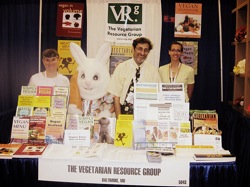
Pictures from Book Expo America in NYC last week! Thanks to Veronica Lizaola, Ashley Boss, and Karen Lazarus for helping us throughout the event as well!


BEA 2010

BEA 2010

BEA 2010

All Pizza Hut Cheeses Made with Chymax™, a Microbial Rennet

Posted on June 02, 2010 by The VRG Blog Editor

by Jeanne Yacoubou, MS
VRG Research Director

In February 2010, a reader asked us about the ingredients contained in The Natural™ pizza line at Pizza Hut. This line was first introduced in 2008 in test markets and then became nationwide in 2009. A purchasing manager at Pizza Hut told us that The Natural™ pizza line was discontinued from the national menu although it may still be available at certain Pizza Hut restaurants. Those that may carry it are franchises, not corporate-owned restaurants.

While inquiring into The Natural™ pizza line, we asked customer service representatives for an update on ingredient sources, especially since the Pizza Hut Ingredient Statement is no longer available on its website. The last information we received from Pizza Hut was in May 2007, when we were told by a Quality Assurance Specialist at the Dallas Pizza Hut headquarters that Pizza Hut cheeses were made with a non-animal enzyme.

We spoke with several people on the toll-free consumer line throughout February 2010 and received contradictory information. One time in mid-February, a representative told us that animal rennet was used to make the cheese.

The VRG found this information dubious considering what we were told in 2007 by Pizza Hut. Furthermore, we were told by several major enzyme manufacturers in 2008 that microbial rennet accounted for 80-95% of all enzymes used in cheese making in the United States. Thus we continued to research the question.

In May 2010, The VRG received confirmation through a source in management at the Pizza Hut corporate level, who had in turn been told in writing by the only supplier of all six varieties of its cheeses, that the enzyme used to make its cheese was microbial. Chymax™ is the brand name of the microbial fermentation product used to curdle the milk during cheese production. Our contact told us that his search lasted three months and led him to contact many companies along the supply chain, starting with the six from which Pizza Hut purchases its six cheese types, until he finally got to the cheese maker itself. He told The VRG that both corporate and franchised Pizza Hut restaurants must use companies chosen from an approved list of suppliers.

To cross-confirm what our Pizza Hut contact told us, The VRG contacted the senior product development specialist that sent the letter to our Pizza Hut contact. She confirmed that only Chymax™ is used to make its cheeses. She also stated that her company provides cheese to "the big three" quick-service chains in the United States as well as many other major restaurant chains. The company also sells its cheese to many major food service providers and food distributors, some of whom re-label the cheese using their own name.

Note: There is a specially-blended mix of Parmesan cheese and spices automatically sprinkled on all pizzas in Pizza Hut kitchens. Customers may request that it (known as "fairy dust" by staff) be left off.

Potato Tofu Breakfast Hash for a Week

Posted on May 26, 2010 by The VRG Blog Editor

Potato Tofu Breakfast Hash for a Week

Thanks to VRG volunteer Linda for this recipe!

I like savory breakfasts, and something that will stick to my ribs for the long morning ahead. I make this on the weekend and divide into seven containers for easy microwaving each morning.

Ingredients:

  • 3 small/medium potatoes, any kind
  • 1 medium or large onion, diced
  • 1.5 T. olive oil
  • 12-16 ounces extra firm tofu, crumbled
  • 3-4 cups steamed or otherwise cooked vegetables (or a mix) (asparagus, broccoli, corn, lima beans, peas, spinach, carrots, zucchini or other summer squash, etc.)
  • 1 t. salt (more if desired)
  • Sauce of your choice (pesto, enchilada, salsa, romesco, peanut, marinara, etc.)

Instructions:

  1. Boil the potatoes in water for about 20-25 minutes until done (not too soft). Let cool, then grate them (you don’t have to peel them – the peel comes off as you grate them).
  2. In a large pan (e.g., large frying pan or Dutch oven), sauté the diced onions in the olive oil until they start to turn golden.
  3. Add in the grated potatoes, the crumbled tofu, the cooked vegetables, and salt. Stir gently until combined.
  4. Divide into 7 containers for easy microwaving, and add your preferred sauce on top of each.

This recipe is infinitely flexible. You can substitute grain pilaf for the grated potatoes. You can try many combinations of vegetables and sauces.

When is Tuna not Fish?

Posted on May 25, 2010 by The VRG Blog Editor

Most know Tuna as a fish, the ‘chicken of the sea.’ However, there is another type of Tuna that has nothing to do with fish or animals at all. It is actually a fruit!

This ‘tuna’ that I am referring to is a bold green in color and about the size of a pear when its thick skin is still intact. It is a fruit that grows on a prickly pear cactus that is very abundant in the Mexico region.

It is perfect for hot, summer weather and is surprisingly sweet.

To prepare the tuna, make sure it is very clean and there are no thorns. You must be very careful in removing its skin for it is very thick and can give splinters if not cleaned properly. The best way to remove the skin is by chopping off about half an inch off each end and then slicing the tuna in the middle so that the skin can be easily peeled off and removed. All throughout the inside there are little gray seeds. Just bite into the tuna as you would a tomato. It will have a much more crunchier texture but all of it (except the skin) can be consumed.

Written by VRG intern Veronica Lizaola

YEA Summer Camp

Posted on May 21, 2010 by The VRG Blog Editor

Youth Empowered Action Camp is accepting applications for their summer programs (youth ages 11-16). If you are interested, contact details are below.

Youth Empowered Action Camp (YEA!) is a summer camp for young people ages
11 to 16 who want to make a difference in the world. YEA builds
knowledge, skills, confidence, and community to prepare young people to be
confident and effective changemakers. Youth will learn valuable
communications, leadership, and campaign skills during this six-day camp
in the Santa Cruz mountains. All participants will leave YEA camp having
chosen an issue important to them, having created a thoughtful plan of
action and the support of a community of peers and a year-long mentorship
to help make it happen. YEA has locations in the Santa Cruz Mountains, CA
and outside or Portland, OR.

What: Youth Empowered Action YEA! Summer Camp
When: Session 1: from July 25-30, 2010 OR Session 2: July 31-August 5, 2010
Where: Ben Lomond, CA, Santa Cruz Mountains

OR

When: August 14 – 21
Where: Molalla, OR just outside Portland
For more info, including inspiring testimonials and details about our
activities, please visit www.yeacamp.org, email [email protected], or
contact us at 415-710-7351.

Any Veg*n Readers Who Are/Were in the Military?

Posted on May 19, 2010 by The VRG Blog Editor

If there are any vegetarian/vegan readers who are (or were) in the military, we would love to hear from you for an upcoming article on the subject. Please contact Ann Marie at [email protected]. Thanks!

May 2010 VRG-NEWS online

Posted on May 19, 2010 by The VRG Blog Editor

The May 2010 issue of VRG-NEWS is being emailed out now, and is also available online.

VRG-NEWS is our free, monthly email newsletter which offers recipes, ingredient information, reviews of new products, announcements of new books, free samples of products, events, and highlights of materials that are available through VRG.

To sign up for VRG-NEWS, simply enter your first name, last name, and email address in the fields to the right on this page.

Back issues are available here.

VRG’s Guide to Food Ingredients Now Available Online

Posted on May 17, 2010 by The VRG Blog Editor

VRG's Guide to Food Ingredients

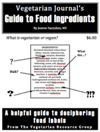
Our Guide to Food Ingredients, which lists the uses, sources, and definitions of 200 common food ingredients, has now been published in its entirety online: http://www.vrg.org/ingredients/

The Guide is also still available for purchase in print for just $6: http://www.vrg.org/catalog/index.php?main_page=product_info&cPath=1&products_id=8

Our objective in this Guide is to provide an easy-to-read, useful list of ingredients commonly found in many foods and beverages that indicates whether they are vegetarian, vegan, or non-vegetarian. Our Guide is unique in that we place emphasis on the commercial sources of ingredients most commonly used today while mentioning other possible sources of ingredients.

The Guide is one offshoot of an ongoing VRG food ingredients project. New information and changes in commercial processes and sources will constantly appear. Check http://www.vrg.org for updates.

We are happy to now provide this content on our website and hope that it continues to assist people in deciphering ingredient labels.

Your support allows us to continue this ingredient research and make updates as new information arises. Please consider making a donation here: https://www.givedirect.org/give/givefrm.asp?CID=1565

Chalet for Rent That Benefits VRG

Posted on May 14, 2010 by The VRG Blog Editor

Bear's Den Chalet

If you’re looking for a summer getaway in the Blue Ridge Mountains, or even a more permanent rental, Bruce Moose has several properties available where you can enjoy the mountains, wildlife, and also support VRG. They have just built a loft and done extensive work in one of their chalets, Bear’s Den, which backs up to the Shenandoah National Park with great views, and deer and bears as neighbors.

If you are interested, please contact Bruce Moose, and don’t forget to mention VRG, as a donation will be made to us!

  • Donate

  • Subscribe to the blog by RSS

  • VRG-NEWS

    Sign up for our newsletter to receive recipes, ingredient information, reviews of new products, announcements of new books, free samples of products, and other VRG materials.

    Your E-mail address:
    Your Name (optional):


↑ Top