Posted on
May 11, 2010 by
The VRG Blog Editor
VRG is in the process of compiling a set of Teen FAQs, written by our wonderful interns and volunteers.
Today we are featuring an FAQ about visiting Japan as a vegetarian, written by VRG intern Yuko Tamura:
I'm going to be traveling to Japan with my family. What do I need to know about being vegetarian in Japan?
Japan has a lot of foods like tofu or miso, which are globally well known especially among vegetarians, however, it is actually far from a vegetarian friendly country. Though Japan had a vegetable-oriented eating style in the past, food-westernization completely changed the landscape. Now meat is found everywhere and many people believe that having meat, fish and dairy products is good for their health. Therefore, it can be challenging to be a vegetarian in Japan. In a society where animal product consumption is strongly encouraged, people tend to be prejudiced against a vegetarian way of eating.
However, we, who used to be rarely meat eaters, have developed very healthy and nutritious vegetarian food. Tofu and soy lovers will definitely get excited to see shelves filled with a variety of tofu and unique traditional soy products such as natto or yuba in supermarkets. (Natto is soybeans fermented by natto bacillus, it is sticky and has strong smell and taste. Yuba, also known as bean curd skin, is the skin that forms on soy milk when it is heated. Both are highly nutritious and good sources of protein.) These products are often served with fish and seaweed stock called "dashi" in restaurants, but when you buy and cook them by yourself, you can enjoy them without dashi. In fact, these products are delicious when you use only salt or soy sauce for seasoning. If you stay in a ryokan (Japanese traditional hotel with tatami and futon) or a hotel with cooking facilities, you can also try cooking Japanese noodles without dashi. You can season them with soy sauce and sweet sake.
Since many Japanese dishes are cooked with dashi or any kind of animal products (mainly fish and seafood), it is actually very difficult to find vegetarian dishes in Japanese restaurants. I have to tell you that the availability is limited, still, there are some. At first, you can order a bowl of steamed rice, the everyday must for Japanese. Then as side dishes, try vegetable pickles, fried tofu, grated radish, vegetable tempura, fried noodles or okonomiyaki without meat and sauce. (Okonomiyaki, or vegetable pancake, is usually made with eggs, but you may be able to ask for them prepared without eggs. You also need to ask not to put sauce, which usually contains animal products.)
Click here to read the entire FAQ.
Category
Students, Teens
Comments
0
Posted on
May 07, 2010 by
The VRG Blog Editor

VRG will be having a booth at Veggie Pride Parade! See details below, and stop by and say hi!
*********************
Veggie Pride Parade NYC
http://www.veggieprideparade.org/
Sunday, May 16, 2010
Veggie Pride Parade is a noncommercial First Amendment event.
Parade line-up, 11 a.m.
Start point:
9th Avenue & Gansevoort Street
New York, NY
Download poster with map (PDF):
http://www.veggieprideparade.org/pdfs/veggieprideposter.pdf
Parade launch:
12 Noon
Parade route:
Start point: 9th Avenue & Gansevoort St.
southeast on Greenwich Avenue
east on 8th Street
north on University Pl.
to Union Square Park (north end, across from Barnes & Noble)
Category
Events
Comments
1
Posted on
May 06, 2010 by
The VRG Blog Editor
If you’re raising veggie kids right now or plan on starting a family soon, you may want to join The Vegetarian Resource Group’s online parents list. See: http://groups.yahoo.com/group/vrgparents/
This group now has over 1,500 families participating. A wide range of questions are raised and parents quickly respond with supportive and practical advice from their own experience raising veggie kids. Some questions have included:
- Parent looking to relocate to a veg-friendly area to raise family.
- Someone looking for green bed for child that is moving out of
their crib.
- Someone looking for help to raise hypoglycemic child veggie.
- Parent asked if it was worth it economically to join a CSA Farm.
- Parent raising kid veggie without soy asked for suggestions on
what to feed him high in protein, etc.
- Someone looking for help with vegan food ideas for an 18 hour
train ride.
- Searching for natural alternatives to give a child with a stuffy
nose and cough.
- Kids looking for veggie pen pals.
- What’s a reasonable food budget for a vegan family of 4 (2 adults, 2 kids)?
- Child is starting pre-school. How do I explain that we are vegan
and I don’t want my child to be given non vegan food, etc.
Category
Kids
Comments
0
Posted on
May 05, 2010 by
The VRG Blog Editor

Our brochure Save Our Water: The Vegetarian Way is now available online in Spanish: ¡Salvemos el agua por medio del vegetarianismo!
Thanks to VRG volunteers Cecilia and Elizabeth for translating this!
Sin lugar a dudas, todos necesitamos agua limpia. Cómo obtenerla y mantenerla limpia y abundante se está convirtiendo en un problema universal. De hecho, la FAO (la Organización para la Alimentación y la Agricultura de las Naciones Unidas), en un informe titulado La larga sombra del ganado (Livestock’s Long Shadow), predice que en el año 2050, dos tercios de los seres humanos en todo el mundo carecerán de agua potable para satisfacer sus necesidades básicas. Sin embargo, una parte de la solución es fácil y factible. Todo comienza con el tenedor. Read more
Category
Environment
Comments
0
Posted on
April 29, 2010 by
The VRG Blog Editor
Nucoa Margarine Still an All-Vegetable Product Despite Label Change
by Jeanne Yacoubou
VRG Research Director
A reader recently asked The VRG if Nucoa margarine was still whey- and dairy-free. She was concerned because of a recent label change that removed the words “contains no milk or whey” from the tub container.
The VRG contacted Nucoa’s manufacturer and spoke with Connie, a Customer Service Representative. She assured us the change occurred only on the label. The margarine still is free of any and all milk products. The lactic acid in Nucoa is derived from corn and all flavors are non-animal as well.
The Nucoa tub margarine did undergo a reduction in total fat from 10g to 7g; the sticks did not undergo a reformulation keeping their total fat steady at 11g. Connie informed us that Nucoa is available only regionally, being most commonly available in California, Arizona, and Nevada.
Category
Research
Comments
134
Posted on
April 27, 2010 by
The VRG Blog Editor
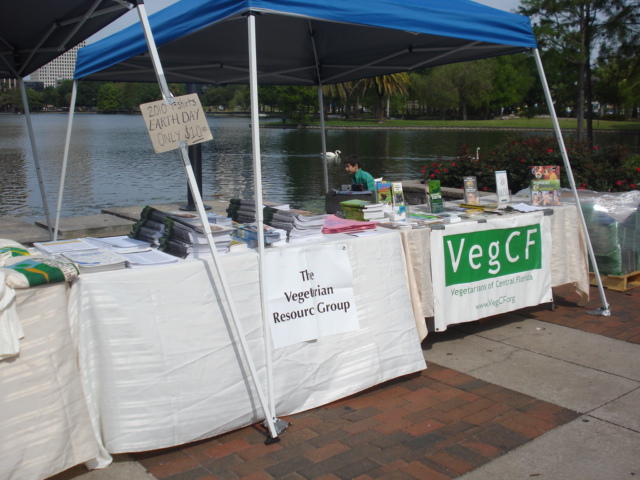
Thanks to VRG volunteer Jacqueline for staffing our table at Central Florida Earth Day this past Saturday! We’re glad that lots of people took copies of VRG’s brochures and our Vegetarian Journal.
You can read Jacqueline’s write-up, and see some mouthwatering pictures of the vegan food that was available at the event, on her blog:
http://www.vegblogger.com/blog/2010/04/what-do-vegetarians-eat-at-central-florida-earth-day-a-lot.html
Category
Events, Pictures
Comments
0
Posted on
April 26, 2010 by
The VRG Blog Editor
PART-TIME JOB: Vegan group seeks volunteer/educational materials coordinator in Baltimore. 29 hours per week, with possibility for future full time job.
Please send resume, a writing sample, and cover letter addressing your short term and long term goals, interests, vegetarian and vegan knowledge, skills, strengths, and challenges to [email protected].
Category
Employment
Comments
0
Posted on
April 23, 2010 by
The VRG Blog Editor
A reader asked if the vitamin D in cow’s milk is animal derived.
VRG Researcher Jeanne Yacoubou responds:
Thanks for your recent inquiry to The VRG about possible animal-derived ingredients added to cow’s milk.
According to the National Institutes of Health Fact Sheet on Vitamin D, http://dietary-supplements.info.nih.gov/factsheets/vitamind.asp, vitamin D3 derived from lanolin, (the oily wool of sheep), is the form of vitamin D that is typically added to cow’s milk in the United States. It may also be added to evaporated milk and infant formulas, margarine, and yogurt. Vitamin D2 derived from yeast may be added to certain rice milks and soy milks. Either, but mostly vitamin D3, may also be added to fortified breakfast cereals and fruit juices.
The VRG Guide to Food Ingredients may have more information of interest to you.
Category
Research
Comments
0
Posted on
April 20, 2010 by
The VRG Blog Editor
by Jeanne Yacoubou, MS
VRG Research Director
Maryland-based Martek Biosciences Corporation, which created a microalgae-derived form of DHA (docosahexaenoic acid), an omega-3 fatty acid important for brain, eye, and heart health and often derived from fish oil, is formulating a fermentation process using bacteria to create a non-animal derived chondroitin. Chondroitin, believed to be important in joint health, is used by many with osteoarthritis or similar conditions. Currently, chondroitin is derived from the cartilage of sharks and sometimes pigs and cows. For its non-animal chondroitin, Martek is working in conjunction with the Japanese company, Seikagaku.
Martek expects its microbially-derived chondroitin to be on the market in two years. For more information, visit their website at www.martek.com.
Category
Research
Comments
1
Posted on
April 19, 2010 by
The VRG Blog Editor
If you have general nutrition questions, Mark Rifkin, MS, RD, LDN, will be available from 2:30 p.m. – 5:30 p.m. EST on Friday, May 7, 2010. To reserve a 20-minute time slot, please email the VRG office at [email protected] or call (410) 366-8343.
Please be advised that these sessions are not individualized nutritional counseling. Such advice should only be provided through direct in-person contact with a qualified health professional. There is no charge, but if you do commit, please call on time. Otherwise you are taking someone else’s spot.
Mark Rifkin, a VRG volunteer since the mid-1980s, holds a Master’s Degree in health education and is a Registered Dietitian. Through many different settings, he focuses on plant-based diets to prevent and treat chronic diseases and nutrient deficiencies, particularly for women, seniors, minority populations, and vegetarians. He also presents on other topics, such as reducing food costs and “green” issues. He has been presenting on nutrition and food-related topics since 1997.
In addition, Mark is offering a 20% discount on any service for VRG members. This is for his private practice and is not affiliated with The VRG or Call-A-Dietitian Day.
Category
Events
Comments
0