Posted on
December 23, 2020 by
The VRG Blog Editor
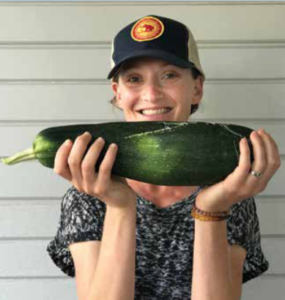
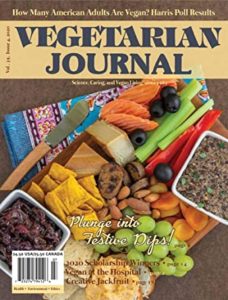
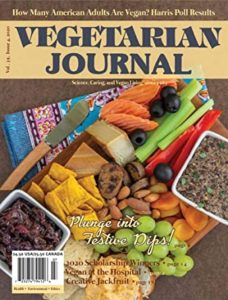
Each issue of Vegetarian Journal features a vegan activist. In the latest issue
we honor Wendy Gabbe Day. She coordinated the Santa Cruz, California 2019
VegFest, hosts webinars, wrote a cookbook called Scatter Vegan Sweets, and writes a blog titled Lively Days, which features many of her family’s favorite recipes.
Posted on
December 22, 2020 by
The VRG Blog Editor
Reed Mangels, PhD, RD, reviews
recent scientific papers related to vegetarianism in the present issue of Vegetarian Journal. Topics covered
include Eat a Carrot Every Day!; Human Milk: The Ideal First Food; and Vegan
Motivations.
Posted on
December 22, 2020 by
The VRG Blog Editor
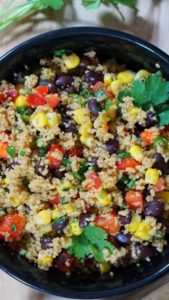
Salads are popular during summer months; however, you can prepare a
delicious warm winter salad as well. A previous Vegetarian Journal article
by Debra Daniels-Zeller provides recipes for Spicy Black Bean, Corn, and
Couscous Salad; Buckwheat and Rice Salad with Balsamic Vinaigrette; Hot Italian
Bean and Pasta Salad with Broccoli; Curried Lentil Salad; Sesame Noodles with
Wilted Greens; Whole Grain and Cabbage Salad with Lemon-Peanut Dressing; and
Smoky Potato-Squash Salad.
Posted on
December 21, 2020 by
The VRG Blog Editor
Photo from Frey Vinyards
By Emilio Gironda, The Vegetarian Resource Group Volunteer Coordinator
While wine contains mostly vegan friendly components – grapes, yeast, and (sometimes) sulfites – the processing of wine involves ingredients of concern to both vegetarians and vegans alike. Here are some links to various articles on the issues presented, a list of American Wineries than only sell Vegan Wines, and links to listings of Vegan-friendly Wines. Cheers!
The contents of this posting, our website, and our other publications, including The Vegetarian Journal, are not intended to provide personal medical advice. Medical advice should be obtained from a qualified health professional. We often depend on product and ingredient information from company statements. It is impossible to be 100% sure about a statement, info can change, people have different views, and mistakes can be made. Please use your best judgment about whether a product is suitable for you. To be sure, do further research or confirmation on your own.
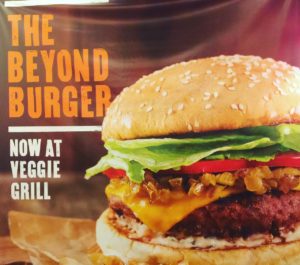
We noticed
that the VG Classic menu item featuring a Beyond Burger®
at Veggie Grill had different nutritional values for the patty alone
than those posted on the Beyond Meat (BM) website for the Beyond Burger patty.
Veggie Grill
(VG) is a fast-casual vegan restaurant chain currently in New York,
Massachusetts, Illinois, California, Oregon, and Washington that has been
enjoyed by VRG staff and volunteers. See https://www.veggiegrill.com/
Using Veggie
Grill’s online nutrition calculator, https://www.veggiegrill.com/nutrition-calculator.html
and eliminating all condiments, the Beyond Meat Beyond Burger®
patty in their VG Classic menu option received the following nutritionals:
[VRG note:
To see the nutrition facts for the patty itself on the Beyond Meat website,
click on the leftmost label (there are four) below the large photo of the trial
pack from the link above.]
The VRG
noticed that the Veggie Grill website calculator did not list a patty weight.
Beyond Meat’s website label stated it was 4 oz. Thinking that a
difference in serving size weight, cooking method, different ingredients – or
some combination – created the discrepancies, we contacted both Beyond Meat
and Veggie Grill for more information.
Initial
Response from Beyond Meat Customer Service
The Customer
Care Team at Beyond Meat, quickly replied in May 2020 by saying:
“…when our
products are in restaurants, the restaurant does have the liberty to cook and
serve our products as they wish – this is the same for U.S. and international
restaurants. Therefore the nutritional information for our retail burger and
the one at Veggie Grill may be slightly different depending on size. We hope
this clears things up!”
Beyond Meat also
told us, “Our nutrition information is for our products uncooked, we don’t have
information to offer for after cooked.”
Response from
Veggie Grill Customer Service
We received a
reply to our inquiry using the Veggie Grill website contact request form.
“…We have
followed up with our culinary team and confirmed that we receive a proprietary
patty that is different than what can be purchased at the store. This would
explain why the nutritional information is different than what is listed on
their website.”
The VRG
followed up by asking about whether the patty nutritional values were for a
cooked or uncooked patty. We also wanted to know how much it weighed.
Veggie Grill
responded that “A representative from Beyond Meat will contact you shortly to
answer all of your questions regarding the Beyond patties we use at our
locations. We believe this will be the best solution as they will have all of
the answers for you as the patty that we use is not the exact same as what can
be purchased in a store.”
Later
Responses from BM
We received
an email from Beyond Meat and learned:
There is a retail Beyond
Meat patty and a food service (FS) patty.
Veggie Grill receives
a foodservice patty from Beyond Meat.
Consumers purchase
retail Beyond Meat patties in the store.
There is less fat in
the retail product than in the foodservice patty.
The added fat (in
this case, coconut oil) is there to prevent the patty from drying out until
it’s served to a restaurant guest.
Both the retail patty
and the foodservice patty have the same proteins (that is, pea proteins and
brown rice) but in different amounts.
Veggie Grill receives
a 4 oz. patty.
Beyond Meat then sent us specification sheets for the retail and foodservice burgers. Specification sheets, also known as spec sheets, give information – including nutritional data – about products. They are intended for wholesale customers, although general consumers can request to see them.
Here is the relevant information from the spec sheets:
Retail BM patty (4 oz.)
Food Service BM patty (4 oz.)
Calories: 260
Calories: 280
Sodium: 350 mg
Sodium: 390 mg
Satd. Fat: 5 g (Total fat: 18 g)
Satd. Fat: 6 g (Total fat: 20 g)
Here is the
ingredient statement for the food service patty:
Water, Pea
Protein Isolate, Expeller-Pressed Canola Oil, Refined Coconut Oil, Rice Protein,
Natural Flavors, Mung Bean Protein, Methylcellulose, Potato Starch, Apple
Extract, Salt, Potassium Chloride, Vinegar, Lemon Juice Concentrate, Sunflower
Lecithin, Beet Juice Extract (for color), Pomegranate Fruit Powder, Lycopene
Color (from Tomato).
Here is the
ingredient statement for the retail patty:
“Water, Pea
Protein, Expeller-Pressed Canola Oil, Refined Coconut Oil, Rice Protein,
Natural Flavors, Cocoa Butter, Mung Bean Protein, Methylcellulose, Potato
Starch, Apple Extract, Pomegranate Extract, Salt, Potassium Chloride, Vinegar,
Lemon Juice Concentrate, Sunflower Lecithin, Beet Juice Extract (for color).”
The
specification sheets created more questions, since the values from Veggie
Grill’s online calculator (shown above) were different from both of the
spec sheets. These are responses from Veggie Grill to additional questions we
asked.
“We do not
add any oil to the flat top when cooking the burgers because the burgers
contain enough fat in them.
Depending on
what style we are doing, sometimes seasonings are added (those are included in
the nutritionals we post). All of our burgers have sauces, garnishes, breads,
etc. added. Any ingredient we use on our
burgers is included in the nutritionals. It will never be JUST the patty
nutritionals.”
The last
reply implies that something else beside the patty is included in the
stated nutritional values given above for the Veggie Grill patty since they are
greater than those of the foodservice patty.
In reply to
our additional questions, Beyond Meat said, “Also, the reason you are seeing a
discrepancy in spec sheet info is most likely due to the fact we are constantly
innovating and improving our products so our spec sheets are constantly
changing.”
September
Follow-up from Veggie Grill
Here is
additional information we learned from our phone conversation with Veggie Grill:
The patty Veggie
Grill uses from Beyond Meat is “smaller in terms of ounces” than the retail BM
burger.
No salt is added to
the burger.
The burger isn’t grilled
in oil.
“…Some of the confusion may be in that we are in the
process of doing a 90% overhaul to our menu and so over the past few months,
our burger skus have changed slightly as we’ve perfected the menu items. [VRG
Note: SKU, or stock-keeping unit, is a unique identifier for an item sold by a business. Businesses
create their own codes based on various characteristics of their merchandise. This allows
vendors to track inventory. Each business has its own definitions of skus for
internal use, unlike other identifiers of a product, which are the same for all
businesses. A Beyond Burger at one chain would have a different SKU than at another
restaurant chain.]
Also within that time, Beyond Burger switched their
formula. So the actual nutritionals have changed a few times, although we try
to keep up with those changes in all portals as they happen…We are extremely
committed to and conscious of the need for transparency in our nutritional
information. Our menu items change frequently, and the vendors we use also make
changes. It is common for nutritionals to change on menu items even though the
overall item may not appear to change for the guest.”
VRG had observed on Beyond Meat’s foodservice spec sheet
and a NFP (nutrition facts profile) sent to us stating that it was “the
nutritional statement from Beyond Meat.”
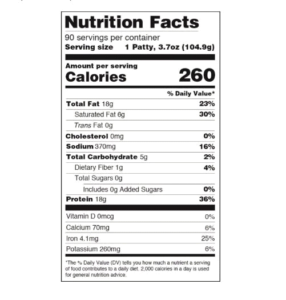
Here is that NFP (nutrition facts profile):
Upon seeing the 3.7 oz serving size, The VRG learned that
Beyond Meat has several different formulas. Their standard is 4 oz., but Veggie
Grill uses a 3.7 wt oz. patty.
It was at this time, when we checked the Veggie Grill website,
that the Nutrition Facts Profile for the Beyond Meat patty alone on the Veggie
Grill nutrition calculator no longer showed the April 2020 values (shown
above). Now the values were:
Calories: 260
Sodium: 370 mg
Saturated Fat: 6 g
These were
the same values shown on the Nutrition Facts Profile (above) and attributed as
coming from Beyond Meat.
The VRG performed a proportional analysis of Beyond Meat’s
and Veggie Grill’s values using the numbers listed on the Beyond Meat spec
sheet (sent to us by Beyond Meat) for the food service patty and those now
appearing on Veggie Grill’s calculator, taking into account weight differences:
Assuming
there may be slight discrepancies due to rounding, the proportional analysis
indicates that website differences are due – at least in part – to the patty
size difference (4 oz. vs. 3.7 oz.)
Veggie Grill
confirmed it does not grill the patty in any oil. Therefore, the difference in
calories between the Veggie Grill and Beyond Meat websites is not due to
cooking. Veggie Grill also confirmed no sodium was added before serving,
during, or after cooking. If so, sodium would be included in the nutritionals.
General
Conclusions on Veggie Grill’s VG Classic made with Beyond Meat’s Beyond
Burger
Based on
information from Beyond Meat and Veggie Grill, we know that:
The nutritional
values for the uncooked retail burger appear on the Beyond Meat site.
The VG Classic
burger values are based on a cooked patty made by Beyond Meat for food service
(that is, restaurants, hospitals, schools, etc.)
The Beyond Meat
patties (food service and retail) are listed on their respective specification
sheets as 4 oz. each uncooked. Beyond Meat told us this on several
occasions, too.
Veggie Grill reports
that the patty sold to them by Beyond Meat is listed as being 3.7 oz.
A proportional
analysis of the nutritional values confirms, notwithstanding minor rounding
discrepancies, that the 0.3 oz. weight difference (4.0 oz. – 3.7 oz.) accounts
for differences in calories and sodium between the two patties.
No differences in
saturated fat amounts were observed. Beyond Meat told us that the foodservice
patty has “added fat” – more than the retail burger ounce for ounce.
(See chart above.) Since the Veggie Grill food service patty is smaller, (3.7
oz.), its saturated fat content should be slightly less than the
saturated fat content in a 4 oz. food service Beyond Meat burger – according
to proportional analysis. A possible explanation for this apparent anomaly
may be due to rounding.
Veggie Grill states
that the nutritional values for the Beyond Meat patty used in their VG
Classic, currently appearing on their online calculator, are the identical
values reported to them by Beyond Meat.
Thank you to Beyond Meat and Veggie Grill for all your
assistance in answering these questions.
The contents of this
posting, our website, and our other publications, including Vegetarian Journal,
are not intended to provide personal medical advice. Medical advice should be
obtained from a qualified health professional. We often depend on product and
ingredient information from company statements. It is impossible to be 100%
sure about a statement, info can change, people have different views, and
mistakes can be made. Please use your best judgment about whether a product is
suitable for you. To be sure, do further research or confirmation on your own.
Which of the following, if
any, best describes your eating behavior?
-I never eat meat, fish, seafood, poultry, dairy, or eggs. -I never eat meat, fish, seafood, or poultry. -I never eat meat, fish, seafood, poultry, dairy, or eggs when eating out or getting takeout, but eat one or more of these foods at home. -I never eat meat, fish, seafood, or poultry when eating out or getting takeout, but eat one or more of these foods at home. -When eating out or getting takeout, I sometimes eat meals without meat, fish, poultry, dairy, or eggs. -When eating out or getting takeout, I sometimes eat meals without meat, fish, or poultry. -None of these.
We considered those that
never eat meat, fish, seafood, or poultry; plus those that never eat meat,
fish, seafood, poultry, dairy, or eggs, as vegetarian. We classified that
second category of vegetarians who don’t eat dairy or eggs also as vegan.
Because we use the word “never” and don’t just ask if a person considers
him/herself vegetarian, our numbers may be lower than others. Be wary of
comparing to polls in other countries that ask if you are vegetarian or vegan,
since people may self define differently. We did not ask about honey.
More than half of the U.S. adult population (54%) always
or sometimes eats vegetarian (including vegan) meals when eating out. One
fourth (25%) of U.S.
adults always or sometimes eats vegan meals when eating out. Six percent of
American adults are vegetarian (including vegans) all the time, and half of the
vegetarians are also vegan (three percent of American adults).
Looking at the number of vegetarians
(including vegan) by race/ethnic group shows few differences across the groups,
which reflects information we have found in other polls we have conducted. Six
percent of Latinos and Asians were vegetarian, while 5% of Blacks were
vegetarians, all of which is pretty close to the U.S. total for all adults.
However, of the 5% of Blacks that are vegetarian, included are 4% vegan and 1%
not vegan. From our experience, vegetarians from India often have a hard time
giving up dairy which is a part of their culture, so it makes sense that vegan
was such a small percentage of Asian vegetarians (6% vegetarians including
vegans – with less than 1% vegan.)
Black
1% Vegetarians (not including vegans)
5% Vegetarians (including vegans)
4% Vegans
55% Eats vegetarian meals including vegan sometimes or always when eating out
27% Eats vegans meals sometimes or always when eating out
Most important when making food choices: taste (58%); personal health (43%); cost (37%)
Latino
3% Vegetarians (not including vegans)
6% Vegetarians (including vegans)
3% Vegans
64% Eats vegetarian meals including vegan sometimes or always when eating out
30% Eats vegans meals sometimes or always when eating out
Most important when making food choices: taste (49%); cost (38%); personal health (35%)
Asian
6% Vegetarians (not including vegans)
6% Vegetarians (including vegans)
<1% Vegans
59% Eats vegetarian meals including vegan sometimes or always when eating out
23% Eats vegans meals sometimes or always when eating out
Most important when making food choices: taste (55%); cost (40%); personal health (36%)
Total
3% Vegetarians (not including vegans)
6% Vegetarians (including vegans)
3% Vegans
54% Eats vegetarian meals including vegan sometimes or always when eating out
24% Eats vegans meals sometimes or always when eating out
Most important when when making food choices: taste (57%); cost (38%); personal health (36%)
In 2016, we asked what the
main reason you eat/you would eat meals without meat, fish, seafood, or poultry.
Top reasons that black individuals eat/would eat meals without meat, fish,
seafood, or poultry were health (38%) and cost (11%). For Latinos it was
health reasons (31%), cost (5%), animals (5%), and inability to obtain animal
products that are organic, GMO-free, or labeled humane (5%). Taste was not a
choice. We can’t compare the poll questions directly since they were different
questions. See: 2016 poll at https://www.vrg.org/nutshell/Polls/2016_eating_out.htm
This survey was conducted online within the United States by The Harris Poll on behalf of The Vegetarian Resource Group from June 22-24, 2020 among 2,074 U.S. adults ages 18 and older. This online survey is not based on a probability sample and therefore no estimate of theoretical sampling error can be calculated. For survey methodology, please contact [email protected]. Please note that this poll was taken during the Covid-19 pandemic. We do not know what influence, if any, that may have had on the survey answers. See: https://www.vrg.org/nutshell/faq.htm#poll for more poll information
Posted on
December 17, 2020 by
The VRG Blog Editor
Through December 31, 2020, you can give a gift membership to The Vegetarian
Resource Group (includes a 1-year subscription to Vegetarian Journal) for $15 each. Offer is valid
in the USA only!
This is a terrific way to share the vegan message, as well as support VRG
outreach. Gift subscriptions can be done online by simply typing in your
message and the name and address of each gift recipient in the comments field.
Go to: www.vrg.org/donate
Posted on
December 16, 2020 by
The VRG Blog Editor
A Vegetarian Resource Group member wrote that she purchased a hair product in a rush, saw the “cruelty-free” bunny, and assumed it was vegan. “Get home and read the ingredients and it has silk protein in it. Don’t be fooled by the little bunny… it doesn’t mean it’s vegan.”
According to Leaping Bunny FAQs, “To assist shoppers looking for vegetarian or vegan cruelty-free products, we ask our brands to let us know if they have some products which qualify and have included a refined search option on our website.” So though these products don’t involve experimentation on animals, they are not necessarily vegetarian or vegan.
Companies may be certified by PETA under one of two designations:
Global animal test–free recognizes companies and brands that have verified that they and their suppliers do not conduct, commission, pay for, or allow any tests on animals for their ingredients, formulations, or finished products anywhere in the world and that they will never do so in the future.
Global animal test–free and vegan recognizes companies and brands that meet the same requirements and whose entire product line is free of animal-derived ingredients. These companies are truly cruelty-free.
And a company can put their own bunny on a label. So always make sure to read ingredients.
The contents of this posting, our website and our other publications, including Vegetarian Journal, are not intended to provide personal medical advice. Medical advice should be obtained from a qualified health professional. We often depend on product and ingredient information from company statements. It is impossible to be 100% sure about a statement, info can change, people have different views, and mistakes can be made. Please use your best judgment about whether a product is suitable for you. To be sure, do further research or confirmation on your own.
The Vegetarian Resource Group (VRG) is a non-profit organization dedicated to educating the public on veganism and the interrelated issues of health, nutrition, ecology, ethics, and world hunger. We have been helping health professionals, food services, businesses, educators, students, vegans, and vegetarians since 1982. In addition to publishing the Vegan Journal, VRG produces and sells a number of books.
Sign up for our newsletter to receive recipes, ingredient information, reviews of new products, announcements of new books, free samples of products, and other VRG materials.