The Vegetarian Resource Group Blog

LEXVEGFEST OCTOBER 1, 2016

Posted on September 29, 2016 by The VRG Blog Editor

unnamed

LexVegFest (October 1, 2016 from 11:00 a.m. to 4:00 p.m. at 2312 Palumbo Dr, Lexington, KY 40509) is the first annual VegFest in Lexington and central Kentucky sponsored by GA Sanctuaries and Housewarmings. Our mission is to celebrate and promote plant-based lifestyles for health, environment, and compassion for animals. LexVegFest will feature local speakers, delicious food and drink, vendors, cooking demonstrations, informative exhibitors, children’s activities and more.

Our Facebook page: https://www.facebook.com/lexingtonvegfest/
Contact: [email protected]

The Notion “You Must Care About Animals More Than People”

Posted on September 28, 2016 by The VRG Blog Editor

file4591244373579

By Whitney Gray, VRG intern

Sometimes I think to myself that people are strange, but I’ve realized we’re mostly all the same. We like to compartmentalize. There’s so much to take in throughout our lives that it’s easier to make ideas black and white, to label, or to “other” each other based off of the knowledge of a few traits or beliefs. One perplexing comment you may have heard as a vegan is, “Oh, you’re vegan? You must care about animals more than people.” I know I have a few times. Somewhere along the way we’ve been labeled as misanthropic plant pushers, which is at best comical and at worst a little disheartening. It sounds trivial, but what does it mean for veganism if all people hear when they hear the word “vegan” is a self-righteous tree hugger who cares about a cow more than the homeless? Here a few of my points to counteract this accusation that might help you as well.

We’re all Multidimensional
Who said caring about animals cancels out any concern one might have for all of the world’s injustices and social ills? You wouldn’t say that loving your mom has to mean that you can’t love your dad. It’s much like the child in first grade who dumps you because they found another kid to play with and for some reason they believe that they can’t have more than one best friend. It’s always interesting when one of those mournful infomercials with sickly and fragile cats and dogs comes on and someone interrupts Sarah McLachlan’s “In the Arms of The Angel” to say, “Why would I donate to that when there’s plenty of starving children to feed?” (meanwhile doing nothing to feed starving children). I, like many others, have the capacity to care about a variety of causes with animal rights being just one not pertaining specifically to humans.

People are Animals???
I’m sure mostly everyone has heard this in a science class at some point in their life. Humans are animals. We may walk upright, wear clothes, create technology, and enjoy a spoken and written language, but we’re still animals. You don’t have to get into an argument with anyone on whether humans are more important than other animals or not (or weird hypothetical questions on whether you’d save your dog or a toddler about to drown in a river). The main point is that we all contribute something different to this world. Different animals have their different traits and qualities that we don’t, even if some label those as insignificant. Also, let’s not forget that we are the ones senselessly killing each other and killing the planet. And while there can be a lot of anger in such a statement, we are all a part of society, so no individual can be put on a pedestal or condemn the rest of humankind. If I were to hate humans, I’d have to hate myself as well.

Veganism is about Compassion
It is for me personally at least. If anything, veganism has strengthened my patience and understanding towards others. I find that when many people become passionate about an idea, they become angry, vicious, and practically insufferable when they were in the opposite position just moments ago. Because of this, I understand why vegans get type casted at times. However, I want to extend kindness to all sentient beings, including humans that may or may not lead a similar lifestyle or eat a similar diet. Of course nothing is perfect and there are various arguments on whether any of our efforts with veganism or any other cause make a difference, but in my eyes, it’s worth a try.

Bottom line is be confident in why you made this decision and don’t let others place you in a box where you don’t fit. Often times when we are confronted with a concept far outside our worldview, we reject not only the concept as extreme, but also the person. What the people who say, “You must care about animals more than people,” don’t realize is that I’m just their neighbor like anyone else, and not some radical on the fringe of society trying to start an animal revolution a’la George Orwell’s Animal Farm. My advice is let the naysayers know you care for them…and the cows of course.

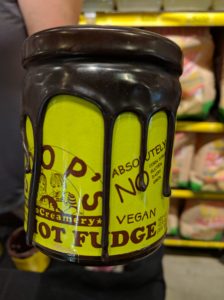
Review of COOP’s Micro Creamery® Hot Fudge Sauce

Posted on September 27, 2016 by The VRG Blog Editor

By John Lytle

My review:
This is a damn good Hot Fudge Sauce. It demonstrates one of the best possible uses of coconut cream. The taste is wonderful!!! Hope you try this product and enjoy it as much as I did.

This web page has an announcement about the new Vegan version part way down the page:
http://coopsmicrocreamery.com/fudge.html

Yummy Plants review:
http://yummyplants.com/product-reviews/vegan-hot-fudge-coops-microcreamery-review/2016-09-23-17-15-05

JOIN US AT THE VEGETARIAN RESOURCE GROUP’S VEGAN THAI DINNER IN BOSTON AT MY THAI VEGAN CAFE

Posted on September 27, 2016 by The VRG Blog Editor

o

JOIN US AT THE VEGETARIAN RESOURCE GROUP’S VEGAN THAI DINNER IN BOSTON AT MY THAI VEGAN CAFE
Sunday, October 16, 2016, 6 PM

The Vegetarian Resource Group will host a vegan Thai dinner
at My Thai Vegan Café in Boston on Sunday, October 16, 2016 during the
annual meeting of The Academy of Nutrition and Dietetics. Meet VRG
advisors Reed Mangels PhD RD, Catherine Conway MS RD, Debra Wasserman,
and vegetarian dietitians from around the country. All are welcome.

MENU:
Tom Kha, Thai Coconut Soup with tofu
Thai Mango Salad
Nam Prik Kaeng Kari with tofu (Yellow http://findviagra.com Curry) and brown rice
Pad See Ew. Wide rice noodles with Chinese broccoli and vegan gluten.
Fruit cocktail for dessert or other fruit
Tea and cold water

This will be a plated sit down dinner.

TO RESERVE: Send $30 person (includes tax and tip) (Under eight is half
price) with names of attendees to The Vegetarian Resource Group,
P.O. Box 1463,
Baltimore, MD 21203.
Call (410) 366-8343.

You can also pay at www.vrg.org/donate and write Boston Dinner in the Comments.
Refunds after September 30th only if your seat can be replaced.

Hope to see you there!

Vegetarian Market in Germany

Posted on September 26, 2016 by The VRG Blog Editor

By Alicia Hückmann, VRG intern visiting from Germany

Vegetarianism and Veganism in Germany
The market for vegan and vegetarian foods in Germany is growing rapidly. According to Mintel, one in ten foods/drinks newly introduced to the market was labeled vegan – twice as much as the European average. Furthermore, the number of vegetarian ready-made foods (including salads, sandwiches, wraps, pizza, pasta, pastry, etc.) showed a seven-fold increase between 2011 and 2015; those labeled “vegan” experienced a twenty-fold increase. For the market as a whole, this means that about 12% of all instant meals launched in 2015 were meat-free and 9% vegan.

Germans do not only buy more vegetarian and vegan products than they used to, they are also more interested in cruelty-free cooking and baking: The number of vegan cookbooks published in 2015 (119) is about ten times higher than it was back in 2011 (12), as reported by the VEBU (German Vegetarian Union).

On first sight, these numbers might imply that Germany is about to be taken over by literal Krauts. Surveys on vegetarianism and veganism, however, paint a different picture. According to a representative study by the University of Hohenheim, only 1.5% of Germans (20% of whom are vegan) had banned meat, fish, and poultry from their fridges in 2013, another 2% only meat and poultry. The numbers of vegetarians and vegans in the US as provided by the VRG are twice as high (3% and 1% respectively).

As is the case for many surveys, the problem with most studies on vegetarianism that are publicly available is transparency. While Hohenheim gives a relatively clear definition of what they consider to be strictly vegetarian (no meat, no poultry, no fish), other institutes like YouGov allow their participants to answer all questions according to their own individual ideas of what vegetarianism is. If presented with a questionnaire that only differentiates between ‘meat-eater,’ ‘vegetarian,’ and ‘vegan,’ pescetarians, occasional meat-eaters, and flexible vegans will probably tick one of the latter two options rather than the first one. It is therefore not surprising, that YouGov’s numbers are four times as high as Hohenheim’s (6%). The German Vegetarian Union reports that the numbers of vegetarians and vegans are as high as 10%; however, the surveys they mentioned are even less transparent than YouGov’s and should thus be treated with caution.

The fact that none of the publicly accessible surveys except Hohenheim includes a clear definition of what a vegetarian or a vegan is makes it virtually impossible to provide accurate statistics. As a consequence, there is currently no data available that is reliable enough to either support or contradict Hohenheim’s figures.

“Flexitarians” and Meat-reducers
Research on so-called flexitarians and meat reducers, on the other hand, is surprisingly popular and scientifically conducted. It is likely that they are the main reason meat-less foods are on the rise in Germany, more so than strict vegetarian and vegan. Recent statistics by the GfK (society for consumption research) show that casual meat eaters consume 20 percent less meat in comparison to regular meat-eaters while at the same time consuming up to five times more meat alternatives than “non-flexitarians.” Furthermore, the University of Hohenheim claims that about 12% of the population identify as flexitarian; another 10% are willing to cut down on meat. If we believe these figures, roughly a quarter of Germany’s population is going to turn away from conventional meat production to a certain degree, be it by eating less meat in general or switching to organic meat and healthy plant-based alternatives.

Hohenheim’s survey also reveals major motivations for eating less or no meat at all. While up to 88% of all vegetarians feel sympathy for farm animals and admit that animal agriculture poses a major threat to the environment, this is the case for less than two thirds of all flexitarians and meat reducers. Regular meat eaters seem to care even less about the consequences of their lifestyle: More than two thirds deny that farm animals suffer and more than 75% are convinced that the animal industry has little to no impact on the environment. On the other hand, only about a fifth of all meat eaters claims to be well-informed about animal husbandry in comparison to half of all vegetarians.

The driving force for flexitarians and meat reducers appears to be health. About 70% are eager to follow a balanced diet and regularly check their food products’ nutritional value, 86% make sure that their foods contain few artificial additives. Although vegetarians are much more concerned with their health than the average meat eater, they tend to be less concerned with what they eat compared to the other two groups.

The Market for Meat-free and Organic Products in Germany
Thanks to the growing number of people cutting down on animal products, the market for vegetarian and vegan products is booming. In 2015, the three main categories – meat alternatives, plant milk, and breakfast products (cereals, muesli, and spreads) – had an unprecedented revenue of €454 million (note: one Euro equals about $1.12) with an annual increase of 17% on average since 2010 when the revenue was only €208 million. The Institute for market research in Cologne, which published the previously mentioned figures, found out that not only the demand for the most common vegetarian and vegan products has increased but also the popularity of cruelty-free alternatives for products that are often wrongfully perceived to be vegan by nature. These products include wines, juices, and chips, but also shampoo and porcelain.

Another immensely flourishing food sector is the organic market. As a major part of vegan and vegetarian consumers attaches great importance to supporting sustainable farming and food production, the meat-free and the organic markets mostly overlap. In fact, about two thirds of all meat and dairy alternatives are labeled organic in Germany. In recent years, however, more and more omnivore consumers have been discovering the benefits of organic producing as well. According to the German Society of Organic Food Economics, organic farmers recorded sales of €1.58 bn in 2014, which accounts for approximately 3.5% of all revenues in the agricultural industry. About half of these sales were due to food crops, the other half due to animal products including meat, eggs and dairy. In the same year, the organic industry as a whole made €7.91 bn (5% more than in the year before) with consumers correspondingly spending 4.8% more on organic products as reported by the Society for Information on Agriculture (AMI).

In Comparison to Other Countries in the EU
Based on collective research by the Institute for Organic Agriculture (FiBL) and the AMI, Germany is far from being Europe’s #1 organic nation despite its rapidly growing organic market. While the German organic industry’s sales of €7.91 bn are by far the highest in the EU and are only beaten by the US market (about €24.3) on a worldwide scale, the country’s per capita consumption (€100 is spent on organic products per year and person) does not even come close to that of other nations like Denmark (€163), and Switzerland (€200). In these countries, organic products also make up a higher percentage of the overall food market: 6.9% in Switzerland and 8% in Denmark – more than twice as much as the German organic market (3.7%)! Interestingly, the US ratio is very similar to the German one. Even though the US organic industry is by far the leading market of its kind, Americans only came eighth in regard to per capita consumption with about €77 per person in the year 2013. The overall sales for organic food make up 4.2% of the market as a whole (according to the Organic Trade Organization), roughly corresponding to the German figures.

For more poll information, see http://www.vrg.org/nutshell/faq.htm#poll
SUPPORT THE VEGETARIAN RESOURCE GROUP – PURCHASE ITEMS FROM THE VEGETARIAN SITE DURING THE MONTH OF SEPTEMBER

Posted on September 26, 2016 by The VRG Blog Editor

toplabel3

Stock up on your favorite veggie products from The Vegetarian Site this month! For the full month of September 2016, The Vegetarian Site will give 10% of their sales to The Vegetarian Resource Group!

The Vegetarian Site sells vegan footwear, belts, wallets, bags, and other accessories, food products, books, personal care items, plus much more. They are always adding new items in their store. For example, right now you can purchase vegan shoe polish, Dandies Spiced Pumpkin Vegan Marshmallows (in time for Halloween next month), Color Garden Plant-Based Food Coloring to decorate food items, and much more!

Support The Vegetarian Resource Group by shopping online at: http://www.thevegetariansite.com

Vegan Options at Georgia College

Posted on September 23, 2016 by The VRG Blog Editor

By Whitney Gray, VRG Intern

Georgia College is a small liberal arts college located in
Milledgeville, Georgia. As to be expected in an area where even the
healthiest of foods are drenched in butter, I have known Georgia
College’s dining hall to do much of the same. While the dining hall and
surrounding restaurants on or near the campus can be very vegetarian
friendly, it can leave a vegan wondering if there are any vegan options
that can be created. Fortunately with a little creativity, eating on
campus can be not only possible, but filling as well.

Vegan options at Georgia College’s dining hall, which is called The Max,
are few but I’m happy to have found that it has expanded since my
freshman year of attendance. What’s even more convenient is that now,
students can visit https://georgiacollege.sodexomyway.com and not only
view the menu for the upcoming week, but the menu also specifically
labels vegetarian options with a “V” and vegan options with a “VG.”

The Max is split up into several sections. You have the deli where you
can build a sandwich like at Subway, entrées that would be considered a
comforting home cooked meal, the grill for a typical burger with fries,
international where they serve cuisines from different cultures and
countries from day to day, daily pizza and pasta, and then a salad bar
with a daily soup. Not much of the menu is labeled vegan, but often the
entrée section will have sides like summer squash or steamed brown rice.
At the bottom of each day’s menu, there’s a small entirely
vegetarian/vegan section that usually showcases dishes with lentils or
wheat berries and also hummus, potato dishes, and other vegetable
medleys. Of course, you can go to the salad bar as well. It has typical
toppings that you might find at any buffet salad bar. Vegan students can
fill up on steamed veggies, different grain and bean mixes, and salads.
It might not be as exciting as a meal you can make at home, but the
vegan options actually can be built into a meal of whole vegan foods
that will help you get through the day.

When venturing outside of the dining hall, Georgia College’s campus
provides a few restaurants: Chick-fil-A, Einstein Bros. Bagels, Subway,
and Books and Brew. Of course with eating out it’s hard to be sure of
every ingredient and condition the food was cooked in, so you’ll have to
decide for yourself if you’re comfortable eating there or not.

Chick-fil-A and Subway sit side by side in a small dining area. Some
snacks are available for purchase such as Miss Vickie’s kettle chips and
Lay’s chips. You just have to check the labels to make sure there are no
animal products, but the plain flavors I’ve had were fine. There are
also fruit cups and juices. At Chick-fil-A, students can grab some fries
as a snack and head over to Subway and create a veggie delight sandwich
or salad. At Subway, you can pile on veggies and avocado to create a
filling meal. One of my favorite treats in the morning was to go to
Einstein’s and get a cinnamon raisin bagel with peanut butter or you can
choose from hummus and fruit preserves and any of the other bagels
without milk, honey, or dairy. A quick internet search will tell you
what you can choose from. Books and Brew was also a favorite morning
stop of mine. They have a great selection of Tazo brand teas and you can
even make it into a latte with soy milk. They also have fruit and chips
on sale as well as pb&j sandwiches.

There’s even more options when venturing to the downtown Milledgeville
area that’s located right next to the main campus. Just across the
street you will find Barberitos where I have purchased many of my
lunches throughout my college career. For a vegan, any place designed to
build your own meal is a life saver. You can build a burrito, burrito
bowl, salad, tacos, or just get some chips and salsa. They have brown
and white rice, black and pinto beans labeled vegan friendly on the
site, tofu, various veggies, salsa, and guacamole. I spoke with a
Barberitos representative hoping to confirm that the beans are vegan and
she said that they were and are cooked in water, salt, and spices. One
other surprising gem was the campus bookstore which offers plenty of
vegan labeled snack bars, cookies, chips, and drinks.

While Georgia College isn’t exactly a vegan Mecca, I still found it easy
to be vegan for the few years I lived on this campus. Vegan meals aren’t
specifically showcased, but they are definitely accessible when you look
into what’s actually offered, even if you have to piece a meal together.
Snacks are also available for when you bring your own meal but need
something extra. I had no issue keeping it vegan, even in a small
southern town.

Check out these allergen and ingredient guides to check for animal
products at these chains:

http://www.chick-fil-a.com/Food/Healthful-Lifestyle
http://www.einsteinbros.com/images/docs/EBB_Nutrition.pdf
http://www.subway.com/en-us/menunutrition/nutrition
http://www.barberitos.com/food_allergens

The contents of this article, website, and our other publications,
including Vegetarian Journal, are not intended to provide personal
medical advice. Medical advice should be obtained from a qualified
health professional. We often depend on product and ingredient
information from company statements. It is impossible to be 100% sure
about a statement, info can change, people have different views, and
mistakes can be made. Please use your best judgment about whether a
product is suitable for you. To be sure, do further research or
confirmation on your own.

NuVegan Café in Washington, D.C.

Posted on September 22, 2016 by The VRG Blog Editor

fullheader1

By Whitney Gray, VRG Intern

Stepping into NuVegan Cafe was an entirely new experience for me. It wasn’t just my first time visiting them in particular. I’m from a very small town in Georgia with hardly any restaurants with vegan options, so it was my first time dining at a restaurant that didn’t serve meat, let alone one with an entirely vegan menu. Needless to say, I was extremely excited, which completely blocked out the terror I had driving through D.C. to get there. What’s interesting about NuVegan is that they serve their food buffet style. This had me a bit skeptical. Buffets have been the bane of my existence since transitioning to veganism. I’ve had plenty of well-meaning family members and friends take me out to buffet restaurants thinking there had to be at least one thing I can eat on an “all you can eat” menu. All I can eat turns out to be a dry salad and maybe some vegetables if they’re steamed instead of sautéed in butter. Obviously a vegan restaurant wouldn’t have this problem, but I still found myself having flashbacks of a sea of blandness.

NuVegan Cafe, however, delivered in a way I couldn’t have imagined. First the man behind the counter was incredibly friendly and was happy to describe all the dishes to me and how they “veganized” the ones typically made with animal products elsewhere such as their Vegan Chik’n Drummies. What was also great was that they had tiny cups to let you sample some of the dishes so you’d know if you liked it before they serve it to you. I found myself enamored with a vibrant spread with everything from vegan soul food reminiscent of the dishes I used to enjoy every Thanksgiving or Christmas like candied yams and mac and cheese to raw options like a carrot soufflé, artichokes, or marinated kale. For once, I didn’t have to ask twenty questions before ordering, and this was the perfect spot to introduce me into the world of vegan restaurants.

After sampling a few delectable vegetable sides that were well seasoned with a little bite to them still instead of being limp and overcooked, I went straight to the dishes I was eyeing the entire time. After sampling a bit of mac and cheese and lasagna, I fell madly in love. I’ve spent my last three years as a vegan trying to perfect the vegan versions of my two old favorites and coming close, but not quite there. I don’t know what NuVegan Cafe did, but the mac and cheese was the perfect combination of creamy, but with the baked, hearty texture that I’ve always loved and the lasagna had the right amount of tang in the sauce that blended beautifully with what looked like tofu “ricotta” and a cashew “cheese.” For the first time ever at a buffet, I wanted to and could eat everything, but they have you select one entrée and two sides as a meal. After selecting the lasagna, the mac and cheese, and a squash and pepper medley, I paid at the counter and took a seat in their dimly lit and cozy dining area and savored each bite. Since they serve it in a paper to go carton, I could easily close up what I couldn’t finish and head out.

I highly recommend NuVegan Cafe if you’re a vegan missing some of your old comfort foods or anyone looking to discover that we don’t just eat kale. But if you do just eat kale, they easily make that delicious too. My only regret is that I didn’t pick up one of the giant cinnamon buns I saw another girl leave with, but I’ll remember that for next time.

NuVegan Cafe is located at 2928 Georgia Avenue in Washington, D.C. where I visited and also at 8150 Baltimore Ave in College Park, Maryland. They are open Monday – Thursday 11am – 9pm, Friday – Saturday 11am – 10pm, and Sunday 10am-7pm.
For more information see: http://nuvegancafe.com/

202-232-1700 Washington, D.C.
240-553-7567 College Park, Maryland
For more information about other vegan/vegetarian restaurants around the U.S. and Canada, see The Vegetarian Resource Group’s Online Restaurant Guide at: http://www.vrg.org/restaurant

Visit The Vegetarian Resource Group’s Booth at the Charlottesville VegFest and the DC VegFest Saturday September 24th 2016

Posted on September 22, 2016 by The VRG Blog Editor

dcvf16-web-logo

static1-squarespace

The Vegetarian Resource Group will be tabling at both the Charlottesville VA VegFest and DC VegFest this coming http://buylevitra.net weekend. Stop by our booth if you’re attending either event!

For more information on these events, see:
http://www.cvillevegfest.org/#date
http://dcvegfest.com/

Please Show Your Support for all the Good Work The Vegetarian Resource Group Does Year-Round by Donating to VRG Through the Combined Federal Charity Campaign or other Workplace Campaign

Posted on September 21, 2016 by The VRG Blog Editor

mainheader

2016 has been a very productive year so far for The Vegetarian Resource Group. Here’s a sampling of some of our accomplishments and outreach:

-Nancy Berkoff’s Vegan in Volume published by VRG has been distributed to thousands of food service personnel
in different settings. This encourages chefs to serve more vegan food options in universities, hospitals, employee cafeterias, nursing homes, and other places. Nancy also developed vegan recipes for Our Daily Bread in Baltimore, which serves over 700 meals per day to homeless and low income individuals. About 10% requested veggie meals. VRG interns prepared and donated 9 foodservice size trays of vegan food using Nancy’s recipes.

-We continue to work with numerous High School and College interns in our Baltimore office including three future Registered Dietitians and a student visiting from Germany. VRG Nutrition Advisor Reed Mangels, PhD, RD, mentors those interns who are interested in pursuing a career in nutrition. VRG staff also works with students that are majoring in English, Journalism, Business, and other subjects. These students are the future of the vegan movement and we should all be excited about what they will bring to the cause once they graduate.

-The Vegetarian Resource Group assisted media (print, web, radio, tv, etc.) including Family Circle magazine for an article on children who decide to go veggie; NPR member station KUT in Austin, TX about the public’s increased interest in vegan diets and PBS 8 in Phoenix Arizona about vegan options for Thanksgiving; Consumer Report on Health about reducing meat for health benefits; Dr. Don Radio Show about veggie pregnancy and lactation; On the Menu, a radio podcast, on the topics of why people go veggie and VRG poll information; Grocerant magazine about what vegans would like to see in the prepared section of grocery stores; and Baltimore Business Journal about the history of The Vegetarian Resource Group.

-VRG has done numerous outreach booths including at the Annual Meeting of the Academy of Nutrition and Dietetics in Boston, MA; GreenFest in Washington, DC; Natural Products Expo East in Baltimore, MD; Taking Action for Animals in VA; Charlottesville and Richmond, VA VegFests; Vegan SoulFest in Baltimore, MD; Albany VegFest in NY; NH Dietetic Meeting in Concord, NH; Veggie Pride Parade in NYC; New England VegFest in Worcester, MA; etc. VRG Nutrition Advisor Reed Mangels, PhD, RD, spoke at state dietetic meetings in NH, FL, and AZ and gave a webinar on ‘Vegetarian Diets for Older Adults’ for members of the Healthy Aging Dietetic Practice Group.

-The Vegetarian Resource Group provided vegan handouts free-of-charge for outreach in a wide variety of locations including a box of literature to be shared with a High School women’s basketball team in California; 500 Save our Water Brochures for tabling at an Earth Day event in Houston, TX; several hundred handouts to Animal Advocates of Western New York for a local Health Expo; a thousand brochures for leafletting in NYC; and hundreds of handouts for state dietetic meetings in NH, WA-OR, and NE.

Your support is greatly appreciated! You can also donate directly to VRG at www.vrg.org/donate

  • Donate

  • Subscribe to the blog by RSS

  • VRG-NEWS

    Sign up for our newsletter to receive recipes, ingredient information, reviews of new products, announcements of new books, free samples of products, and other VRG materials.

    Your E-mail address:
    Your Name (optional):


↑ Top