The Vegetarian Resource Group Blog

VRG’s College Scholarship in The Wall Street Journal

Posted on April 16, 2010 by The VRG Blog Editor

Yesterday VRG’s college scholarship, and one of our 2009 scholarship winners, was profiled in The Wall Street Journal article “If You’re a Tall Vegan Named Zolp, Your Tuition Worries Are Over“.

The WSJ writes:

Claire Askew, 19, of Lenexa, Kan., had fallen in love with Lewis & Clark during a family trip to Portland, Oregon. But even with generous financial aid from the school, she figured “there was no way” she could afford the annual tuition and fees of about $45,000.

Each night she prowled the Internet for college cash. After sending off several applications and essays, she scored $4,000 from the Potawatomi Indian tribe, of which she is a member. She also managed to impress the Vegetarian Resource Group, a nonprofit educational organization that awarded her $5,000 for a book she had written in high school about being a teenage vegan.

Having a green palate wasn’t enough, stresses Jeannie McStay, outreach coordinator for the group, which provides two scholarships a year. The funds, she says, come from an anonymous donor who wants to reward applicants who have promoted vegetarianism at school or in their community.

Click here to read more about Claire and Ryne Poelker, our 2009 scholarship winners.

Click here to learn more about our college scholarship, and to download the application form.

VRG’s Annual Essay Contest Due May 1!

Posted on April 14, 2010 by The VRG Blog Editor

The deadline for this year’s Essay Contest is fast approaching!

**1st prize is a $50 savings bond**

SUBJECT: 2-3 page essay on any aspect of vegetarianism. Vegetarianism is not eating meat, fish, and birds (for example, chicken or duck). Among the many reasons for being a vegetarian are beliefs about ethics, culture, health, aesthetics, religion, world peace, economics, world hunger, and the environment.

Entrants should base their paper on interviewing, research, and/or personal opinion. You need not be a vegetarian to enter. All essays become the property of The Vegetarian Resource Group.

ENTRY CATEGORIES:

  • A. Age 14-18.
  • B. Age 9-13.
  • C. Age 8 and under.

PRIZES: A $50 savings bond will be awarded in each category.

DEADLINE: Must be postmarked by May 1 for each current year of judging.

SEND ENTRIES TO: The Vegetarian Resource Group, PO Box 1463, Baltimore, MD 21203.

FAX: (410) 366-8804. Include your name, address, telephone number, age, grade, school, and teacher’s name.

Click here to read essays from past winners.

Join VRG with $25 and get a copy of Meatless Meals for free!

Posted on April 12, 2010 by The VRG Blog Editor

Join The VRG with $25 via our donation form,
and receive the Vegetarian Journal for one year and a copy of Meatless Meals for Working People: Quick and Easy Vegetarian Recipes!

Meatless Meals for Working People by Debra Wasserman shows you how to be a vegetarian within your hectic schedule. This book features 100 quick and easy recipes, convenient frozen food ideas, and a chapter on fast packaged foods. A vegetarian spice chart, vegan meal plan, and seasonal party ideas for twelve assist the reader who wants to do more.

Fast meals include Rigatoni Combination and Easy Tostadas. Just a few of the lunch ideas are Mock "Tuna" Salad, Rice Burgers, and Corn Fritters. For dessert try Coconut Clusters, Rice Pudding, Fresh Fruit Salad with Peanut Creme, and Spicy Date Nut Spread.

Working for Vegetarian Food in Your High School Cafeteria

Posted on April 08, 2010 by The VRG Blog Editor

VRG is in the process of compiling a set of Teen FAQs, written by our wonderful interns and volunteers. Click here to see more FAQs that are online.

Today we are featuring an essay excerpted from a Vegetarian Resource Group scholarship application http://www.vrg.org/student/scholar.htm submitted by Kali. Thanks for her great work and for inspiring her fellow students.

Working for Vegetarian Food in Your High School Cafeteria

By Kali Gibbs, Missouri

I hit upon inspiration while looking at vegetarian school menu petitions on the PETA2 website. I began composing a letter to the food-service director of my school, telling how important to me and many others vegetarian and vegan menu options would be. I also began a petition, and over the course of less than one week it accumulated 3 pages of signatures and e-mail addresses. I was so surprised it was so simple. I then took the letter, petition papers, sample menus, a list of food suppliers, and a list of reviews from other schools that had gone through the change, and presented it to the head of the food services.

I asked her about the menu and if it was possible to have meatless options. As simple as that, she respected my request and began serving vegetarian burger patties within a month. She then told me that she was going to add more vegan and vegetarian options to the menu for the student and teachers who wanted them. My original plan was that once a week students would have the option of a vegetarian or vegan meal, but the food service director has made the options available to all teachers and students every day of the week. Originally it was only the burger pattie that was available every day, but that was soon to change.

Weeks later I was in the office working, and the principal stopped me to talk to him; he asked me if I wanted a voice. When I asked him what he meant he told me he would appreciate my being on the school wellness committee. I learned that I was the only student on the committee, and I was a little intimidated. However, I understood my new responsibility and showed up to present my opinions to the people I knew would listen. My request was answered, and one week later another meeting was held in the cafeteria to sample the new vegan lunch options. Only six students showed up, but all six gave great reviews even though not all were vegetarian and none were vegan except me. Several students, however, showed up after school to sample the options and few were displeased. Now a variety of vegan options are available for lunch and soy milk and fresh fruit are often served with cereal for breakfast. All then any student needs to do is sign up for the vegan meal in the mornings before lunch period.

Water Usage Math Worksheet

Posted on April 05, 2010 by The VRG Blog Editor

Click here to see a new math worksheet (middle/high school level) on water usage. Great for student presentations or integration into curricula. Thanks to VRG volunteer Ellen Tattenbaum for writing these questions!

Water Usage Math Worksheet

These questions were written based on the data in:

  • Chapagain A, Hoekstra A (2004) Water Footprints of Nations
    Volume One: Main Report. Value of Water Research Report Series No.16. Delft (The
    Netherlands): UNESCO – IHE Institute for Water Education.
  • Aldaya M, Hoekstra A. (2009) The Water Needed to
    Have Italians Eat Pasta and Pizza. Value of Water Research Report Series No.36. Delft
    (The Netherlands): UNESCO – IHE Institute for Water Education.

As quoted in VRG’s brochure Save Our Water: The Vegetarian Way.

Answers to the questions below are at the bottom of the page.

1) How many liters of water are needed to produce each of the following?

a) A pot of coffee that contains 6 cups?

b) A sandwich consisting of 2 slices of bread with cheese?

c) An omelet made with 2 eggs and 1 tomato?

d) A 50 g serving of potato chips?

2) The number of liters of water needed to produce a glass of milk is how much more than the number of liters needed to produce a cup of coffee?

3) To the nearest tenth, the number of liters of water needed to produce a glass of apple juice is how many times the number of liters needed to produce an apple?

4) The number of liters of water needed to produce a cheese pizza is how many times the number of liters needed to produce a tomato pizza?

5) The number of liters of water needed to produce a slice of bread is what fraction of the number of liters needed to produce a slice of bread with cheese?

6) To the nearest tenth of a percent, the number of liters of water needed to produce a potato is what percent of the number of liters needed to produce a bag of potato chips?

7) The number of liters of water needed to produce a slice of bread is what percent greater than the number of liters needed to produce a potato?

8) The number of liters of water needed to produce a 3 egg omelet is how much greater than the number of liters needed to produce 2 slices of bread?

9) The number of liters of water needed to produce a cheese pizza with 300 g of hamburger meat on it is how many times the number of liters needed to produce a tomato pizza?

10) The number of liters of water needed to produce a tomato pizza is what fraction of the number of liters needed to produce a hamburger?

11) To the nearest whole percent, the number of liters of water needed to produce a sandwich with two slices of bread with 20 g of cheese is what percent of the number of liters needed to produce a hamburger with 20 g of cheese?

12) The number of liters of water needed to produce a hamburger is what percent greater than the number of liters needed to produce a cheese pizza?

Answers:

1a. Answer: 6 x 140 = 840
2b. Answer: 40 + 90 = 130
3c. Answer 2 x 135 + 13 = 283
4d. Answer: (50/200) x 185 = 46.25
2. Answer: 200 – 140 = 60
3. Answer: 190/70 = 2.7 to the nearest tenth
4. Answer: 1200/300 = 4
5. (Answer 40/90 = 4/9
6. Answer: 25/185 = 13.5%, to the nearest tenth of a percent
7. Answer: (40 – 25) /25= 60%
8. Answer: (3 x 135) – (2 x 40) = 325
9. Answer: (1200 + (2 x 2400))/300 = 20
10. Answer: 300/2400 = 1/8
11. Answer: (2 x 90)/(2400 + (2 x (90-40)) = 7% to the nearest whole percent
12. Answer: (2400 – 1200)/1200 = 100%

VRG’s Vegan Dinner in Boston

Posted on March 31, 2010 by The VRG Blog Editor

VEGAN DINNER
Sunday, November 7, 2010, 6 PM
MY THAI CAFE
CHINATOWN, BOSTON, MASSACHUSETTS

The Vegetarian Resource Group will hold a vegan dinner during the American Dietetic Association Food and Nutrition Conference and Expo. Dietitians, VRG members, and the public are invited. Come and meet the dietitians from the ADA Vegetarian Nutrition Dietetic Practice Group. Please reserve early. Hope to see you there.

MENU
Thai Coconut Soup with Tofu
Thai Mango Salad
Yellow Curry with brown rice
Wide Rice Noodles with Chinese Broccoli and Gluten
Fresh Fruit Cocktail
Jasmine tea

This vegan restaurant also sells unique vegan Bubble Tea and vegan cakes. You may want to order takeout after the meal to sample these treats.

COST: $25 before October 1, 2010. $28 after October 1.
Children 12 and under are $12. Includes tax and tip. PAYMENT MUST BE
MADE IN ADVANCE. Menu subject to change. Please reserve
early. Refunds will be made only if we have a replacement for your seat.

Call (410) 366-8343 between 9 AM and 5 PM Eastern Time Monday to Friday; fax (410) 366-8804; click on the donation button at www.vrg.org and write “ADA Dinner” in the notes section; or send a check to VRG, P.O. Box 1463, Baltimore, MD 21203.

NAMES:
NUMBER ATTENDING: x $25/person before 10/1/10= $ Enclosed
NAMES ATTENDING:
ADDRESS:
STATE/ZIP
E-MAIL:
PHONE:
DONATION:
TOTAL ENCLOSED:

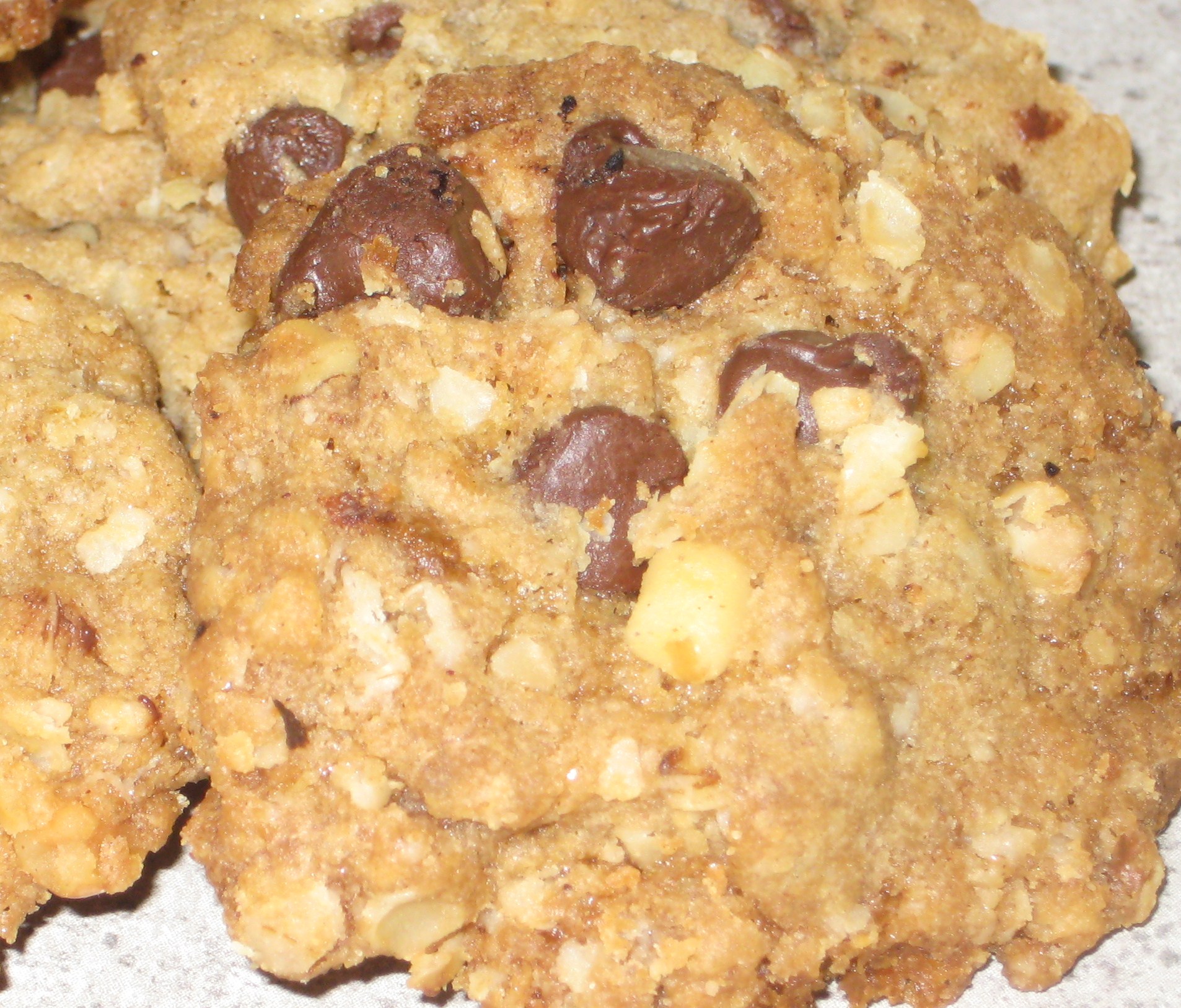
Vegan Oatmeal Nut Chocolate Chip Cookies

Posted on March 30, 2010 by The VRG Blog Editor

vegan cookies

Julia Driggers, R.D., shares a recipe for vegan oatmeal nut chocoloate chip cookies:

Oatmeal Nut Chocolate Chip Cookies

Makes About 5 Dozen

Ingredients:

1 cup Whole Wheat Flour
½ cup All-Purpose Flour
1 tsp Baking Soda
3 cups Quick or Old Fashion Oats (uncooked)
½ cup Walnut Pieces
1 cup Vegan Chocolate Chips or Carob Chips
2 sticks Earth Balance Vegan Margarine (Soft)
1 cup Vegan Brown Sugar (packed firm)
½ cup Vegan Granulated Sugar
2 equivalents of Egg Replacer
1 tsp Cinnamon
1 tsp Vanilla

Preheat oven to 350 degrees F. Combine flour, baking soda, and cinnamon. Add in oats, walnuts, and chocolate chips. Mix well. In separate large bowl, beat together margarine, brown sugar, and granulated sugar until creamy. Add in egg replacer and vanilla. Mix well. Combine flour mixture to margarine mixture and mix. Grease cookie sheet. With a table spoon drop cookie batter onto pan. Bake 10-14 minutes or until tops are golden brown. Cool.

Share these with your friends and make them smile!

Nutritional Information Per Serving (Serving Size 2 Cookies)

Calories: 164 Fat: 8 gm
Fiber: 2 gm Carbohydrates: 21 gm
Protein: 2 gm Sodium: 110 gm
Calcium: 15 mg Iron: 1 mg

Garden of Life Vitamin D3 Derived from Lanolin

Posted on March 29, 2010 by The VRG Blog Editor

Garden of Life Vitamin D3 Derived from Lanolin;
a Provitamin D3 Made from Genetically Modified Yeast Is Available

by Jeanne Yacoubou, MS
VRG Research Director

In November 2009, a VRG member asked us to confirm with the vitamin company, Garden of Life, what the company told him about their vitamin D3, sold as Vitamin Code Raw Vitamin D3:

A preliminary look at the Garden of Life website in November 2009 yielded confusion because the term “vegetarian,” (not “vegan”), was used to characterize their Vitamin Code Raw Vitamin D3. They told a customer that the vitamin D in the Vitamin Code products was from a single cell plant (yeast) rich in vitamin D3. Given that the usual commercial source of vitamin D3 is sheep’s lanolin, the VRG had questions for Garden of Life about its production methods and wanted to determine whether the product was “vegan.”

By the end of January 2010, as we continued to call and email Garden of Life, requesting more detail on their production methods and detection methods, we were informed by Barbara, a Product Support Supervisor at Garden of Life, that the yeast are “fed” lanolin as their starting material. Barbara stated: “The D3 that we use has been synthesized from animal cholesterol, primarily lanolin. For a more detailed explanation, please visit our website www.gardenoflife.com/d3.”

The company said there is no known plant source of Vitamin D3. Wondering whether Garden of Life was correct about there not being a non-animal derived vitamin D3, I further examined the question. After searching patent websites and speaking with several doctors and scientists at biotech companies, vitamin companies and universities, we discovered that there is a patented process, discovered in the late 1980s-early 1990s by Amoco BioProducts Corporation in Illinois to produce a mutant yeast-derived provitamin D3. The patented process is considered “semisynthetic” because petrochemical materials are used in conjunction with the fermentation of genetically engineered yeast to produce the provitamin D3.

Then, during the manufacturing process, the yeast-derived provitamin D3 is exposed to light and transformed to “High Density 25-hydroxy
vitamin D3” used in poultry feed and as an injectable vitamin supplement in Europe. Currently, Roche holds the US patent while DSM holds the European version.

According to the scientists whom we interviewed, one of whom was directly involved in the genetic engineering of the yeast at Amoco which led to the patent and another who is a technical director at DSM, 25-hydroxy vitamin D3 made through the patented process is currently used in poultry feed in the United States because it “ameliorates the effects” of leg bone deformation while maintaining weight gain during the rearing process. It is produced in high yield, too. One source stated that its widespread use in the livestock industry suggests that it is economically feasible to produce it semisynthetically and saw no reason why it couldn’t be used in humans, too. He suggested that since lanolin was an abundant enough source of a vitamin D3 supplement, manufacturers lack an incentive to make it any other way for human use. Nevertheless, the patent application proposes that the semisynthetic process to make provitamin D3 could be “useful in a number of contexts, e.g., in topical pharmaceutical formulations (for the treatment of skin disorders or the like), in oral vitamin compositions, and as livestock feed additives.”

Several scientists told The VRG that 25-hydroxy vitamin D3 made through the patented process is used in injectable form throughout Europe to treat osteoporosis and other bone diseases in people. The VRG has not currently identified European doctors or clinics using this non-animal derived 25-hydroxy vitamin D3 in humans.

American vegan consumers who wish to see the semisynthetic, non-animal-derived 25-hydroxy vitamin D3 available in the U.S. for humans are encouraged to inquire of their healthcare providers and supplement manufacturers about the likelihood of its future use in humans as an injectable, or as an oral supplement like that in poultry.
Joining 4-H as a Vegan

Posted on March 23, 2010 by The VRG Blog Editor

VRG is in the process of compiling a set of Teen FAQs, written by our wonderful interns and volunteers.

Today we are featuring two FAQs relating to 4-H written by VRG volunteer Corey Bivins:

I am thinking of joining 4-H. I am vegan. What kinds of activities could I do?

When you join 4-H you join a community club and enroll in projects and participate in group activities and meetings. The club elects officers, conducts educational programs, practices community service and fulfills county club expectations. If you aren’t interested in a particular club, there are single project clubs. The only difference between a community club and a single project club is the focus. Single project clubs focus on one specific project, such as Photography. Jessica, a former vegetarian 4-H'er, belonged to a club that focused only on rabbits. She also said there was a nature drawing club, a double-dutch jump rope club and a public speaking club within her community […]

Here are a few project ideas:

  • You could choose to do an agronomy project where you explore the areas of plant genetics, plant physiology, soil science and weather. You could set a goal of growing your own sunflowers and give a speech on the different diseases of sunflowers.
  • You could choose to do a cake decorating project where you learn the about cake molds, borders, tiered cakes and special icings. You could set a goal to make a vegan icing to decorate cakes with and enter your final project in a fair.
  • You could choose to do a geology project where you study rocks, minerals and fossils. You could set a goal to take field trips to collect specimens and exhibit your collection at a fair.
  • You could choose to do a sewing project where you develop skills to design and sew your own clothes. You could set a goal to make an entire outfit without using any animal by-products, such as leather, wool or silk.
  • You could choose to do a foods and nutrition project where you could learn to make many tasty vegan recipes which may involve modifying recipes that have eggs, dairy or meat. Displaying these at a fair and sharing these delicious recipes with other members, leaders and judges will help spread the word that vegan dishes – including baked goods – can be delicious as well as healthy.

Click here to read the entire FAQ.

I am a vegetarian thinking of joining 4-H. What are some ways that I can fit in?

4-H is all about the projects, be they animals, photography, sewing, cooking, vegetable growing, furniture refinishing, etc., then documenting and showing off to the judges what you’ve learned and/or done throughout the year. As a vegetarian, you may need to develop techniques to handle certain situations where you are faced with the fact that it’s not a vegetarian world. These techniques could include planning ahead (carry a vegetarian snack), conflict resolution skills (let people know how their actions make you feel), avoidance (not attending certain activities) and a positive mental attitude (create a way of making something undesirable more enjoyable).
Sometimes people bring a snack to 4-H meetings. You could eat beforehand or bring your own snack, either for yourself or to share, like hummus and crudités, cookies or popcorn.

When you plan to go to a 4-H activity where lunch or dinner will be served, you could suggest ahead of time that there be at least one vegetarian dish on the menu or offer to bring a vegetarian dish, such as vegetarian chili, couscous and roasted vegetables or vegan quiche. Some 4-H groups offer a vegetarian option. For example, the Purdue University extension held a clinic for judges and leaders and offered a vegetarian lunch consisting of a Veggie Wrap (chopped broccoli, cauliflower, carrots, bell peppers, and red onion with Italian dressing) with a spinach salad.

Click here to read the entire FAQ.

VRG Nutrition Advisor Reed Mangels on Backstage Gourmet 3/22

Posted on March 19, 2010 by The VRG Blog Editor

Reed Mangels is scheduled to be on the radio program, Backstage Gourmet, 1-2pm PST, Monday 22, 2010. Tune in here!

About Backstage Gourmet: “Great green cuisine meets great global music on the Backstage Gourmet Radio with PJ Grimes, every Monday, 1-2 p.m. Pacific Time, on HealthyLife.Net. The upbeat, educational, thought-and-action-inspiring program features guest interviews, delectable vegetarian/vegan/raw recipes, green lifestyle ideas, tips, advice, and resources, as well as groovin’ music from around the world.”

  • Donate

  • Subscribe to the blog by RSS

  • VRG-NEWS

    Sign up for our newsletter to receive recipes, ingredient information, reviews of new products, announcements of new books, free samples of products, and other VRG materials.

    Your E-mail address:
    Your Name (optional):


↑ Top