Posted on
October 21, 2009 by
The VRG Blog Editor
Click here to view the entire version of VRG’s new lesson plan for kids about water usage.
Lesson Plan: Clean Water for Everyone Today and Tomorrow with Good Food Choices
by Jeanne Yacoubou, MS © The Vegetarian Resource Group.
Purpose: To visualize for young children how much water is used to do everyday tasks and how much water is needed to grow common food items. To graphically illustrate for children how some human activities and how food production causes water pollution. To instill in children that water is a precious resource and should not be wasted.
An integrated worksheet asks children to answer questions based on these adapted charts (numbers rounded for children):
Table 1. Water Consumed during Daily Activities (data taken from http://www.epa.gov/reg5rcra/wptdiv/p2pages/water.pdf)
| Activity |
Water consumed (gallons) |
| Flush toilet |
5-7 |
| Run dishwasher |
15-25 |
| Wash dishes by hand |
20 |
| Water a small lawn |
35 |
| Take a shower |
25-50 |
| Take a bath |
50 |
| Wash a small load in a washing machine |
35 |
| Brush teeth with water running |
2-5 |
Table 2. Water Used to Produce some Common Items (Data taken from Chapagain A, Hoekstra A (2004) Water Footprints of Nations Volume One: Main Report. Value of Water Research Report Series No.16. Delft (The Netherlands): UNESCO – IHE Institute for Water Education. http://www.waterfootprint.org/?page=files/Publications; numbers are rounded off on table children use for activity.)
| Product |
Water used (gallons) |
| 1 glass of milk (200 ml) |
50 |
| 1 glass of apple juice (200 ml) |
48 |
| 1 glass of orange juice (200 ml) |
43 |
| 1 bag of potato chips (200 g) |
46 |
| 1 slice of bread (30 g) |
10 |
| 1 egg (40 g) |
34 |
| 1 slice of bread (30 g) with cheese (10 g) |
23 |
| 1 hamburger (150 g) |
600 |
| 1 potato (100 g) |
6 |
| 1 tomato (70 g) |
3 |
| 1 apple (100 g) |
18 |
| 1 orange (100 g) |
13 |
| 1 cotton T-shirt (medium sized, 500 g) |
1,025 |
| 1 pair of shoes (bovine leather) |
2,000 |
| 1 sheet of 8½ x 11 inch paper |
3 |
Click here for the entire lesson plan.
Category
Education Materials, Environment, Kids
Comments
0
Posted on
October 21, 2009 by
The VRG Blog Editor
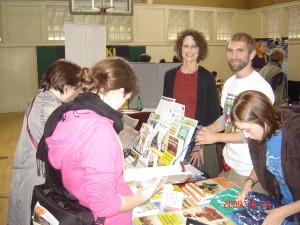
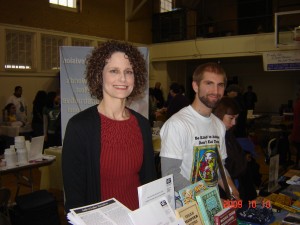
Thanks to Gretchen Chlebowski, Eric Sharer, and Julie Conry for representing VRG at the first year of Chicago Veganmania as well as VeggieFest in Chicago!
You can read more about Veganmania here: http://chicagoveganmania.
blogspot.com
and Veggie Fest here: http://www.veggiefest
chicagoland.org/
Category
Events
Comments
0
Posted on
October 17, 2009 by
The VRG Blog Editor
Great Sage, organic vegetarian restaurant in Clarksville, MD, is donating 10% of proceeds to VRG tomorrow. They have an amazing brunch from 10am-3pm and dinner after until 9pm. Come if you can!
http://www.great-sage.com
Category
Events
Comments
0
Posted on
October 09, 2009 by
The VRG Blog Editor
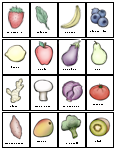
Click here to check out a veggie-friendly take on the classic game of Memory! You can download a 24-card set that you can print as a fun game for kids.
Artwork by Jessica Dadds.
Category
Artwork, Kids
Comments
0
Posted on
October 08, 2009 by
The VRG Blog Editor
On our running National Restaurant Chains Poll, the top ten restaurant chains picked by our readers as most vegetarian-friendly are currently:
1. Chipotle
2. Qdoba Mexican Grill
3. Taco Bell
4. Souplantation/Sweet Tomatoes
5. Subway
6. P.F. Chang’s China Bistro
7. Noodles & Company
8. Moe’s Southwest Grill
9. Panera Bread
10. Baja Fresh Mexican Grill
Click here to cast your vote!
Category
Polls
Comments
1
Posted on
September 24, 2009 by
The VRG Blog Editor
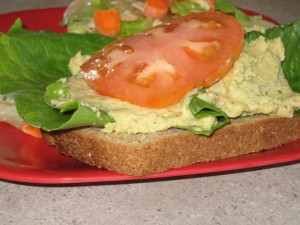
Julia Driggers, Clinical Dietician, shares a recipe for a vegan chickpea spread:
Garden Fresh Chickpea Spread
(Serves 6)
Ingredients:
1½ cups Chickpeas (Garbanzo Beans)
½ cup Celery, chopped
2 TBS Scallions, chopped
1 TBS Green Chili Pepper (may use green bell pepper)
1 TBS Sesame Seeds
1 TBS Spicy or Dijon Mustard
2 TBS Vegan Mayonnaise
½ tsp Dill Weed, Dried
Directions:
In large bowl combine all ingredients and mix. Place mixed ingredients into Food Processor or Blender. Blend on medium speed for 30 seconds or until chickpeas are mashed and mixture appears smooth.
Take mixture and spread on whole wheat bread and top with lettuce, tomato, carrots, or your favorite vegetable. It’s also great for dipping and topping vegetables and crackers!
*Variations: Add 2 TBS Dried Cranberries or Golden Raisins to add sweetness!
Nutritional Analysis per serving:
| Total Calories Per Serving: |
110 |
| Total Fat as % of Daily Value: |
8% |
| Protein: |
4 gm |
| Fat: |
5 gm |
| Carbohydrates: |
12 gm |
| Calcium: |
30 mg |
| Iron: |
1 mg |
| Sodium: |
164 mg |
| Dietary Fiber: |
4 mg |
Category
Vegan Recipes
Comments
1
Posted on
September 22, 2009 by
The VRG Blog Editor
The beginning of a new article by VRG Research Director Jeanne Yacoubou, MS, entitled “Factors Involved in Calculating Grain:Meat Conversion Ratios” is excerpted below, and can be read in full here.
Factors Involved in Calculating Grain:Meat Conversion Ratios
Jeanne Yacoubou, MS
VRG Research Director
“An environmental argument for vegetarianism often involves a discussion of the relative efficiency by which livestock convert grains and legumes that they consume into meat eaten by some people. The process of converting grain, legumes, and their byproducts into human-edible meat is commonly expressed as a grain:meat conversion ratio.
While researching the quantities and types of feedstuffs needed by livestock to produce meat, the writer noticed wide discrepancies in grain:meat ratios calculated by various scientists, government agencies, nonprofits, and agribusiness. Some ratios ran as high as 16 pounds of grain per pound of meat to a low of 0.3 pounds of grain per pound of meat. Thus began an investigation into some of the many factors involved in calculating grain:meat conversion ratios. The investigation revealed the importance of considering the assumptions implicit in all of the determinations. Without a working knowledge of authors’ assumptions, the ratios lack meaning. When two competing values based on different assumptions are viewed together, they cannot be accurately compared.”
Click here to read the rest of the article.
Category
Environment
Comments
0
Posted on
September 15, 2009 by
The VRG Blog Editor
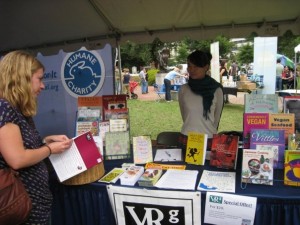
Thanks to Compassion Over Killing and the Vegetarian Society of DC for hosting DC VegFest last weekend — and thanks to everyone who came over to talk with us! Our table was buzzing the whole time.
Check our homepage to see upcoming events where VRG will be: http://www.vrg.org. Next up are the Natural Products Expo East (Boston, MA – 9/23-9/26) and the Baltimore Book Festival (Baltimore, MD – 9/25-9/27).
Compassion Over Killing has more photos from the event here.
Category
Events
Comments
0
Posted on
September 14, 2009 by
The VRG Blog Editor
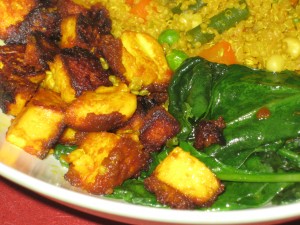
Julia Driggers, Clinical Dietitian, shares a delicious (and simple!) vegan dinner recipe with us:
Sweet Turmeric Tofu and Vegetable Quinoa
(Serves 2)
Ingredients:
7 oz Extra Firm Tofu
½ cup Water
2 TBS Brown Rice Vinegar
1 TBS Canola Oil
1 TBS Agave Nectar (or brown rice syrup or maple syrup)
1 ½ TBS Turmeric
1 cup pre-washed uncoated Quinoa (found in box and bulk supply stores)
1 cup Vegetable Broth
½ cup Water
1 TBS Turmeric
1 ½ cups small-cut fresh, chopped (or frozen mixed vegetables)
Directions:
Pre-cut tofu into 1½” cubes and set aside. In medium sauce pan combine water, brown rice vinegar, canola oil, agave nectar, and turmeric. Stir and bring to a boil. Once boiling add in pre-cut tofu. Cover with lid and let boil on med-high heat for 10 to 12 minutes or until tofu is browned and marinade has evaporated. Stir regularly. After tofu is cooked remove lid and pot from heat and let cool for 4 to 5 minutes.
In medium sauce pan combine vegetable broth, water, quinoa, vegetables and turmeric. Bring contents to a boil then cover with lid, decrease heat, and let simmer for 15 minutes.* Stir occasionally. Remove pot from heat and let cool 5 minutes.
Place quinoa mixture on plate and top with tofu. Serve with a vegetable such as cooked spinach, collard greens, or kale.
*If using a rice cooker to cook quinoa, use 1 cup quinoa, 1 cup vegetable broth, 1 cup water, 1 ½ cups mixed vegetables and 1 TBS turmeric.
Note: Turmeric is a spice that can stain dishware and utensils if left unwashed. Make sure to wash cookware promptly after use.
| Total Calories Per Serving: |
578 |
| Total Fat as % of Daily Value: |
22% |
| Protein: |
22 gm |
| Fat: |
15 gm |
| Carbohydrates: |
92 gm |
| Calcium: |
117 mg |
| Iron: |
12 mg |
| Sodium: |
530 mg |
| Dietary Fiber: |
11 mg |
Category
Vegan Recipes
Comments
2
Posted on
September 11, 2009 by
The VRG Blog Editor
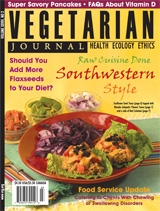
Highlights from this issue include:
FAQs About Vitamin D
Super Savory Pancakes
VRG Nutrition Interns Develop Protein/Calorie Supplement for Vegans
Raw Southwestern Cuisine
Texture Alterations for Vegan Diets
New FDA Labeling Rules for Cochineal Extract and Carmine Coloring
Fish and the ‘Pareve’ Designation
To join VRG and receive The Vegetarian Journal in print either:
* join online with $25
* call (410) 366-8343 and order by phone with your Mastercard® or Visa®
* or complete this form and mail or fax it to:
The Vegetarian Resource Group
P.O. Box 1463
Baltimore, MD 21203
Fax: (410) 366-8804
Category
Uncategorized
Comments
0