The Vegetarian Resource Group Blog

A Swiss Company Writes…How Can Zein Be Approved for Food Use in the European Union? What Are E Numbers?

Posted on February 08, 2011 by The VRG Blog Editor

by Jeanne Yacoubou, MS
VRG Research Director

A Swiss company that buys and sells raw materials intended for food use in the European Union (EU) recently wrote The VRG asking about getting the corn protein, zein, approved for food use in the EU. The VRG recently wrote an article on zein: http://www.vrg.org/blog/2010/12/13/zein-used-for-shellac-biodegradable-coatings-diapers%E2%80%A6 Because zein is currently considered a value-added co-product of bioethanol production, new food as well as industrial uses for zein are being actively pursued by several American companies.

In the United States, zein has GRAS status (Generally Recognized as Safe) for food use by the Food and Drug Administration (FDA). The analogous agency in the EU, the European Food Safety Authority (EFSA), would be responsible for giving food use status to zein, after conducting a review of zein’s safety usually after a petition by a company or organization requesting that zein be extended such status.

If deemed safe for food use, zein could be used in foods manufactured in the EU and sold there or to non-European countries. Zein would be given an “E number” (“E” stands for “Europe”): a number code for food additives approved for use in the EU. E numbers appear frequently on food labels in the EU and increasingly, though still infrequently, on North American packaging.

Several hundred substances have E numbers. Shellac, for example, which was replaced by zein for a short period in the mid-20th century in the United States when shellac was in short supply, is identified as “E904.” E numbers may have a pejorative connotation in some European countries with respect to certain artificial food additives (such as artificial colors), but E numbers apply to ingredients such as vitamin C, lecithin, and pectin which are naturally found in many types of foods and have GRAS status.

For more information about ingredients, see
http://www.vrg.org/ingredients/index.php

To support VRG’s ingredient research, donate at
https://www.givedirect.org/give/givefrm.asp?CID=1565
or
http://www.vrg.org/catalog/index.php?main_page=index&cPath=4

USDA Bio-Based Label: Newest Eco-Label for Non-Food Products

Posted on February 07, 2011 by The VRG Blog Editor

by Jeanne Yacoubou, MS
VRG Research Director

Announced in the Federal Register in January 2011, the United States Department of Agriculture (USDA) will begin the voluntary Bio-Based Label program “to boost demand for products made from renewable commodities and support green jobs.” Agriculture Deputy Secretary Kathleen Merrigan states that bio-based products “have enormous potential to create green jobs in rural communities, add value to agricultural commodities, decrease environmental impacts, and reduce our dependence on imported oil.”

With this third-party certification (by ASTM International) and labeling program, similar in design to the USDA Certified Organic Label program, the USDA launches the second part of its BioPreferred Program (instituted by the 2002 Farm Bill), from federal procurement employees ordering preferred, sustainable products for government agencies to all consumers and commercial markets (as specified in the 2008 Farm Bill). USDA Bio-Based labels should appear on store products, including lip balm, household cleaners, sheets and towels, by Spring 2011. Readers may learn more about the BioPreferred Program at http://www.biopreferred.gov.

According to a USDA press release, “bio-based products are those composed wholly or significantly of biological ingredients – renewable plant, animal, marine or forestry materials.” Originally 51% was the minimum amount allowed for certification. It has been changed to 25%, which, according to the USDA, might be increased in the future, just as the permissible percentage of organic ingredients in a product labeled as “USDA Certified Organic” has risen. The percentage of bio-based ingredients in the product is indicated on the label in a prominent place, aiding consumers to make informed purchasing choices. The label will also specify whether it is the product, packaging or both that are certified as bio-based. Readers may view a sample label at www.biopreferred.com. To view the entire Final Rule in the Federal Register: http://www.biopreferred.gov/files/BP_Label_Final_Rule_01_20_11.pdf

Products with a historically high bio-based percentage (set at pre-1972, according to the USDA), such as paper plates, wood furniture, and cotton T-shirts, are not eligible to display the new label.

Whether a life cycle assessment (LCA), tracing all environmental costs and benefits from a product’s incipience to the end of its useful life, should be required for bio-based products is still being debated. To date, no LCAs are required in order to label a product as “USDA Bio-Based” although initially in the BioPreferred Program, they were. The lack of this requirement has raised concern among some environmental groups, fearing that the new label adds to confusion about the meaning of “sustainable” versus “natural” or “biological” (i.e., non-petroleum based) products. The USDA states in its Federal Register announcement that it “is currently continuing its efforts to formulate a final decision on any requirements to perform LCA analyses on products in conjunction with the BioPreferred Program.” Final decisions will be published in the Federal Register.

Reminder: Applications for VRG’s $5,000 College Scholarship Due Feb 20

Posted on February 03, 2011 by The VRG Blog Editor


Each year, VRG awards $10,000 in college scholarship money to two high school seniors who have promoted vegetarianism in their schools/communities ($5,000 to each). The deadline – February 20 – is right around the corner, so if you want to apply, or know someone who should apply, click here for more information.

VRG also offers The Eleanor Wolff Scholarship which is a paid summer internship ($2,500 plus $1,000 toward housing) at VRG’s Baltimore office. Here’s what our intern Veronica had to say about her internship at VRG last summer: http://www.vrg.org/blog/2010/07/21/vrg-summer-internship-report/

—————-

Link to our scholarship on the web!

Copy the text below to use this image to promote our scholarship on your website!

—————-
Would you like to sponsor a scholarship or internship? This provides a tremendous opportunity for students who are doing some great work promoting vegetarianism.
Click here to read about past scholarship winners (right-hand side).
Click here to read about past Eleanor Wolff Scholarship winners.

Vegan Recipes from Egypt

Posted on February 02, 2011 by The VRG Blog Editor

This has been excerpted from the article Tasty Vegetarian Recipes from Egypt by Marie Henein. Click here to read the full article.

Introduction

Being raised in an Egyptian family, I soon found out that food was of tremendous importance in our culture. Social and family gatherings were centered around large amounts and various types of food. I found the dishes my mother and grandmothers would prepare quite flavorful and grew up always adding lots of spices to whatever I ate. Spices common to Egyptian foods include cumin, garlic, onion, and allspice, and the list goes on and on.

My family is Christian — Coptic Orthodox to be exact. This was one of the earliest forms of Christianity and was the religion of the country until the Arab invasions. Many of the following recipes have been passed down from generation to generation.

The Coptic church believes in partial fasting almost 200 days of every year. During about 60 of those days, the members eat a completely vegan diet. The remaining days they are permitted to eat fish, but no other animals or animal products. The reasons behind the fasting vary by interpretation. They look to stories in the Bible for the reasoning behind the fasts.

According to the Coptic interpretation of the Bible, when God first created the world, he gave humans only vegetables as food. It was only later, when people multiplied and became sinful, that God permitted them to eat animals, only because it was in accordance with their sinful behavior. Therefore, the Copts believe humans survived for a great length of time without eating animals. In an effort to purify themselves and to make a sacrifice to God, they give up the eating of animals during these 60 days. The Copts consider the vegan food they eat during fasts to be a sacrifice because they consider such food less appetizing and less nutritious.

A tremendous number of vegan dishes were created for the fasting periods. However, when I became a vegetarian, I realized that these recipes were neither a sacrifice of flavor nor of nutritional value. I have recently become vegan and am truly thankful for all the delicious vegan recipes I am able to enjoy from my culture. Please note, however, that some of my favorite Egyptian recipes were originally prepared with meats, but I have found that they are delicious when prepared without meat.
Less Common Ingredients

Fava Beans
Sometimes called broad beans. Can be found canned in Middle Eastern and some regular grocery stores. Progresso makes canned fava beans. Canned fava beans may also be ordered through the mail by calling the Near East Bakery in Baltimore at (410) 254-8970 Monday-Saturday between 8-6 EST. They will ship via UPS and payments are C.O.D.

Grape Leaves
Can be found in Greek or Middle Eastern specialty stores. Some large grocery stores carry them in the ethnic foods section or they may be found near the section where pickles are sold. They are difficult to order by mail because they almost always come in glass jars.
Recipes

KOSHERI — LENTILS AND RICE WITH A TANGY TOMATO SAUCE
(Serves 6)

This is a typical dish prepared during fasts. You can substitute one layer of cooked elbow macaroni for a layer of rice.

2 cups uncooked brown or white rice
1 pound lentils
2 Tablespoons vegetable oil, divided
1 Tablespoon crushed garlic
Two 16-ounce cans of tomato sauce
1/2 cup water
1/4 cup vinegar
1 medium onion

Cook rice according to directions. Rinse lentils and put them in a pot, covering them with water, and bring to a boil. Then simmer on low heat until almost all water is absorbed and lentils are well cooked. Add extra water if longer time is needed. To make the sauce, first saute the garlic in 1 Tablespoon oil until golden. Add both cans of tomato sauce and simmer 10-15 minutes. Add water and vinegar and bring to a boil. Remove from heat immediately and add salt to taste. Finally, slice onion in thin, small pieces and saute in remaining 1 Tablespoon oil until brown and crispy.

This dish should be arranged as a layer of lentils (on the bottom), followed by a layer of rice, then another layer of lentils and another layer of rice. Sprinkle the onions and the sauce on top before serving.

Total Calories Per Serving: 563
Fat: 7 grams

WARAH ENAB –STUFFED GRAPE LEAVES
(Makes about 40 leaves)

This recipe for grape leaves has been passed down through my family. Ground lamb is the ingredient I’ve omitted.

1 cup uncooked basmati brown or traditional white rice
(traditionally prepared with white)
2 large tomatoes, chopped
1 medium onion, chopped
1/4 cup chopped parsley
1 Tablespoon vegetable oil
Juice of 1 lemon
1/2 teaspoon salt
1/4 teaspoon pepper
1/4 teaspoon allspice
One 16 oz jar of grape leaves
1 cup tomato sauce
2 cups water
Round sliced carrots, frozen or fresh
(enough to cover the bottom of a 3 quart pot,
approximately 15 carrot slices, depending on their size)

Mix all ingredients except grape leaves, tomato sauce, water, and carrots in a bowl. Remove grape leaves from jar, unfold, and rinse with water. Place grape leaves with the rough side up, one at a time, on a large, flat plate. Be sure that the pointy parts of the leaf are directed away from you and the flatter edges and stem are towards you. Place one teaspoon of the mixture on the bottom of the leaf, near the stem, and arrange it lengthwise using your fingers. First roll the flat edges near the stem upwards and tuck them slightly under the filling. Then applying pressure to keep the leaves rolled tightly, tuck one side at a time of the two parts of the leaf pointing outwards. Now, roll the rest of the way upwards still applying pressure to keep the leaf tight.

Cook sliced carrots in water until tender. Cover the bottom layer of a large pot with these carrots. Begin layering the stuffed leaves above the carrots and be sure that they are packed tightly together; otherwise they may fall apart during cooking. Each layer of leaves should be in varying directions across the pot. Pour the tomato sauce and water over the leaves and bring the sauce to a boil. Reduce heat to medium, and place a flat plate (glass or stoneware) upside down over the top layer of leaves, and press down as hard as you can. Leave the plate in place during cooking. Cover the pot with its cover as well, and cook for 40-45 minutes. Check one leaf to see if rice has cooked fully. Serve warm.

Total Calories Per Stuffed Grape Leaf: 27
Fat: 1 gram

LEMON AND GARLIC POTATO SALAD
(Serves 5)

My mother’s recipe for a light, tasty potato salad.

2-1/2 pounds red potatoes
1/2 cup chopped parsley
1 clove garlic, minced
Juice of 2 lemons
1 Tablespoon vegetable oil
Salt and pepper to taste

Boil potatoes, and cool. Add remaining ingredients and mix well. Chill and serve.

Total Calories Per Serving: 197
Fat: 3 grams

BEAN SALAD
(Serves 4-6)

This is a delightful salad for summertime.

One 16-ounce bag frozen French cut green beans
One 16-ounce can black eyed peas
2 large ripe tomatoes, chopped
1/2 cup chopped parsley
4 entire scallions, chopped
Juice of 2 lemons
1 Tablespoon vegetable oil
Salt and pepper to taste

Steam and drain the green beans and allow them to cool completely. Drain and rinse the black eyed peas. Combine all ingredients and mix well. May be served chilled.

Total Calories Per Serving: 233
Fat: 5 grams

SPINACH WITH DILL
(Serves 4)

A delicious dish from my grandmother that is traditionally prepared with ground beef, which I omitted.

1 medium onion, chopped
1 Tablespoon vegetable oil
2 garlic cloves, chopped
2 Tablespoons chopped fresh dill
One 15-ounce can tomato sauce
10 ounces frozen, thawed spinach
1/2 cup water
Salt and pepper to taste

Saute onions in oil. Add garlic and dill to saucepan and continue to saute for two minutes. Add tomato sauce and bring to a boil. Simmer for 10 minutes on low heat. Add spinach and water, then bring to a boil again. Cover and simmer on low heat for 15 minutes. Serve warm over cooked rice.

Total Calories Per Serving: 94
Fat: 4 grams

FOOL MEDEMMAS — FAVA BEANS
(Serves 4)

This way of preparing fava beans, which are commonly eaten as a breakfast food in Egypt, is my uncle’s recipe. The ingredients tend to be common for the dish but may be varied in their quantities.

One 16-ounce can cooked fava beans
1 large onion, chopped
1 large tomato, diced
1-1/2 Tablespoons olive oil
1 teaspoon cumin powder
1/4 cup parsley, chopped
Juice of 2 lemons
Salt, pepper, and red chili pepper to taste
Pita bread (optional)

Pour the beans into a pot and bring to a boil. Mix them well and add remaining ingredients. Bring to a boil again, then reduce to medium heat and cook for about 5 minutes. This dish is usually eaten with pita bread.

Total Calories Per Serving: 160
Fat: 6 grams

2010 Dietary Guidelines Released; Vegetarian and Vegan Meal Patterns Included

Posted on January 31, 2011 by The VRG Blog Editor

The U.S. Department of Agriculture and the U.S. Department of Health and Human Services have released the 2010 Dietary Guidelines for Americans. This evidence based document assists policy makers, nutrition professionals, food assistance program administrators, the food industry, scientists, academics, and the nutrition-focused media with a consistent, science-based foundation for their nutrition efforts.

The 2010 Dietary Guidelines states: “In prospective studies of adults, compared to non-vegetarian eating patterns, vegetarian style-eating patterns have been associated with improved health outcomes –lower levels of obesity, a reduced risk of cardiovascular diseases, and lower total mortality. Several clinical trials have documented that vegetarian eating patterns lower blood pressure.”

The Guidelines continue: “On average, vegetarians consume a lower proportion of calories from fat (particularly saturated fatty acids); fewer overall calories; and more fiber, potassium, and vitamin C than do non-vegetarians. Vegetarians generally have a lower body mass index. These characteristics and other lifestyle factors associated with a vegetarian diet may contribute to the positive health outcomes that have
been identified among vegetarians.”

The Dietary Guidelines include vegetarian and vegan adaptations of USDA food patterns. The vegan dairy group includes calcium-fortified beverages and foods commonly used as substitutes for milk and milk products.

While the USDA Average Daily Food Pattern of the Protein Group at the 2,000 Calorie Level includes 1.8 ounces of meat, 1.5 ounces of poultry, 1.2 oz. of seafood, .4 oz. of egg, no beans and peas, less than .1oz. of soy products, and .5 oz of nuts for a total of 5.5 ounces, THE VEGAN ADAPTATION INCLUDES 1.9 oz. of beans and peas, 1.4 oz. of soy products, and 2.2 oz. of seeds and nuts for a total of 5.5 ounces.

THE U.S.D.A. DAILY VEGAN FOOD PATTERN FOR A 2,000 DAILY INTAKE INCLUDES:

Fruit, 2 cups/day
Dark-green vegetables, 1 ½ cups/week
Red and orange vegetables, 5 ½ cups/week
Beans and peas, 1 ½ cups/week
Starchy Vegetables, 5 cups/week
Other Vegetables, 4 cups/week
Whole grains, 3 oz./day
Refined grains, 3 oz./day
Beans and Peas (in addition to above), 13oz./week
Soy Products, 10 oz./week
Nuts and Seeds, 15oz./week
Dairy (vegan), 3 cups/day
Oils, 18grams/day

The vegan dairy group is composed of calcium-fortified beverages and foods from plant sources. For analysis purposes, the following products were included: calcium-fortified soy beverage, calcium-fortified rice milk, tofu made with calcium-sulfate, and calcium-fortified soy yogurt.

This is not personal nutrition advice. For personal medical and nutrition advice, please speak to your health professional.

Oprah & 378 Staff Members Go Vegan This Week

Posted on January 31, 2011 by The VRG Blog Editor

Beginning tomorrow (Feb 1), Oprah is holding a one-week vegan challenge: “No meat, no milk, no animal anything.” In the preview for tomorrow’s show, Oprah says they will go inside a beef processing plant. Guests will include Michael Pollan and Kathy Freston.

For more information, click here, and/or tune in to tomorrow’s show!

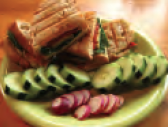
Vegan Panini Recipes!

Posted on January 28, 2011 by The VRG Blog Editor

Have a Panini Party
By Nanette Blanchard

This article originally appeared in Vegetarian Journal Issue 4 2010.

Panini are becoming ubiquitous, and it's no wonder why! One bite of that flaky loaf and some piping-hot fillings, and most people are hooked!

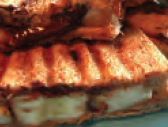
Panini are delicious grilled sandwiches that are Italian in origin and typically made from a bread like ciabatta. In fact, this primary ingredient is the basis for the sandwich's name. 'Panino' is Italian for 'small bread roll,' and 'panini' is the word's plural form.

It's time to get in on the panini craze (if you haven't already)! Panini have emerged as a popular option for lunch, but you don't have to limit their consumption to your midday meal. Try a panini for breakfast or a late-night snack-they're quick to make and can be low in fat if you simply use vegetable cooking spray to coat the grill. They are also a great way to add some fruits and veggies to children's meals.

Panini grills are inexpensive and versatile, and even health-conscious vegans can use them to make wonderful and festive creations. There are two basic types of panini grills:

  • A non-stick grill allows you to lower the top of the grill to compress the sandwich. George Foreman Grills are a familiar example. These grills can vary greatly in price.
  • The other kind includes the cast-iron stovetop panini grills. You can even buy just a panini press top in cast iron; simply put the sandwich in a castiron pan and use the preheated panini top to compress and grill the sandwich.

You'll have the greatest success with your panini if you use thin slices of bread and remember to serve them immediately.

A panini party is a fun and casual way to entertain. Purchase several different types of breads and a variety of condiments and vegetables to add to customize your panini. Start your party by making the Eggplant, Roasted Red Pepper, and Spinach Panini with Chipotle Mayonnaise (below) and/or the Crimini Mushroom and Mustard Panini (opposite) because they are the lightest. Then, serve either the Tempeh Reuben Panini (opposite) or the Southwestern Tofu Panini (page 8) for the main event. Finish up the party with some sweet Dark Chocolate, Peanut Butter, and Banana Panini (page 8) or Creamy Carrot and Pineapple Panini (page 8) on raisin bread. Add a large salad of dark leafy greens and some sparkling cider, and you will have a memorable party.

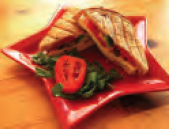
EGGPLANT, ROASTED RED PEPPER, AND SPINACH PANINI WITH CHIPOTLE MAYONNAISE

(Makes 3 sandwiches)

This colorful sandwich uses a spicy, non-dairy mayonnaise for extra flavor. Use chipotle powder if you can't find chile pepper in adobo sauce in your grocer's international aisle.

CHIPOTLE MAYONNAISE

  • 1 Tablespoon chipotle chile pepper
    in adobo sauce, minced
  • 2 Tablespoons vegan mayonnaise
  • 1 1/2 teaspoons fresh lime juice

In a small bowl, mix the ingredients
together.

PANINI

  • Vegetable cooking spray
  • 1 small eggplant, peeled and sliced into
    1/2-inch slices
  • 6 thin slices ciabatta
  • 3 large slices roasted red peppers
    (approximately 3 ounces)
  • 1 cup fresh spinach leaves, washed and
    dried

Preheat the panini grill and spray with vegetable cooking spray. Grill the eggplant slices for 4-5 minutes or until soft. Spread each slice of bread with 1 1/2 teaspoons chipotle mayonnaise. Top 3 bread slices with roasted red peppers,
spinach, and grilled eggplant. Then, top each sandwich with another slice of bread.

Spray the panini grill with additional vegetable cooking spray. Grill each panini for 5 minutes or until golden brown.

Cut each panini in half and serve hot.

Total calories per serving: 186 Fat: 3 grams
Carbohydrates: 34 grams Protein: 6 grams
Sodium: 551 milligrams Fiber: 7 grams

PICADO DE RÁBANO (CHOPPED RADISH SALAD)

(Serves 5)

This is a refreshing 'side' salad to serve as an appetizer with breadsticks or as an accompaniment to spicy menu items. Or create an entirely new salad by combining this recipe with some tossed greens, cooled cooked pasta, quinoa, brown rice, or barley.

  • 2 cups trimmed and thinly sliced red
    radishes (not daikon)
  • 3 Tablespoons chopped fresh mint
  • 1/2 cup fresh orange juice
  • 2 Tablespoons lime juice
  • 1 teaspoon ground black pepper

Combine all ingredients in a nonreactive bowl. Refrigerate or chill on ice for at least 30 minutes before serving. This salad can be made the night before.

Total calories per serving: 21 Fat: < 1 gram
Carbohydrates: 5 grams Protein: 1 gram
Sodium: 19 milligrams Fiber: 1 gram


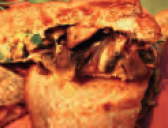
CRIMINI MUSHROOM AND MUSTARD PANINI

(Makes 3 sandwiches)

You can use any type of mushrooms for these savory panini, but I like the crimini variety for its nutty flavor.

  • 8 ounces crimini mushrooms, sliced
  • 1 large shallot, minced
  • 1 Tablespoon extra-virgin olive oil
  • 3 Tablespoons grainy mustard (whole grain
    or coarse type mustard, such as Trader
    Joe’s Whole Grain Dijon Mustard)
  • 6 slices whole wheat bread
  • 3 slices vegan American soy cheese
  • 2 Tablespoons minced Italian parsley
  • Vegetable cooking spray

In a sauté pan, cook mushrooms and shallots in olive oil over medium heat, stirring occasionally, until the mushrooms are golden brown, approximately 7-8 minutes.

Preheat the panini grill. Spread 1 1/2 teaspoons mustard on each
slice of bread. Top 3 bread slices with the mushroom mixture, soy cheese, and parsley. Then, top each sandwich with another slice of bread.

Spray the panini grill with additional vegetable cooking spray. Grill each panini for 5 minutes or until golden brown.

Cut each panini in half diagonally and serve immediately.

Total calories per serving: 224 Fat: 9 grams
Carbohydrates: 36 grams Protein: 9 grams
Sodium: 497 milligrams Fiber: 4 grams

TEMPEH REUBEN PANINI

(Makes 3 sandwiches)

The Reuben is a natural choice for a panini since it is, by definition, a grilled sandwich. The original version tops layers of deli staples with sauerkraut and flavorful dressings.

Tempeh, which fills in for the traditional corned beef, is available in the refrigerated section at natural foods stores and some supermarkets. If you can't find pumpernickel, get the darkest rye bread that you can. I use a sauerkraut from the refrigerated section of my health foods store that has much less sodium than canned sauerkraut. You can also add sliced tomatoes or caramelized onions to these hearty sandwiches before grilling.

TEMPEH

  • 3/4 cup water
  • 1 Tablespoon low-sodium soy sauce
  • 1/4 teaspoon granulated garlic
  • 1/2 teaspoon dry mustard
  • 1/4 teaspoon liquid smoke
  • 1 teaspoon smoked paprika (optional)
  • 1 teaspoon agave nectar
  • 8 ounces tempeh, thinly sliced

In a small saucepan, mix water, soy sauce, garlic, mustard, liquid smoke, paprika if using, and agave nectar. Add tempeh and simmer over medium-low heat for 10 minutes, adding more water if necessary, until all liquid is absorbed.

THOUSAND ISLAND DRESSING

  • 2 Tablespoons vegan mayonnaise
  • 1 Tablespoon ketchup
  • 1 1/2 teaspoons pickle relish
  • 1/4 teaspoon onion powder

In a small bowl, combine dressing ingredients.

PANINI

  • 6 slices pumpernickel bread
  • 6 Tablespoons sauerkraut
  • Vegetable cooking spray

Preheat the panini grill. Spread each slice of bread with dressing. Top 3 bread slices with the tempeh and then sauerkraut. Then, top each sandwich with another slice of bread.

Spray the panini grill with vegetable cooking spray. Grill each panini for 5 minutes.

Cut each panini in half and serve immediately.

Total calories per serving: 325 Fat: 12 grams
Carbohydrates: 38 grams Protein: 20 gram
Sodium: 854 milligrams Fiber: 4 grams


SOUTHWESTERN TOFU PANINI

(Makes 4 sandwiches)

These filling sandwiches include tofu that has been brushed with
a bit of salsa and grilled on the panini grill before the sandwiches are assembled.

  • Vegetable cooking spray
  • One 14-ounce package firm organic tofu,
    cut into 8 slices
  • 3 Tablespoons store-bought salsa,
    preferably a smooth variety
  • Sea salt to taste
  • 8 slices whole wheat bread
  • 1 avocado, sliced
  • 2 Roma tomatoes, sliced
  • 8 green olives, halved
  • 8 pickled jalapeño rings
  • Extra salsa for serving, if desired

Preheat the panini grill and spray with vegetable cooking spray.

Brush each tofu slice with a heaping teaspoon of salsa and sprinkle with sea salt. Grill tofu for 5-6 minutes or until browned. Remove from grill.

To make panini, top 4 bread slices with avocado, tomatoes, olives, and jalapeños. Top each sandwich with 2 pieces of tofu. Then, top each sandwich with another slice of bread.

Spray the panini grill with additional vegetable cooking spray.

Grill each panini for 5 minutes or until golden brown.

Cut each panini in half. Serve with additional salsa, if desired.

Total calories per serving: 322 Fat: 15 grams
Carbohydrates: 37 grams Protein: 16 grams
Sodium: 596 milligrams Fiber: 10 grams


DARK CHOCOLATE, PEANUT BUTTER, AND BANANA PANINI

(Makes 2 sandwiches)

  • 2 Tablespoons unsalted creamy peanut
    butter
  • 4 slices soft whole wheat bread
  • 1 large banana, sliced
  • 1 ounce (approximately 6 squares) dark
    vegan chocolate, chopped
  • Vegetable cooking spray
  • 1/4 teaspoon cinnamon

Preheat the panini grill. Spread peanut butter thinly on all 4 slices of bread. Top 2 bread slices with the chopped chocolate and banana slices. Then, top each sandwich with another slice of bread.

Spray the panini grill with vegetable cooking spray. Grill each panini for 3-4 minutes or until it is golden brown and the chocolate has melted.

Remove panini from the grill and cut each sandwich into 3 slices. Sprinkle with cinnamon. Serve hot.

Total calories per serving: 373 Fat: 15 grams
Carbohydrates: 53 grams Protein: 11 grams
Sodium: 304 milligrams Fiber: 7 grams

DARK CHOCOLATE, PEANUT BUTTER, AND BANANA PANINI

(Makes 3 sandwiches)

These dessert sandwiches are a terrific way to get kids to eat more carrots. Be sure to watch these sandwiches closely as they are cooking because raisin bread has a tendency to brown more quickly in the panini grill than other breads do.

  • 1/4 cup vegan cream cheese
  • 1 carrot, peeled and grated (approximately
    7/8 cup)
  • 6 slices whole wheat raisin bread
  • 6 thin canned pineapple rings (approximately
    8 ounces)
  • Vegetable cooking spray

Preheat the panini grill.

In a small bowl, combine the cream cheese and carrots. Spread the mixture on the raisin bread slices. Top 3 bread slices with pineapple rings. Then, top each sandwich with another slice of bread.

Spray the panini grill with vegetable cooking spray. Grill each panini for 4 minutes or until golden brown.

Slice each sandwich in half and serve immediately.

Total calories per serving: 254 Fat: 6 grams
Carbohydrates: 47 grams Protein: 5 grams
Sodium: 327 milligrams Fiber: 4 grams

Donating to Charity from IRA’s

Posted on January 27, 2011 by The VRG Blog Editor

The Pension Protection Act of 2006 added a provision that allowed IRA owners over the age of 70 1/2 to contribute up to $100,000 ($100,000 per spouse for Married Filing Jointly taxpayers) directly to a charity (such as The Vegetarian Resource Group). This direct transfer from the IRA to the charity would count toward the IRA owner’s required minimum distribution (RMD) and would be excluded from income on their tax return. The Tax Relief Act extended this provision through 2011 and further provided that qualified donations made after December 31, 2010 and before February 1, 2011 would be deemed to have been made by December 31, 2010.

It should be noted that because the distribution is excluded from income, the taxpayer cannot take a charitable deduction on Schedule A for the amount. Further, in order to qualify, it is required that the distribution be made directly to the organization from the IRA. Distributions made to the taxpayer and then paid by the taxpayer to the charity will not qualify.

(This information is from Clifton Gunderson and should not be construed as legal, accounting, or tax advice. Speak to your own tax professional.)

What do home schoolers and vegetarians have in common?

Posted on January 26, 2011 by The VRG Blog Editor

by Corey Bivins

When I tell people that I homeschool my children, their response is something like "oh, you must be a saint, I wish I could do that!" If there's one thing I have learned over the years, it's that when you choose to do things that aren't mainstream, be prepared to answer questions regarding misconceptions and assumptions by the misinformed. So, I politely smile and assure them that they could, as I mentally prepare myself to dispel the myths of home schoolers. "Do you really think you're qualified to educate your children?" "Aren't you worried about socialization?" "Don't you get tired of being stuck at home?" Fortunately, I know these questions come from ignorance of homeschooling and I have done my homework and am prepared to enlighten my audience with the facts and truths of homeschooling.

I carry the same attitude about mine and my families food choices. I don't eat meat or dairy and I have chosen to raise my children vegetarian inside our home. But, when folks get wind of our food choices, I am again prepared for the onslaught of the vegetarian myths. "Aren't you worried you're not getting enough protein?" "Do you get sick a lot?" "Don't children need meat in order to grow properly?" Thankfully, to books like Becoming Vegan by Brenda Davis and Vesanto Melina and Simply Vegan by Debra Wasserman and Reed Mangels, I feel I am well versed in meat-free prose to share my knowledge with others in the hopes of easing their fears.

As you can see, home schoolers and vegetarians have several similarities: they are both unconventional, they are both misunderstood, they are both intriguing to those who are unfamiliar with them, and they both have demands for more open-mindedness. I have put together a list of vegetarian related resources for home schooled families to assist in your furthering education of yourselves, your children, and those around you.

www.teachkind.org, a division of People for the Ethical Treatment of Animals, is a resource to help students become kinder, more compassionate individuals. There are free lessons, materials, and alternatives to dissection.

www.foodstudies.org offers a Food is Elementary curriculum focusing on plant-based nutrition with lessons plans for pre-k through adult.

www.globalvillageschool.org online and text-based curriculum integrating peace, justice, diversity, and sustainability through the "Whole Child, Healthy Planet" curriculum.

www.mistyforesthomeschool.com is a home education center in Orlando, Florida for kids K-6. One of the co-directors in a Plant Based Nutrition Educator and past classes included Plant Based Nutrition.

http://vegbooks.org is a website dedicated to assisting parents in finding books and movies that support vegetarian and vegan values.

The Vegetarian Resource Journal has several lesson plans and games geared towards veggie kids:
I Love Animals and Broccoli Coloring Book & Activity Book.
http://www.vrg.org/family/lessonplan.htm lesson plans for grades 1 & 2 to accompany the I Love Animals & Broccoli Coloring Book.

http://www.vrg.org/family/memory_cards_math_game1.php veggie counting game for kids.

http://www.vrg.org/family/memory_cards.php veggie-friendly memory cards for kids.

http://www.vrg.org/environment/K-2_lesson_plan_clean_water.php lesson plans for grades K-2 regarding water usage.

http://www.vrg.org/essay/ annual essay contest on any aspect of vegetarianism open to everyone under 18 years old.

http://www.vrg.org/student/scholar.htm $5000 college scholarship to graduating high school students who have promoted vegetarianism in their community (several home schooled students have entered this).

http://www.vrg.org/teen/ FAQs for vegetarian teens and their parents. Topics range from
veg-friendly colleges to vegetarian athletes to vegan 4-Hers.

http://groups.yahoo.com/group/vrgparents/ support group for vegetarian/vegan parents or even parents of kids who want to be vegetarian/vegan. Parents share information on vegetarian/vegan food, restaurants, local events, and even ideas for picky eaters.

Shellac on Coffee Beans?

Posted on January 24, 2011 by The VRG Blog Editor

by Jeanne Yacoubou, MS
VRG Research Director

In response to The VRG’s 2010 articles on shellac, a concerned reader wrote in wondering how likely it is that shellac serves as a coating on coffee beans, and, if so, if it would be stated on the label.

When The VRG asked Starbucks Coffee and Whole Foods if shellac were applied as a coating to coffee beans in this country right before being sold or grounded, both companies responded with a definitive "no." Starbucks said: "We do not use shellac on our beans." Whole Foods said: "Nothing is added to our coffee beans. As coffee is roasted the oils inside the beans are brought to the surface. Darker roasted coffees are going to be shinier and have more oils on the surface than a light roasted coffee."

Folger’s Coffee also said that nothing is added to their coffee beans. However, when asked if the beans may have been treated soon after harvesting in other countries before they are bagged for shipment to the United States, a Folger’s customer service representative said "to the best of my knowledge, no. I’ll send the question to our research department for an answer." We don’t yet have an answer to this question.

The VRG also spoke to two companies that sell shellac. Both said that shellac may be used as a coating on coffee beans. In fact, one company put it this way when asked if he had ever heard of shellac being used as a coating on coffee beans: "Of course. All the time. It is used to extend the shelf life of the beans." He supplied the contact information for a Canadian company using shellac in this way.

We asked the shellac companies if shellac may more likely be applied to flavored coffee beans than non-flavored ones thinking that possibly the shellac would serve to keep the flavor coating on the beans. It was explained to us that a gum or starch ingredient (most likely vegetable based) would adhere the flavoring to the bean keeping the flavor in place. Shellac, if used at all, would be used as a top layer to make the beans shiny.

According to food laws set forth by the Food and Drug Administration (FDA) in the United States, coffee beans coated with shellac would have to be labeled as such, just as in the case of fruits or vegetables. "Lac resin" is the most common alternative name among several possibilities. The VRG would hope that a shellac coating be labeled regardless of when the shellac was applied at any point during processing, either here or abroad, as food laws indicate. We are continuing to search for a definitive answer regarding how coffee beans are processed from coffee plant to cup to determine, where, if at all, shellac would most likely be applied.

For more information on shellac, readers may view:

http://www.vrg.org/blog/2010/11/30/q-a-on-shellac/comment-page-1/#comment-19484

http://www.vrg.org/blog/2010/12/13/zein-used-for-shellac-biodegradable-coatings-diapers%E2%80%A6/

Interested readers may subscribe to our free e-newsletter at www.vrg.org/vrgnews for updates on this issue or check our blog regularly at www.vrg.org/blog/

To purchase our Guide to Food Ingredients, go to:
http://www.vrg.org/catalog/index.php?main_page=product_info&cPath=1&products_id=8

To support The Vegetarian Resource Group research, please donate at:
https://www.givedirect.org/give/givefrm.asp?CID=1565
or
http://www.vrg.org/catalog/index.php?main_page=index&cPath=4

  • Donate

  • Subscribe to the blog by RSS

  • VRG-NEWS

    Sign up for our newsletter to receive recipes, ingredient information, reviews of new products, announcements of new books, free samples of products, and other VRG materials.

    Your E-mail address:
    Your Name (optional):


↑ Top